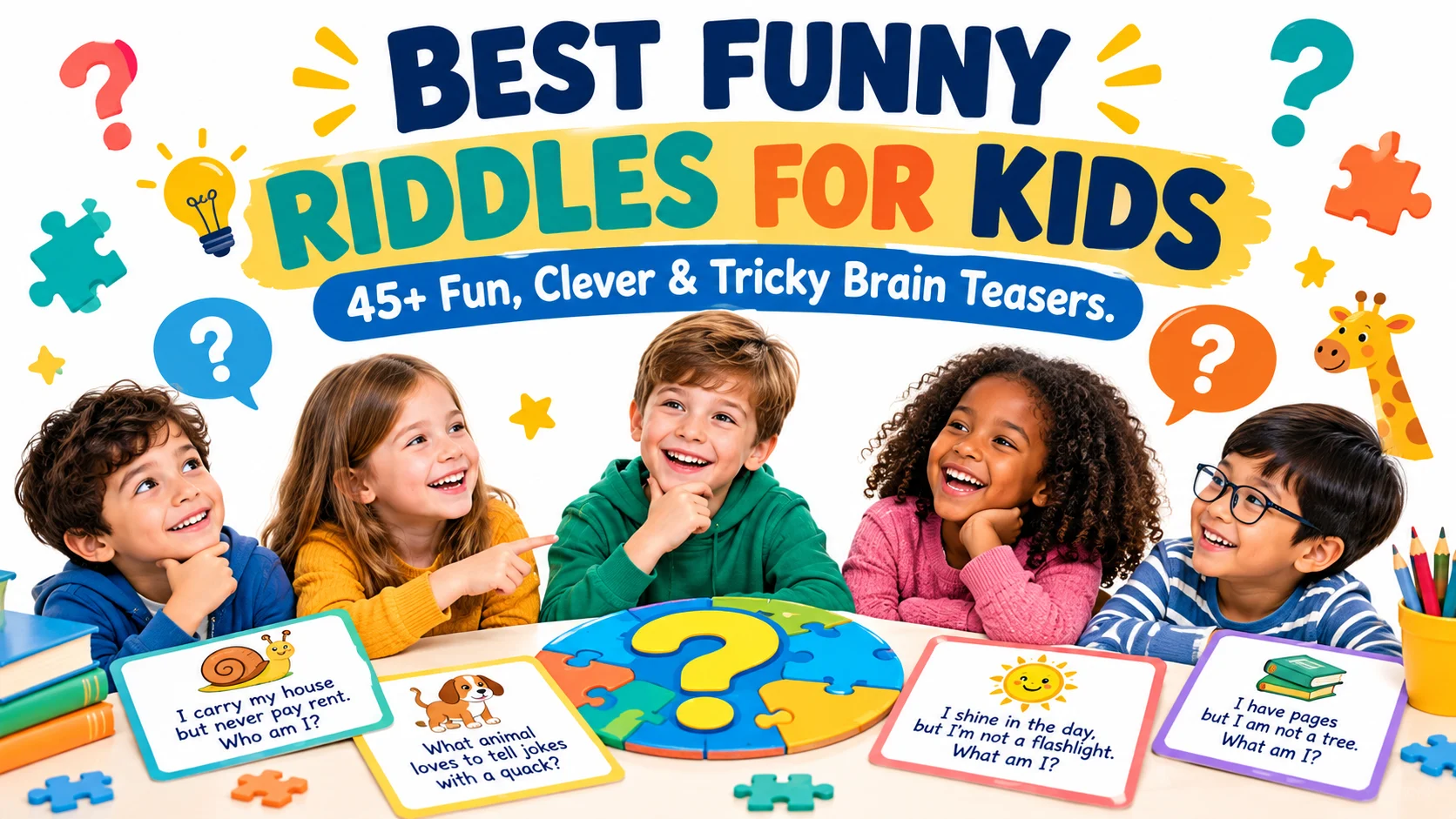
The best funny riddles for kids combine simple clues, clever wordplay, and surprising answers. They give children a chance to think, guess, laugh, and learn at the same time. This collection includes easy, tricky, animal, object, word, math, and logic riddles that are perfect for kids, families, classrooms, and parties.
Finding a riddle that makes a child laugh is fun. Finding one that also makes them stop and think is even better.
These best funny riddles for kids are designed to do both. Some have silly answers, some use clever wordplay, and others hide the solution behind an unexpected clue.
You can use them as quick classroom warm-ups, family game-night challenges, party activities, road-trip entertainment, or simple conversation starters. Read the riddle aloud, give everyone a moment to guess, and then reveal the answer.
Ready to test your brain?
Easy Funny Riddles for Kids
These easy funny riddles are great for younger children and beginners. The clues are simple, but the answers may still produce a giggle.
Riddle 1
Riddle: What has four legs but never goes for a walk?
Answer: A table.
Riddle 2
Riddle: What kind of tree can you carry in your hand?
Answer: A palm tree.
Riddle 3
Riddle: What has a face and two hands but cannot clap?
Answer: A clock.
Riddle 4
Riddle: What gets wetter the more it helps you get dry?
Answer: A towel.
Riddle 5
Riddle: What has lots of teeth but never needs a dentist?
Answer: A comb.
These riddles work especially well with younger children because they use familiar objects. After revealing each answer, ask kids whether they can create a similar riddle of their own.
Silly Animal Riddles
Animal riddles are naturally fun for children because they combine familiar creatures with unexpected clues.
Riddle 6
Riddle: I carry my house everywhere I go, but I never pay rent. Who am I?
Answer: A snail.
Riddle 7
Riddle: What animal can jump higher than a house?
Answer: Any animal that can jump the house cannot jump!
Riddle 8
Riddle: I have a long neck, but I never wear a scarf. Who am I?
Answer: A giraffe.
Riddle 9
Riddle: Which animal is always ready for a musical performance because it has a natural drum?
Answer: A woodpecker.
Riddle 10
Riddle: What animal loves telling jokes because it always has a good “quack” at the punchline?
Answer: A duck.
Try acting out the animals after solving these riddles. Kids can make the activity even funnier by imitating each animal’s sound or movement.
Funny Object Riddles
Everyday objects can become surprisingly entertaining when you look at them from a different angle.
Riddle 11
Riddle: I have a neck but no head, and I can hold a drink. What am I?
Answer: A bottle.
Riddle 12
Riddle: I have one eye, but I cannot see. What am I?
Answer: A needle.
Riddle 13
Riddle: I can travel around the world while staying in one corner. What am I?
Answer: A stamp.
Riddle 14
Riddle: I have pages but I am not a tree. I can take you to imaginary places without moving. What am I?
Answer: A book.
Riddle 15
Riddle: I have a tongue but cannot taste, and I help your foot make music. What am I?
Answer: A shoe.
Ask children to look around the room after this section and choose an object they can turn into a riddle. It is a simple way to encourage observation and creativity.
Clever Word Riddles
Word riddles help children notice letters, sounds, meanings, and unusual ways words can work.
Riddle 16
Riddle: What word becomes shorter when you add two letters to it?
Answer: “Short” becomes “shorter” when you add “er.”
Riddle 17
Riddle: What begins with T, ends with T, and has T inside it?
Answer: A teapot.
Riddle 18
Riddle: What word sounds like something you might do when you see a funny joke?
Answer: Laugh.
Riddle 19
Riddle: What has four letters, sometimes has nine letters, but never has five letters?
Answer: The words themselves: “what” has four, “sometimes” has nine, and “never” has five.
Riddle 20
Riddle: What letter appears once in “cat,” twice in “cattle,” but never in “dog”?
Answer: The letter T.
Word riddles are useful for classrooms because children can solve them while also thinking about spelling, letters, sounds, and vocabulary.
Tricky Riddles for Kids
These riddles are slightly harder because the wording encourages you to think in a different direction.
Riddle 21
Riddle: A farmer has ten sheep. All but three run away. How many sheep remain?
Answer: Three.
Riddle 22
Riddle: If you have three apples and take away two, how many apples do you have?
Answer: Two the two you took.
Riddle 23
Riddle: What can you catch but never throw?
Answer: A cold.
Riddle 24
Riddle: What has a bottom at the top?
Answer: Your legs when you are doing a handstand.
Riddle 25
Riddle: What is full of holes but can still hold water?
Answer: A sponge.
The fun of tricky riddles comes from noticing exactly what the question says rather than assuming what it means.
Funny Math Riddles
Math riddles turn numbers into playful challenges. They are useful when kids need a fun way to practice simple reasoning.
Riddle 26
Riddle: You have five candies and give two away. How many candies do you have left?
Answer: Three.
Riddle 27
Riddle: I am an even number. Take away one letter from my name and I become odd. What number am I?
Answer: Seven. Remove the “s” from “seven” and you get “even.”
Riddle 28
Riddle: What number becomes smaller when you turn it upside down?
Answer: 9 becomes 6.
Riddle 29
Riddle: If two ducks lay two eggs in two days, how many eggs would four ducks lay in two days?
Answer: Four eggs.
Riddle 30
Riddle: A number has three digits. Its first digit is 2, its second is twice the first, and its third is one less than the second. What number is it?
Answer: 241.
Use these as quick mental challenges rather than formal math exercises. Let children explain how they reached the answer.
Logic Riddles With a Twist
Logic riddles reward careful reading. They can be especially entertaining when several people give different guesses before noticing the key clue.
Riddle 31
Riddle: A room has three light switches outside and three bulbs inside. You cannot see inside until you enter once. How can you determine which switch controls which bulb?
Answer: Turn one switch on for a while, then turn it off. Turn another switch on and enter. The lit bulb belongs to the second switch, the warm unlit bulb belongs to the first, and the cold unlit bulb belongs to the third.
Riddle 32
Riddle: You see a boat filled with people, but there is not a single person on board. How is that possible?
Answer: Everyone on the boat is married, so there is not a single person on board.
Riddle 33
Riddle: A child walks into a room carrying an umbrella, but it is not raining outside. Why might the umbrella still be useful?
Answer: The child could be carrying it for shade.
Riddle 34
Riddle: What can run but never walks, has a mouth but never talks, and has a bed but never sleeps?
Answer: A river.
Riddle 35
Riddle: A boy drops a ball from a tall building, but the ball does not break. Why?
Answer: The ball is not made of glass.
These are excellent group riddles. Ask everyone to explain their reasoning, not just shout out an answer.
Funny Nature Riddles
Nature gives us plenty of strange and wonderful things to turn into riddles.
Riddle 36
Riddle: I fall from the sky but never get hurt. What am I?
Answer: Rain.
Riddle 37
Riddle: I have no feet, but I can run across the sky. What am I?
Answer: A cloud.
Riddle 38
Riddle: I shine during the day, but I am not a flashlight. What am I?
Answer: The sun.
Riddle 39
Riddle: I disappear when the sun comes out, but I am not afraid of sunlight. What am I?
Answer: A shadow in certain places where the light changes.
Riddle 40
Riddle: I can be loud, colorful, and impossible to hold. What am I?
Answer: Thunder and lightning together.
For younger children, nature riddles can become a mini outdoor game. Read a riddle and let everyone search for something nearby that matches the clue.
Family and Classroom Challenge Riddles
These final riddles are perfect for groups. Use them during family game nights, classroom breaks, birthday parties, or friendly competitions.
Riddle 41
Riddle: What has many keys but cannot open a single door?
Answer: A piano.
Riddle 42
Riddle: What has a head and a tail but no body?
Answer: A coin.
Riddle 43
Riddle: What goes up but never comes down?
Answer: Your age.
Riddle 44
Riddle: What can you hear but never see, even though it may come from someone standing right beside you?
Answer: A voice.
Riddle 45
Riddle: What has a ring but no finger?
Answer: A telephone.
Riddle 46
Riddle: What gets bigger the more you take away from it?
Answer: A hole.
Riddle 47
Riddle: What has a head, a foot, and four legs but is not an animal?
Answer: A bed.
Riddle 48
Riddle: What can fill a room without taking up any physical space?
Answer: Light.
Riddle 49
Riddle: What is easy to lift but difficult to throw?
Answer: A feather.
Riddle 50
Riddle: What has a thumb and four fingers but is not alive?
Answer: A glove.
How to Make Riddles More Fun for Kids
Riddles become even more entertaining when they are turned into a game rather than simply read from a page.
Give thinking time. Let children think for several seconds before revealing the answer.
Use teams. Divide a classroom or family into small groups and award a point for each correct solution.
Act out clues. Animal riddles are especially fun when children imitate the creature after solving the puzzle.
Create a riddle jar. Write riddles on small cards and let children randomly choose one.
Let kids become the writers. After solving several riddles, ask children to create their own.
Use a hint system. For difficult riddles, give one extra clue instead of immediately revealing the answer.
Make sharing part of the game. Kids can challenge siblings, classmates, friends, or parents with their favorite riddle.
The goal is not simply to get every answer right. The real fun comes from thinking creatively, explaining ideas, and enjoying the surprise when the answer is revealed.
Why Funny Riddles Are Good for Kids
Funny riddles can turn ordinary question-and-answer activities into playful learning experiences.
They encourage critical thinking because children need to examine clues carefully. They can also support language skills by introducing wordplay, multiple meanings, vocabulary, and unusual sentence structures.
Math and logic riddles provide opportunities to practice reasoning without making the activity feel like a worksheet. Animal and nature riddles can encourage observation, while creative riddles invite children to invent their own questions.
Most importantly, riddles create opportunities for interaction. Parents, teachers, siblings, and friends can solve them together, making them useful for both learning and entertainment.
Whether you need a five-minute classroom activity or a longer family game, a good riddle can quickly get everyone involved.
Quick Riddle Challenge
Ready for a final mini challenge?
Try answering these without looking back:
- What has many keys but opens no doors?
- What gets wetter while making something else dry?
- What has a head and a tail but no body?
- What gets bigger when you take something away?
- What goes up but never comes down?
Answers: Piano, towel, coin, hole, and age.
How many did you solve without checking?
People Also Ask
1. What are the best funny riddles for kids?
The best funny riddles for kids are simple enough to understand but surprising enough to make them think. Good examples include animal riddles, object riddles, wordplay, easy logic puzzles, and funny trick questions with one clear answer.
2. Are funny riddles good for kids?
Yes, funny riddles can provide both entertainment and mental practice. They encourage children to listen carefully, identify clues, use reasoning, explore language, and think creatively while enjoying a playful activity.
3. How do you solve a funny riddle?
Start by reading every word carefully and identifying the important clues. Avoid assuming what the question means. Consider literal and playful meanings, then test possible answers against every clue before choosing the solution.
4. What makes a good riddle for children?
A good children’s riddle should use age-appropriate language, contain understandable clues, have one intended answer, and provide a satisfying moment of surprise. Funny wordplay and familiar subjects can make the riddle even more engaging.
5. Where can kids use funny riddles?
Kids can use funny riddles at home, in classrooms, during birthday parties, on road trips, at family game nights, or when chatting with friends. Teachers and parents can also use them as short warm-up activities.
6. What are easy funny riddles for kids?
Easy funny riddles use familiar objects, animals, numbers, and everyday situations. Examples include asking what has four legs but never walks or what gets wetter while helping something else become dry. They are particularly suitable for younger children and beginners.
7. What age are funny riddles suitable for?
Funny riddles can be adapted for almost any childhood age. Younger children generally benefit from simple object and animal riddles, while older children can handle wordplay, logic puzzles, math challenges, and trick questions with more complicated clues.
8. How can teachers use riddles in the classroom?
Teachers can use riddles as lesson warm-ups, vocabulary activities, brain breaks, team challenges, or creative-writing exercises. Students can solve a riddle individually and then explain their reasoning or write a new riddle for classmates.
9. Can riddles help children develop thinking skills?
Yes. Riddles can encourage careful reading, logical reasoning, pattern recognition, vocabulary development, and creative thinking. Their effectiveness depends on the type of riddle and how the activity is used, but they provide an engaging way to practice these skills.
10. How can I make a riddle game more exciting for kids?
Turn riddles into a friendly challenge by using teams, points, hints, timed rounds, or mystery cards. You can also ask children to create their own riddles after solving yours, which adds a creative element to the game.
Conclusion
Funny riddles for kids are a simple and entertaining way to make learning more enjoyable. They encourage children to think creatively, improve their problem-solving skills, and share plenty of laughs. Whether you’re looking for easy brain teasers, silly questions, or tricky riddles, these fun puzzles are perfect for family time, classrooms, parties, and playdates. So, pick your favorite riddles, challenge the kids, and get ready for lots of smiles and laughter!

Dominic Rafe is a humor writer and content creator at Punzite.com specializing in witty puns, clever jokes and entertaining wordplay. With a passion for creating fun and engaging content, he helps bring fresh laughter and creative humor to readers around the world.