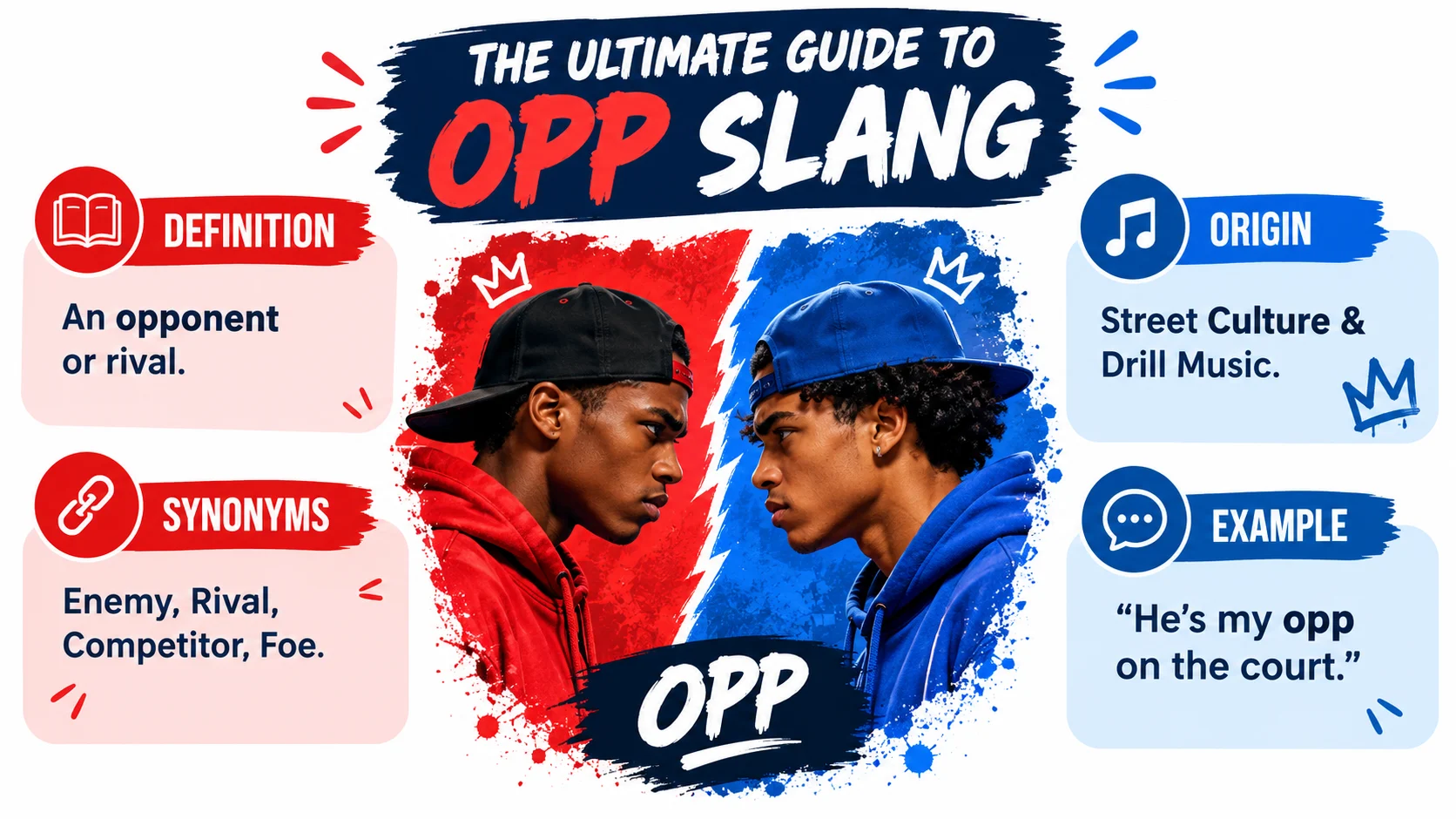
Opp is a slang term that means “opponent” or “enemy.” It refers to someone you dislike, compete with, or consider a rival. The term originated in street and gang culture but has since spread to mainstream social media for describing any kind of opposition.
Understanding the opp meaning slang is essential for navigating modern social dynamics, especially in music, sports, and online debates. Consequently, this term has become a powerful way to identify rivals and express loyalty to your own group. For example, you might hear someone say, “That’s my opp,” when referring to a competitor on the basketball court or a rival in a debate.
This comprehensive guide breaks down everything you need to know about the term. We will cover its definition, origins, platform-specific usage, and how to respond when someone calls you an “opp.” By the end, you will be fully equipped to use this slang confidently in any digital chat.
QUICK ANSWER BOX
| Meaning | Context | Primary Platforms | Example | Tone |
| An opponent, rival, or enemy. | Used to describe someone you compete with or dislike. | TikTok, Instagram, Snapchat, X (Twitter). | “He’s my opp on the court.” | Confrontational, competitive, and territorial. |
What Does Opp Meaning Slang Entail?
At its core, opp meaning slang refers to an opponent or enemy. It’s a term used to identify someone you are in conflict with or compete against. This could be on a basketball court, in a rap battle, or even in a heated online argument. The term is about defining who is on your side and who isn’t.
The term has deep roots in street culture and gang terminology. It originated as an abbreviation for “opposition” or “opponent.” In these contexts, it was used to identify rival gang members. Furthermore, the term gained mainstream popularity through drill music, a subgenre of hip-hop that often discusses street life and rivalries. Artists like Pop Smoke, Chief Keef, and others used the term frequently in their lyrics, bringing it to a national audience.
Moreover, the term has evolved beyond its violent origins. Today, you might hear it used playfully among friends to describe a friendly rivalry. However, its core meaning of “the other side” remains consistent. It’s a way to draw a line between “us” and “them.”
Contextual Dynamics & Nuances of the Term
The meaning of opp can shift dramatically based on tone, context, and the relationship between the speakers. Understanding these nuances is key to using the term correctly and avoiding serious misunderstandings.
Deadly Rivalry vs. Friendly Competition
In its original street context, referring to someone as an “opp” could carry deadly consequences. It signified a genuine enemy. However, in mainstream usage, the term has softened considerably. For instance, calling a rival sports team “the opps” is a way to build team spirit without any real animosity.
Loyalty and In-Group Identity
Using the term opp often signals loyalty to your own group. It creates a sense of unity and shared identity. When you call someone an “opp,” you are publicly stating that they are not part of your circle. This can be a powerful social signal.
The Fluctuating Intensity
The intensity of the term varies greatly. In a rap battle, calling someone an “opp” is a serious diss. However, in a comment on a TikTok video, it might just be a joke. Therefore, it’s crucial to read the room and understand the context before using it.
Real-Life Conversation Examples Using Opp
To truly grasp how opp meaning slang is used in the wild, it helps to see it in natural dialogue. Here are five distinct chat scenarios that showcase its versatility.
Scenario 1: Competitive Gaming
Gamer 1: “I just beat you in that match.”
Gamer 2: “Lucky shot. Next time, you’re my opp.”
Gamer 1: “Bring it on.”
Scenario 2: Sports Rivalry
Friend 1: “Are you going to the game on Friday?”
Friend 2: “Of course. We’re playing our biggest opps.”
Friend 1: “Yeah, we have to crush them.”
Scenario 3: Online Debate
Person A: “I can’t believe you support that team.”
Person B: “Why, are they your opps or something?”
Person A: “They’re everyone’s opps.”
Scenario 4: Playful Teasing Among Friends
Friend 1: “You ate the last slice of pizza?”
Friend 2: “Yeah, I was hungry.”
Friend 1: “That’s it. You’re officially my opp now.”
Friend 2: “LOL, calm down.”
Scenario 5: Referring to a Group
Person A: “Did you see what that group posted?”
Person B: “Yeah, they’re just a bunch of opps.”
Person A: “For real. They always start drama.”
Platform-Specific Breakdown
The usage of opp meaning slang varies slightly depending on the social media platform. Here is how it is typically used across the most popular apps.
How It Is Used on Snapchat
On Snapchat, opp often appears in direct messages or in response to Stories. For example, if a friend posts a Story showing off a win against a rival, you might reply “We love beating the opps.” It’s a quick way to show solidarity and share in the victory.
The Role of Opp on TikTok
TikTok has been instrumental in spreading opp beyond its original context. The platform is a hub for sports, gaming, and music content. Consequently, the term appears in millions of videos and comments. Popular formats include videos about sports rivalries, gaming beefs, and even school competitions. Users frequently comment “opp” to joke about a rival team or individual.
Instagram and Texting Dynamics
On Instagram, opp is heavily featured in comments, Reels, and Stories. For instance, a user might comment “Our opps are so mad” on a post showing their team winning. In texting, it’s a convenient shorthand. A friend might text you a photo of a rival’s fail and say, “Opps are losing it.” This usage fits perfectly into the fast-paced, informal nature of digital communication.
Alternative Meanings & NLP Variations of the Phrase
While we have focused on the slang definition, it is important to note that opp has other meanings. Search engines and natural language processing (NLP) models must distinguish between these to provide accurate results.
The Business Abbreviation
In a business context, OPP can stand for “Other People’s Property” or “Opportunity.” These are completely different contexts from the slang term and are rarely used in casual conversation.
The Literal Meaning
As a standard English abbreviation, “opp” is a short form for “opposite” or “opposition.” For example, a teacher might say, “The opp side of the argument is…” This is the literal, original definition of the abbreviation.
The Statistics Term
In statistics, OPP can sometimes mean “Opportunity to See,” a metric used in advertising. This is a niche, professional usage.
Misinterpretations: When NOT to Use Opp
Using opp in the wrong context can lead to misunderstandings. Here are a few scenarios where you should avoid the term.
Professional Settings
Opp is highly informal. Using it in a professional environment, such as in an email to a boss or during a business meeting, would be inappropriate. Stick to formal language in these settings.
With People You Don’t Know
Calling someone you don’t know well an “opp” can be seen as aggressive or threatening. The term implies a rivalry that might not exist.
When the Rivalry is Not Serious
If you have a minor disagreement with someone, calling them an “opp” might escalate the situation unnecessarily. It’s better to use lighter language.
How to Respond in Chat Comfortably
If someone calls you an “opp” in a chat, your response should depend on the context and your relationship with the person. Here are a few ways to handle it.
Clarify the Intent
If you are unsure if the person is joking, you can ask, “Are you serious?” or “Are we really opps now?” This opens the door for a conversation.
Play Along
If you know the person is joking, you can play along. You might say, “Yeah, you’re my opp now!” or “We’re officially rivals.”
Defuse the Situation
If you think the person is serious and you don’t want conflict, you can try to defuse the situation. You can say, “I don’t want to be your opp. Let’s just chill.”
FAQs
What does opp mean in slang?
Opp is slang for an opponent, rival, or enemy. It’s used to describe someone you compete with or dislike.
Is opp a bad word?
It can be. In some contexts, it’s a serious insult. In others, it’s used playfully. It depends on the context and the relationship.
Where did the slang opp come from?
The term originated in street and gang culture and was popularized through drill music and hip-hop.
What does opp mean on TikTok?
On TikTok, opp is used to describe rivals in sports, gaming, or any kind of competition. It’s often used in a humorous way.
What does opp mean on Snapchat?
On Snapchat, opp is used in direct messages and replies to Stories to talk about rivals or enemies.
How do you use opp in a sentence?
You can say, “That team is our biggest opp,” or “I can’t believe you’re siding with the opps.”
Is opp the same as “enemy”?
Yes, opp is essentially a slang synonym for “enemy” or “opponent.” However, it’s more informal.
Can opp refer to a group?
Yes, you can refer to a rival group as “the opps” to describe the opposing side.
What if someone says “you’re my opp”?
This means they consider you a rival. Depending on the context, it could be playful or serious.
Is opp a slang word?
Yes, opp is a modern slang term, particularly popular among Gen Z and Millennials.
Conclusion
Understanding opp meaning slang offers a fascinating glimpse into how language evolves in the digital age. What started as a term for dangerous street rivals has become a versatile word used in sports, gaming, and everyday conversations. Propelled by social media and hip-hop culture, the term has cemented its place in modern vocabulary. While the term can be serious, its effectiveness relies on understanding the context and your audience.
As with any slang, the key to using opp effectively lies in using it appropriately and at the right moment. When used correctly, it can be a powerful way to show loyalty, express competition, or even share a joke. As digital communication continues to shape our language, terms like opp remind us that language is a living, breathing entity that adapts to the times.

Sara Mitchell is a content writer at Punzite.com who specializes in internet slang, word meanings and language trends. She creates clear, engaging and well-researched content that helps readers understand modern digital communication with ease.