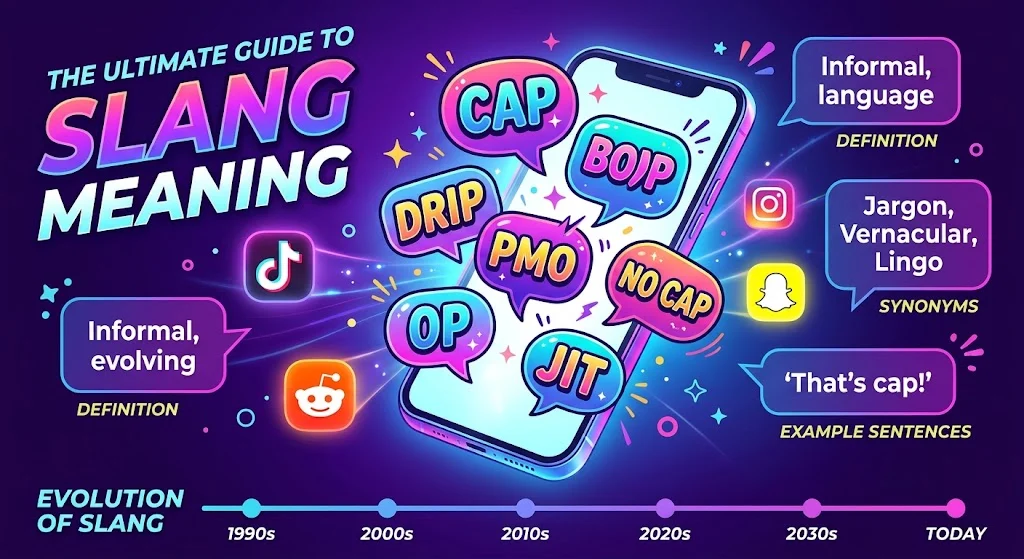
Slang refers to informal, often playful language that evolves rapidly within specific communities or subcultures. It includes words, phrases, and acronyms that deviate from standard English. Modern slang spreads quickly through social media platforms like TikTok, Instagram, and Snapchat.
Understanding the slang meaning and its cultural significance is essential for navigating modern digital conversations. Consequently, this guide serves as your comprehensive roadmap to the ever-changing world of informal language. From acronyms like PMO to expressive terms like drip and cap, slang shapes how we connect online. For example, knowing when to use “no cap” can save you from misunderstandings in a text conversation.
This comprehensive guide breaks down everything you need to know about modern slang. We will cover its definition, origins, platform-specific usage, and how to stay current with emerging terms. By the end, you will be fully equipped to understand and use slang confidently in any digital chat.
QUICK ANSWER BOX
| Meaning | Context | Primary Platforms | Example | Tone |
| Informal, rapidly evolving language used by specific communities. | Used to express identity, humor, or cultural belonging in digital spaces. | TikTok, Instagram, Snapchat, Reddit, X (Twitter). | “That outfit is pure drip.” | Casual, expressive, and culturally aware. |
What Does Slang Meaning Entail?
At its core, slang meaning refers to informal language that deviates from standard vocabulary and grammar. However, it represents much more than just non-standard words. Slang serves as a powerful social marker, signaling group membership, cultural awareness, and generational identity.
The term “slang” itself has an interesting history. It emerged in the mid-18th century, possibly deriving from the Scandinavian word “slengenamn,” meaning “nickname.” Over centuries, slang has evolved from being viewed as low-class or improper speech to being recognized as a legitimate and vibrant aspect of language evolution.
Furthermore, modern slang differs from its historical counterparts in one crucial way: speed of dissemination. Thanks to social media platforms, a new slang term can go global in days rather than decades. This acceleration has fundamentally changed how language evolves and how we communicate online.
The Evolution of Modern Slang
Understanding the slang meaning requires examining how it has transformed over time. The evolution reflects broader cultural, technological, and social shifts.
Pre-Internet Era
Before the internet, slang spread slowly through music, literature, and regional communities. Jazz musicians introduced terms like “cool” and “hip” in the 1920s. Beatniks popularized “beat” and “square” in the 1950s. Hip-hop culture brought us “dope,” “fly,” and “fresh” in the 1980s and 1990s.
The Internet Revolution
The rise of the internet and social media accelerated slang evolution exponentially. Online forums, chat rooms, and early social networks created new linguistic ecosystems. Acronyms like “LOL,” “BRB,” and “OMG” became universal shorthand.
The Social Media Explosion
Platforms like TikTok, Instagram, and Snapchat have become primary drivers of slang creation and dissemination. Viral videos, memes, and challenges spawn new terms almost daily. Consequently, keeping up with slang has become a full-time endeavor for many digital natives.
Contextual Dynamics & Nuances of Slang
The slang meaning shifts dramatically based on context, community, and relationship between speakers. Understanding these nuances is key to using slang effectively.
In-Group vs. Out-Group
Slang often functions as a secret code that signals membership in a particular group. Using slang correctly shows you belong, while using it incorrectly can mark you as an outsider. For example, using AAVE-derived slang without cultural understanding can be seen as appropriation.
Generational Divides
Different generations use different slang, creating communication barriers. Gen Z and Millennials have distinct vocabularies that sometimes confuse older generations. For instance, “cap” and “no cap” might be confusing to someone who only knows “cap” as a hat.
Platform-Specific Variations
The same slang term can have different meanings or usage patterns across platforms. For example, “OP” means “Original Poster” on Reddit but can mean “Overpowered” in gaming contexts. Understanding these nuances is crucial for effective communication.
Real-Life Conversation Examples Using Slang
To truly grasp the slang meaning in action, it helps to see it in natural dialogue. Here are five distinct chat scenarios that showcase modern slang versatility.
Scenario 1: Fashion Talk
Friend 1: “Check out my new jacket.”
Friend 2: “That’s drip, bro. Where’d you get it?”
Friend 1: “Vintage shop downtown. Only 20 bucks!”
Scenario 2: Calling Out a Lie
Person A: “I aced that test without studying.”
Person B: “Cap. I saw you studying all night.”
Person A: “Okay, fine. You caught me.”
Scenario 3: Music Discovery
Friend 1: “Have you heard the new album?”
Friend 2: “No, PMO to it.”
Friend 1: “Here’s the link. It’s a bop.”
Scenario 4: Gaming Discussion
Gamer 1: “That character is so OP.”
Gamer 2: “I know. They need to nerf him.”
Gamer 1: “Agreed. It’s not even fun anymore.”
Scenario 5: Expressing Truth
Friend 1: “Are you actually coming to the party?”
Friend 2: “No cap, I’ll be there.”
Friend 1: “Alright, I’m holding you to that.”
Platform-Specific Breakdown
The usage of slang varies significantly across social media platforms. Understanding these differences is crucial for effective digital communication.
How Slang Is Used on Snapchat
On Snapchat, slang appears primarily in direct messages and Story captions. The platform’s ephemeral nature encourages casual, unfiltered communication. Users frequently use slang like “jit,” “drip,” and “cap” in quick snaps. The visual nature of Snapchat also means slang often accompanies images and videos.
The Role of Slang on TikTok
TikTok has become the primary engine of modern slang creation and dissemination. Viral sounds, dances, and challenges introduce new terms almost daily. The platform’s comment sections are hotspots for slang usage, with users reacting to videos using the latest terminology. Furthermore, TikTok’s algorithm accelerates slang spread by exposing users to diverse content.
Instagram and Texting Dynamics
On Instagram, slang appears in comments, Reels, Stories, and DMs. The platform’s visual focus means slang often accompanies photos and videos. In texting, slang serves as a convenient shorthand for quick communication. Acronyms like “PMO” and “OP” help users communicate efficiently.
Alternative Meanings & NLP Variations
While we have focused on the slang meaning, it is important to note that many slang terms have other meanings. Search engines and natural language processing (NLP) models must distinguish between these to provide accurate results.
The Literal Meanings
Many slang terms have literal definitions. For example, “drip” literally means a slow fall of liquid. “Cap” literally means a type of headwear. “OP” can mean “operations” in business. Understanding these multiple meanings is crucial for accurate communication.
The Professional Contexts
In professional settings, slang terms often have completely different meanings. PMO can mean “Project Management Office.” JIT can mean “Just In Time” manufacturing. Recognizing these contexts prevents confusion and miscommunication.
The Historical Meanings
Some slang terms have historical meanings that differ from modern usage. For instance, “bop” originally referred to a style of jazz music. “Jit” was once short for “jitterbug,” an energetic dancer. Understanding these historical roots adds depth to the slang meaning.
Misinterpretations: When NOT to Use Slang
Using slang in the wrong context can lead to misunderstandings and awkward situations. Here are scenarios where you should avoid slang.
Professional Settings
Slang is highly informal. Using it in professional environments like business meetings, emails to bosses, or formal presentations is inappropriate. Stick to standard English in these settings to maintain professionalism.
With People Unfamiliar with Slang
If you’re talking to someone older or someone who doesn’t follow current trends, using slang might confuse them. They might take terms literally, leading to misunderstandings. It’s better to use clear, standard language in these situations.
When the Intent Is Unclear
Some slang terms can be perceived as disrespectful or offensive depending on context. If you’re unsure how someone will interpret your words, it’s best to avoid slang altogether. For instance, calling someone a “jit” might be playful among friends but disrespectful with strangers.
How to Stay Current with Slang
Keeping up with the ever-changing slang meaning can feel overwhelming. However, there are effective strategies for staying in the loop.
Follow Social Media Trends
The best way to learn new slang is to immerse yourself in social media. Platforms like TikTok, Instagram, and X (Twitter) are where new terms emerge and spread. Follow creators, engage with comments, and observe how language evolves in real-time.
Engage with Younger Generations
Younger generations are the primary creators and disseminators of new slang. Engaging with Gen Z and Gen Alpha content, whether through media or personal relationships, can help you stay current. Listen to how they communicate and ask questions when you encounter unfamiliar terms.
Use Online Resources
Numerous online resources track and explain modern slang. Websites like Urban Dictionary, Know Your Meme, and various social media glossaries provide definitions and usage examples. These resources can be invaluable for decoding unfamiliar terms.
People Also Ask
What is the slang meaning?
Slang refers to informal, rapidly evolving language used by specific communities or subcultures.
Why do people use slang?
People use slang to express identity, show cultural awareness, build community, and communicate efficiently in informal settings.
Where does modern slang come from?
Modern slang originates from various sources including music (especially hip-hop), social media platforms, gaming communities, and regional dialects.
How does slang spread so quickly?
Social media platforms like TikTok, Instagram, and Snapchat accelerate slang spread through viral content, comments, and direct messaging.
Is slang disrespectful?
Not necessarily. Slang can be playful and inclusive when used appropriately. However, it can be disrespectful in professional settings or when used without cultural understanding.
How do I learn new slang?
Follow social media trends, engage with younger generations, and use online resources like Urban Dictionary to stay current.
Can slang become formal language?
Yes, many slang terms eventually become accepted as standard English. Examples include “cool,” “hip,” and “internet.”
What is AAVE and why is it important?
AAVE stands for African American Vernacular English, a linguistic variety that has significantly influenced modern slang. Understanding its cultural context is crucial for respectful usage.
What if I use slang incorrectly?
Using slang incorrectly can mark you as an outsider or lead to misunderstandings. When in doubt, ask for clarification or observe how others use the term.
Is slang the same as jargon?
No. Slang is informal and playful, while jargon refers to specialized terminology used within professional or technical fields.
Conclusion
Understanding the slang meaning and its cultural significance offers a fascinating glimpse into how language evolves in the digital age. What started as niche community language has become a global phenomenon, propelled by social media and the innate human desire to express identity and belonging. While slang can be playful and inclusive, its effectiveness relies on understanding the context and your audience.
As with any aspect of language, the key to using slang effectively lies in using it authentically and at the right moment. When used correctly, it can be a powerful way to connect with others, express cultural awareness, and navigate digital spaces. As digital communication continues to shape our language, slang reminds us that language is a living, breathing entity that adapts to the times. Stay curious, stay engaged, and embrace the ever-evolving world of modern slang.