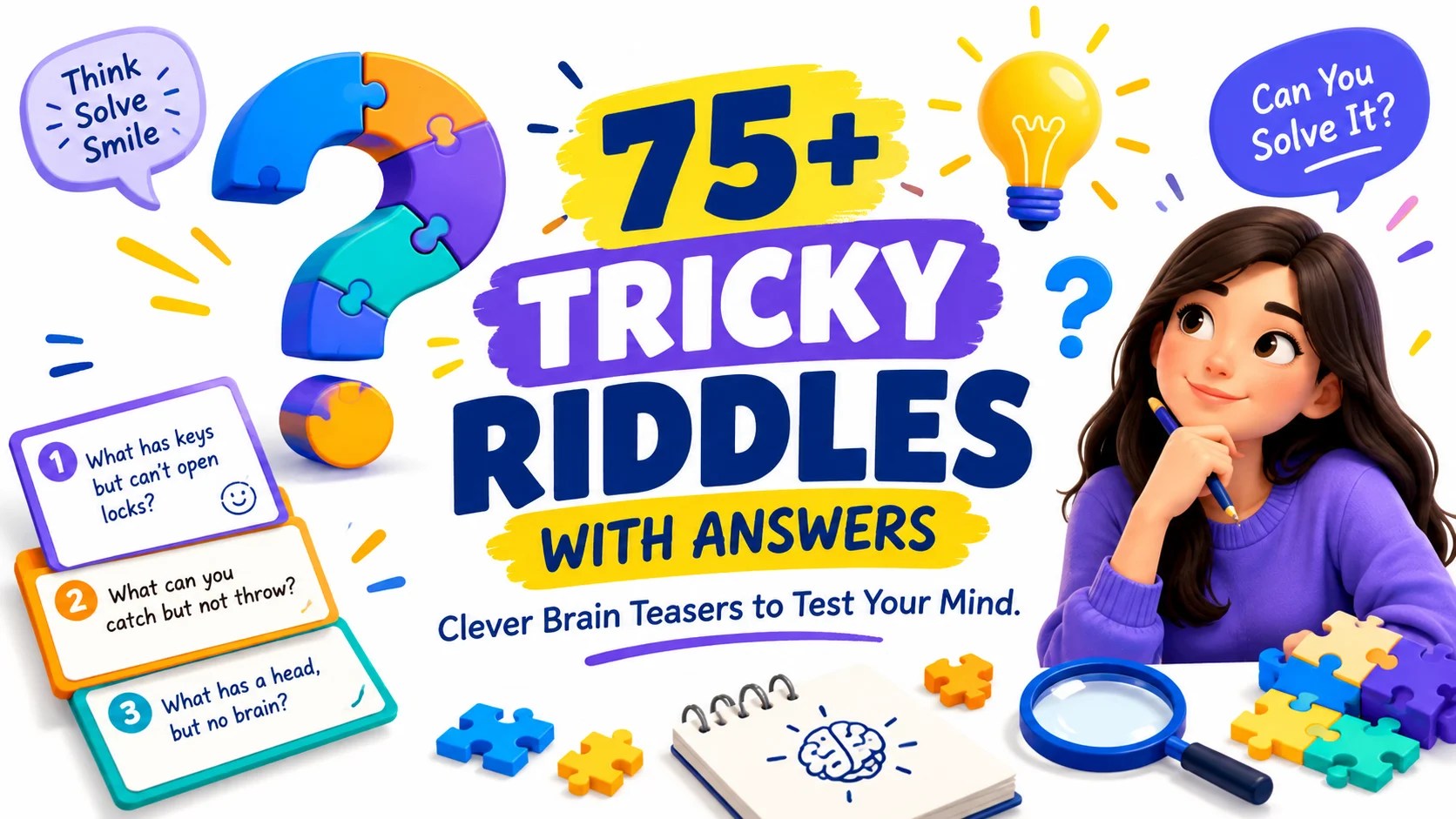
Tricky riddles with answers are puzzles designed to challenge your thinking through clever wording, hidden clues, logical twists, and unexpected solutions. They are perfect for testing observation, reasoning, wordplay, and lateral thinking. Some are easy to start, while others require you to slow down and look at the question differently.
If you enjoy puzzles that make you say, “Wait what?” you are in the right place.
A good riddle does more than ask a difficult question it makes your brain reconsider what it thinks it already knows. These tricky riddles with answers use wordplay, logic, observation, and clever misdirection to create satisfying “aha!” moments.
You can solve them by yourself, challenge friends at a party, use them as classroom brain teasers, or share them in group chats and on social media. Start with the easier puzzles, then work your way toward the trickiest challenges.
Ready to see how sharp your thinking really is?
Easy Tricky Riddles
These riddles look simple, but each one hides a small twist. They are great warm-ups before moving on to harder challenges.
Riddle 1
I have hands but cannot clap. I have a face but cannot smile. What am I?
Answer: A clock.
Solution: A clock has hands and a face, but neither is alive.
Riddle 2
What gets wetter the more it dries?
Answer: A towel.
Solution: A towel dries other things while becoming wetter itself.
Riddle 3
What has many keys but cannot open a single door?
Answer: A piano.
Solution: Piano keys make music rather than unlocking doors.
Riddle 4
What can travel around the world while staying in one corner?
Answer: A stamp.
Solution: A stamp stays attached to the corner of an envelope while the envelope travels.
Riddle 5
What has a neck but no head?
Answer: A bottle.
Solution: A bottle has a neck, but it does not have a head.
Riddle 6
What can you catch but never throw?
Answer: A cold.
Solution: “Catch” can mean becoming infected with an illness rather than physically grabbing something.
Challenge: Which of these fooled you the longest? Share your result with someone who loves puzzles.
Medium Tricky Riddles
Now the clues become less obvious. Read every word carefully because the wording may contain the key.
Riddle 7
I become smaller every time I take a bath. What am I?
Answer: A bar of soap.
Solution: Water gradually washes the soap away.
Riddle 8
What has one eye but cannot see?
Answer: A needle.
Solution: The hole in a needle is called its eye.
Riddle 9
What has cities but no houses, forests but no trees, and rivers but no water?
Answer: A map.
Solution: A map represents these things without containing the physical objects themselves.
Riddle 10
What belongs to you but is used more often by other people?
Answer: Your name.
Solution: Other people usually say your name when talking to or about you.
Riddle 11
What can fill a room without taking up any space?
Answer: Light.
Solution: Light can spread throughout an entire room without occupying physical space like furniture does.
Riddle 12
What has four legs in the morning, two at noon, and three in the evening?
Answer: A person.
Solution: This classic-style puzzle describes crawling as a baby, walking on two legs as an adult, and using a cane later in life.
Challenge: Try answering the next six riddles without looking at the solutions. Give yourself one point for every correct answer.
Hard Tricky Riddles
These challenges require more than knowing common objects. Look for assumptions hidden inside the question.
Riddle 13
A room contains three candles. You light two of them. How many candles are left?
Answer: Three.
Solution: Lighting two candles does not remove them from the room. All three candles are still there.
Riddle 14
A farmer has 17 sheep. All but 9 run away. How many sheep remain?
Answer: 9.
Solution: “All but 9” means 9 sheep did not run away.
Riddle 15
You have one match and enter a dark room containing a candle, a fireplace, and a lamp. What do you light first?
Answer: The match.
Solution: You cannot light any of the other objects before lighting the match.
Riddle 16
A bus driver travels down a road, turns left, turns right, and passes several streets. He never breaks a traffic law. What is unusual?
Answer: Nothing.
Solution: The riddle never says the driver did anything illegal. The wording encourages you to search for a problem that does not exist.
Riddle 17
A box contains 12 identical-looking balls. One ball is heavier than the others. Without opening another box, how can you know which box contains the heavy ball if there are three boxes and only one contains the balls?
Answer: The question itself gives the clue: the box containing the 12 balls is the one you need.
Solution: This is a wording challenge rather than a weighing puzzle. It tests whether you add assumptions that the question never made.
Riddle 18
A man walks into a building, goes up three floors, and then walks down four floors. He ends up exactly where he started. How?
Answer: He is walking inside a building with floors arranged so that the route returns him to the starting level.
Solution: The riddle never says the floors are numbered consecutively or that “up” and “down” refer to the same staircase. The trick is avoiding assumptions.
Challenge: Hard riddles become easier when you separate what the riddle says from what you assume.
Wordplay Tricky Riddles
Word riddles can hide their answers in meanings, spelling, sounds, or unusual interpretations.
Riddle 19
What word becomes shorter when you add two letters to it?
Answer: Short.
Solution: Adding “er” creates “shorter,” which describes something that is less long.
Riddle 20
What word sounds the same when one letter is removed from it, but its meaning changes?
Answer: Whole.
Solution: Removing “w” gives “hole,” which sounds like “whole” but has a completely different meaning.
Riddle 21
What starts with T, ends with T, and has T inside it?
Answer: A teapot.
Solution: “Teapot” starts with T, ends with T, and contains “tea,” which sounds like the letter T.
Riddle 22
What has words but never speaks?
Answer: A book.
Solution: A book contains words, but it cannot literally speak.
Riddle 23
What five-letter word becomes shorter when you add two letters?
Answer: Short.
Solution: “Short” becomes “shorter” after adding two letters.
Riddle 24
What can be found once in a minute, twice in a moment, but never in a thousand years?
Answer: The letter M.
Solution: “Minute” contains one M, “moment” contains two, and “thousand years” contains none.
Challenge: Wordplay riddles are especially good for captions and group chats because people can debate the wording before revealing the answer.
Logic and Lateral-Thinking Riddles
Lateral-thinking puzzles encourage you to abandon the obvious interpretation and consider another possibility.
Riddle 25
A man was born in 2000 and died in 2000 at the age of 80. How is that possible?
Answer: 2000 was a room number or location, not necessarily the year.
Solution: The wording says he was born “in 2000,” not necessarily “in the year 2000.”
Riddle 26
Two people were born on the same day, in the same year, to the same parents, but they are not twins. How?
Answer: They are two of a set of triplets or quadruplets.
Solution: Being born at the same time to the same parents does not mean there are only two siblings.
Riddle 27
A person looks at a photograph and says, “I have no brothers or sisters, but this person’s father is my father’s son.” Who is in the photograph?
Answer: The person’s son.
Solution: Since the speaker has no siblings, “my father’s son” means the speaker. Therefore, the person in the photograph is the speaker’s son.
Riddle 28
A house has four walls, and every wall faces south. A bear walks past the house. What color is the bear?
Answer: White.
Solution: A house with every wall facing south must be near the North Pole, where the bear would be a polar bear.
Riddle 29
You are running a race. You pass the person in second place. What position are you now in?
Answer: Second place.
Solution: Passing the person in second means you take their position. You have not passed the person in first.
Riddle 30
A person enters a restaurant, asks for water, and the waiter suddenly points a knife at them. The person says “Thank you” and leaves. Why?
Answer: The person had hiccups.
Solution: The waiter startled them, curing the hiccups. The knife was used as a scare tactic rather than an attack.
Think Differently: The strongest lateral-thinking riddles often become obvious only after you stop interpreting every clue in the most conventional way.
Observation Tricky Riddles
Observation riddles reward careful reading. Sometimes the answer is hiding in plain sight.
Riddle 31
What is always in front of you but can never be seen?
Answer: The future.
Solution: The future is always ahead of you, but it cannot be visually observed before it happens.
Riddle 32
What has a beginning, an end, and a middle but no body?
Answer: A sentence.
Solution: A sentence can have a beginning, middle, and end without having a physical body.
Riddle 33
What goes up when the rain comes down?
Answer: An umbrella.
Solution: You raise an umbrella when rain falls.
Riddle 34
What disappears as soon as you say its name?
Answer: Silence.
Solution: Speaking breaks the silence.
Riddle 35
What can you see once in June, twice in November, but never in May?
Answer: The letter E.
Solution: “June” contains one E, “November” contains two Es, while “May” contains none.
Riddle 36
If there are six apples and you take away four, how many apples do you have?
Answer: Four.
Solution: You have the four apples you took away.
Challenge: Read each riddle twice before answering. The second reading often reveals a clue you missed the first time.
Tricky Riddles for Kids and Families
These family-friendly riddles are simple enough for younger solvers while still containing enough wordplay to challenge adults.
Riddle 37
What has ears but cannot hear?
Answer: Corn.
Solution: An ear of corn has an “ear,” but it cannot hear sounds.
Riddle 38
What has teeth but cannot bite?
Answer: A comb.
Solution: A comb has teeth used to separate hair, not teeth used for eating.
Riddle 39
What runs but never walks?
Answer: Water.
Solution: Water can “run” through a stream or pipe without having legs.
Riddle 40
What has a thumb and four fingers but is not alive?
Answer: A glove.
Solution: A glove has spaces shaped for a thumb and four fingers.
Riddle 41
What kind of room has no doors or windows?
Answer: A mushroom.
Solution: The word “mushroom” contains “room,” but it is not an actual room.
Riddle 42
What can jump higher than a house?
Answer: Anything that can jump.
Solution: A house cannot jump at all, so even a small jump can be higher than a house’s jump.
Family Challenge: Take turns reading these riddles aloud. Give everyone five seconds to answer before revealing the solution.
Ultimate Tricky Riddle Challenge
Ready for the toughest part? Try these without checking the answers immediately. They combine logic, language, and clever misdirection.
Riddle 43
A person has four daughters. Each daughter has one brother. How many children does the person have?
Answer: Five.
Solution: The four daughters can all have the same brother, so there are four daughters plus one son.
Riddle 44
A farmer owns 10 cows. Nine of them are brown, but one is white. How many cows does the farmer own?
Answer: 10.
Solution: The color of the cows does not change the number of cows.
Riddle 45
What question can you never answer “yes” to honestly?
Answer: “Are you asleep?”
Solution: If you are genuinely asleep, you cannot honestly answer the question.
Riddle 46
A plane crashes exactly on the border between two countries. Where should the survivors be buried?
Answer: Nowhere.
Solution: Survivors are alive, so they do not need to be buried.
Riddle 47
What becomes more valuable when it is broken?
Answer: A record.
Solution: A rare broken record can become valuable to collectors. The trick is that “broken” does not always mean worthless.
Riddle 48
A person has a key but cannot open a lock. What might they be holding?
Answer: A piano key.
Solution: A piano has keys, but they are not designed to open locks.
Riddle 49
What can have a point without having a sharp end?
Answer: An argument.
Solution: An argument can have a “point,” meaning a central idea or claim.
Riddle 50
If yesterday was tomorrow and today were Friday, what day would tomorrow be?
Answer: Saturday.
Solution: If today is Friday, tomorrow is Saturday. The first part creates a verbal time-shift, but the stated condition determines the answer.
Riddle 51
What has an answer but never asks a question?
Answer: A riddle.
Solution: A riddle can contain an answer even though it is the riddle itself that asks the question.
Riddle 52
What can be opened but cannot be closed, and can be closed but cannot be opened?
Answer: An opportunity.
Solution: An opportunity can “open” or “close,” but these are expressions rather than physical actions.
Riddle 53
You see a basket containing three apples. You take one apple. How many apples do you have?
Answer: One.
Solution: The basket still contains two, but you personally have the one you took.
Riddle 54
A word has six letters. Remove one letter and twelve remain. What is the word?
Answer: Dozens.
Solution: Remove the “s” from “dozens,” leaving “dozen,” which represents twelve.
Riddle 55
What is something you can hold without using your hands?
Answer: A conversation.
Solution: We commonly say that someone can “hold” a conversation.
Riddle 56
What has no beginning and no end but can still be counted?
Answer: A repeating cycle.
Solution: A cycle can continue indefinitely while its individual repetitions can still be counted.
Riddle 57
What can be cracked without being touched?
Answer: A joke.
Solution: You can “crack” a joke simply by telling it.
Riddle 58
What has a head and a tail but no body?
Answer: A coin.
Solution: Coins are often described as having a heads side and a tails side.
Riddle 59
What can you give someone without losing anything yourself?
Answer: Advice.
Solution: Giving advice does not require you to physically surrender the advice you possess.
Riddle 60
What is easy to get into but difficult to get out of?
Answer: Trouble.
Solution: “Getting into trouble” is easy, while escaping its consequences can be much harder.
Riddle 61
What can be broken simply by being spoken?
Answer: A promise.
Solution: A promise is broken when someone fails to keep it, and speaking about an intention does not guarantee that it will be fulfilled.
Riddle 62
What has a bank but no money?
Answer: A river.
Solution: A river has a riverbank, but it has nothing to do with banking or money.
Riddle 63
What has a ring but no finger?
Answer: A telephone.
Solution: A telephone can ring even though it has no fingers.
Riddle 64
What can point in every direction while remaining in one place?
Answer: A compass needle.
Solution: As the compass moves or is rotated, its needle indicates direction while remaining attached to the compass.
Riddle 65
What is full of holes but can still hold something?
Answer: A net.
Solution: A net contains many openings but can still hold objects such as fish or balls.
Riddle 66
What has a face, two hands, and numbers but cannot shake hands?
Answer: A clock.
Solution: Its face, hands, and numbers are all parts of a clock rather than a person.
Riddle 67
What can be written down but cannot be read?
Answer: A password.
Solution: A password can be written down, but depending on how it is displayed, it may be hidden or masked from view.
Riddle 68
What gets louder the farther away it gets?
Answer: An echo in a suitable environment.
Solution: A distant sound can sometimes seem louder because of acoustics and reflections, making the answer depend on how sound behaves in the environment.
Riddle 69
What can you lose without ever having owned it?
Answer: Your patience.
Solution: People commonly say they “lose their patience,” even though patience is not a physical possession.
Riddle 70
What has many branches but no leaves?
Answer: A bank.
Solution: A bank can have many branches, but they are buildings rather than tree branches.
Riddle 71
What can be seen in the middle of March and April but not at the beginning or end of either month?
Answer: The letter R.
Solution: “March” and “April” each contain an R in the middle portion of the word.
Riddle 72
What can you make that nobody can see?
Answer: A decision.
Solution: A decision can be made mentally without creating something visible.
Riddle 73
What has a lot of weight but becomes weightless when you remove one letter?
Answer: Wait.
Solution: “Weight” and “wait” differ by one letter, while “wait” has no physical weight.
Riddle 74
What is always coming but never arrives?
Answer: Tomorrow.
Solution: Once tomorrow arrives, it becomes today, so tomorrow is perpetually “coming.”
Riddle 75
What can go through glass without breaking it?
Answer: Light.
Solution: Light can pass through transparent glass without physically breaking it.
Riddle 76
What has an address but no house?
Answer: An email.
Solution: An email address identifies a digital destination rather than a physical house.
Riddle 77
What gets sharper the more you use it?
Answer: Your mind.
Solution: Regular thinking, learning, and problem-solving can strengthen mental skills.
Riddle 78
What can be lost in a second but take years to rebuild?
Answer: Trust.
Solution: Trust can disappear because of one serious action but may require consistent behavior over a long period to restore.
Riddle 79
What has a screen but cannot watch television?
Answer: A window screen.
Solution: A window screen is a physical mesh covering, not a television display.
Riddle 80
What is something everyone can share but nobody can keep forever?
Answer: A moment.
Solution: People can share a moment together, but time continues and the moment eventually passes.
How to Use Tricky Riddles
Tricky riddles are useful far beyond casual entertainment. Their short format makes them easy to use in different situations.
For Family Game Night
Choose five to ten riddles and let everyone answer before revealing the solutions. Give one point for each correct answer and a bonus point for explaining the reasoning.
For Classrooms
Teachers can use age-appropriate riddles as warm-up activities. They can encourage students to explain why an answer works rather than simply guessing it.
For Parties
Use tricky riddles as quick conversation starters. Divide guests into teams and award points for correct answers.
For Social Media
Short riddles work especially well as interactive posts. Put the riddle in the main post and ask followers to comment their guesses before revealing the answer later.
For Kids
Choose riddles involving animals, objects, simple wordplay, and everyday situations. These encourage observation and language skills without requiring advanced mathematics.
For Friends
Send one riddle at a time in a group chat and make everyone commit to an answer before revealing the solution. The unexpected answers can be just as entertaining as the riddles themselves.
Riddle Challenge: Can You Beat Your Score?
Use this simple scoring system:
| Score | Result |
|---|---|
| 0–20 | Warm-up needed |
| 21–40 | Clever thinker |
| 41–60 | Sharp solver |
| 61–70 | Riddle expert |
| 71–80 | Master of misdirection |
Remember that speed is not everything. A truly tricky riddle rewards careful reading, logical reasoning, and the ability to question your assumptions.
People Also Ask
1. What are tricky riddles with answers?
Tricky riddles with answers are puzzles that use clever wording, misdirection, logic, wordplay, or hidden clues to challenge the solver. Their answers are often surprising but still logical. They are commonly used for entertainment, brain training, classroom activities, family games, parties, and social-media challenges.
2. How do you solve tricky riddles?
Start by reading the wording carefully and identifying exactly what the riddle says. Avoid adding assumptions that are not provided. Consider alternative meanings, wordplay, and unusual interpretations before choosing an answer. For logic riddles, break the problem into smaller facts and test each possibility.
3. Are tricky riddles good for kids?
Yes, many tricky riddles are excellent for kids when their language and difficulty are age-appropriate. Simple riddles can encourage observation, vocabulary, reasoning, and creative thinking. Parents and teachers can turn them into games by asking children to explain how they reached each answer.
4. What makes a good tricky riddle?
A good tricky riddle has a clear intended answer and enough information to reach it. The challenge should come from clever wording or reasoning rather than missing information. The best riddles create an unexpected “aha!” moment while still making the solution feel fair.
5. Where can I use tricky riddles?
You can use tricky riddles almost anywhere people enjoy quick challenges. They work well for family game nights, classrooms, parties, icebreakers, group chats, social-media posts, road trips, and casual competitions. Short riddles are particularly useful when you want an activity that takes only a few minutes.
6. Are tricky riddles the same as brain teasers?
Tricky riddles and brain teasers overlap, but they are not exactly the same. Riddles often rely on wording, clues, or wordplay, while brain teasers can include mathematical problems, logic puzzles, patterns, and longer reasoning challenges. Many tricky riddles can therefore be considered short brain teasers.
Conclusion
Tricky riddles with answers are a simple way to turn ordinary moments into entertaining brain challenges. From wordplay and observation puzzles to lateral-thinking and logic riddles, each challenge encourages you to slow down, question assumptions, and look for the clue hiding in the wording.
Use these riddles for family game nights, classrooms, parties, group chats, or social-media challenges. Start with the easier puzzles and work toward the ultimate challenges. And once you find a riddle that makes you laugh or think twice, share it with someone who loves a good puzzle.