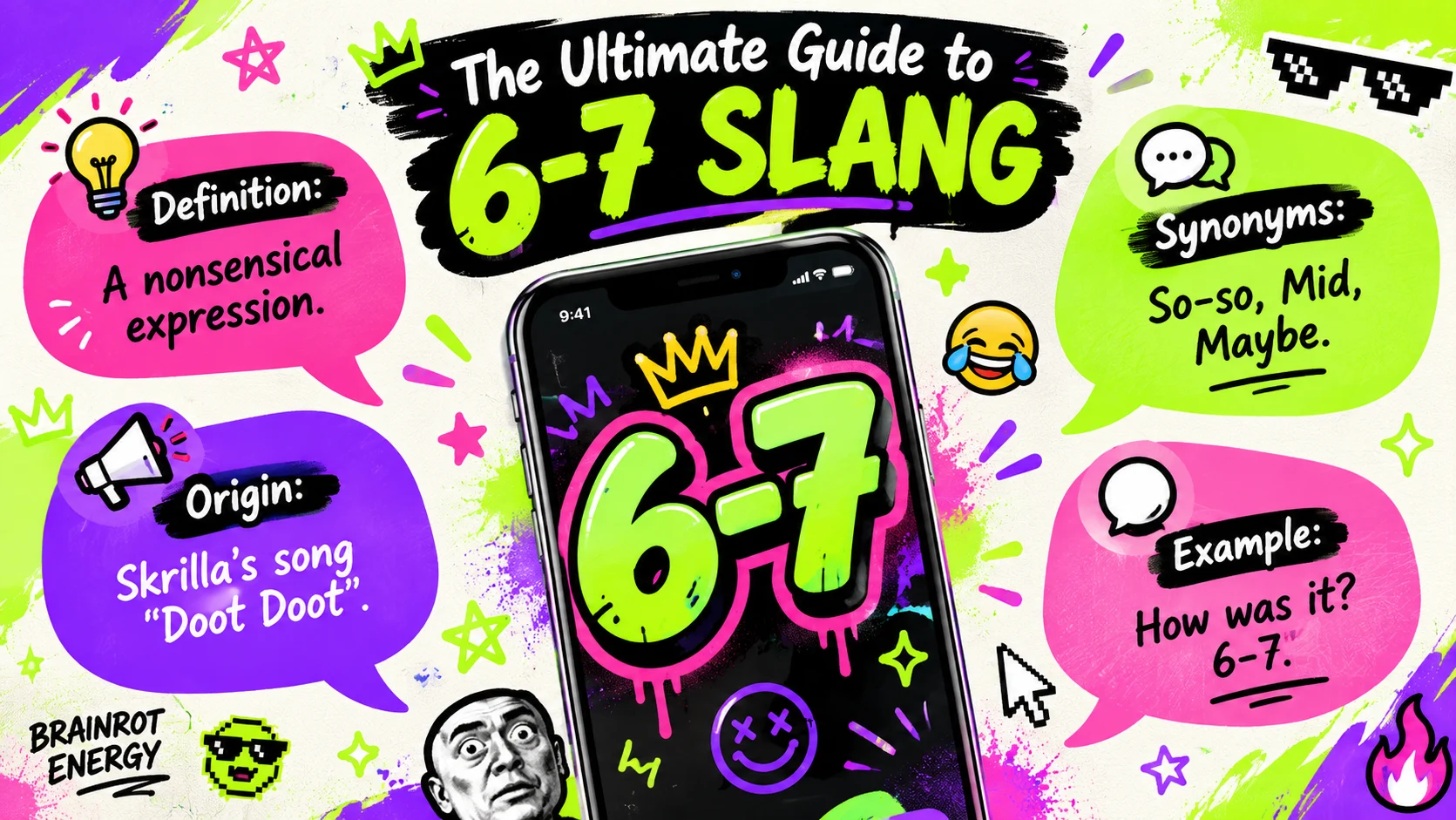
6-7 (pronounced “six-seven”) is a slang term that means nothing at all. Its absurdity is the point, making it a prime example of “brainrot” internet humor. It can also mean “so-so” or “maybe this, maybe that,” often accompanied by a hand gesture.
Understanding the 6-7 slang meaning is essential for keeping up with Gen Alpha and Gen Z digital conversations. Consequently, this seemingly nonsensical phrase became Dictionary.com‘s 2025 Word of the Year. It represents a new kind of internet humor where randomness itself becomes the joke. For example, you might hear someone say “6-7” in response to a question, accompanied by a shrug.
This comprehensive guide breaks down everything you need to know about the term. We will cover its definition, origins, platform-specific usage, and how to respond when someone uses it. By the end, you will be fully equipped to understand this viral slang confidently.
QUICK ANSWER BOX
| Meaning | Context | Primary Platforms | Example | Tone |
| A nonsensical expression meaning nothing. Also means “so-so” or “maybe.” | Used as a joke, to express indifference, or to confuse adults. | TikTok, Instagram, Snapchat, YouTube. | “How was the movie?” “6-7.” | Playful, absurd, and intentionally confusing. |
What Does 6-7 Slang Meaning Entail?
At its core, 6-7 slang meaning is that there is no meaning. The phrase is intentionally nonsensical. Unlike traditional slang that conveys a specific idea, “6-7” is an example of “brainrot” humor a style of internet comedy where randomness and absurdity are the punchlines.
However, context can give it a loose interpretation. Many people use it to mean “so-so,” “just OK,” or “maybe this, maybe that”. It’s a verbal shrug, a way of saying “I don’t know” or “I don’t care” without actually committing to a position. Merriam-Webster defines it as a “nonsensical expression used especially by teens and tweens”.
The term exploded in popularity in early 2025, spreading like wildfire across social media. Its rise is a testament to the power of internet culture to turn a random number into a global phenomenon.
Contextual Dynamics & Nuances of the Term
The meaning of 6-7 can shift depending on the context and the speaker’s intention. Understanding these nuances is key to using the term correctly.
The Nonsensical Joke
The primary use of “6-7” is as a joke without a setup or punchline. It’s a shibboleth a way for insiders to recognize each other. When someone says “6-7,” they are signaling that they are part of the in-group that “gets” the joke. Those who don’t get it are left confused, which is part of the fun.
Expressing Indifference
In some contexts, “6-7” functions as a synonym for “so-so” or “mid”. For example, if someone asks how a meal was, responding “6-7” implies it was average, neither great nor terrible. It’s a way to express mild indifference without elaborating.
The Hand Gesture
The term is often accompanied by a specific hand gesture. This involves holding both palms flat and moving them alternately up and down, like a “maybe” motion. The gesture reinforces the sense of uncertainty or indifference.
Social Meaning
Linguists note that “6-7” has “social meaning” even though it lacks semantic meaning. It expresses solidarity and belonging. Using the term correctly shows that you are tuned into youth culture and internet trends.
Real-Life Conversation Examples Using 6-7
To truly grasp how 6-7 slang meaning is used in the wild, it helps to see it in natural dialogue. Here are five distinct chat scenarios that showcase its versatility.
Scenario 1: Responding to a Question About Quality
Friend 1: “How was the party last night?”
Friend 2: “6-7. It was alright, I guess.”
Friend 1: “That good, huh?”
Scenario 2: Expressing Indifference
Person A: “Do you want pizza or burgers for dinner?”
Person B: “6-7. I don’t really care.”
Person A: “Okay, I’ll pick then.”
Scenario 3: Using It as a Random Joke
Friend 1: “What’s the meaning of life?”
Friend 2: “6-7.”
Friend 1: “That doesn’t make any sense.”
Friend 2: “That’s the point.”
Scenario 4: Reacting to a Confusing Situation
Person A: “Did you see what happened in the game?”
Person B: “Yeah, I don’t get it. 6-7.”
Person A: “Same. So confusing.”
Scenario 5: Ending a Conversation
Friend 1: “Well, I gotta go. Talk to you later.”
Friend 2: “6-7. See ya.”
Friend 1: “What does that even mean?”
Platform-Specific Breakdown
The usage of 6-7 slang meaning varies slightly depending on the social media platform. Here is how it is typically used across the most popular apps.
How It Is Used on TikTok
TikTok has been instrumental in cementing 6-7 as a cultural mainstay. The platform is a hub for viral trends and memes. Consequently, the term appears in millions of videos, comments, and audio clips. Popular formats include videos where creators say “6-7” with the hand gesture, often as a punchline to an absurd situation. The phrase beat out other slang terms to become one of the most used on the platform.
The Role of 6-7 on Instagram
On Instagram, 6-7 appears in Reels, Stories, and comments. Users often use it as a caption for posts that are intentionally confusing or mediocre. It’s also used in memes and as a reaction to questionable content.
Snapchat and Texting Dynamics
On Snapchat, 6-7 is used in direct messages as a quick, cryptic response. A friend might ask a question, and the reply is simply “6-7.” In texting, it serves a similar purpose a shorthand for “so-so” or “I don’t know.” This usage fits perfectly into the fast-paced, informal nature of digital communication.
Alternative Meanings & NLP Variations of the Phrase
While we have focused on the slang definition, it is important to note that 6-7 has other meanings. Search engines and natural language processing (NLP) models must distinguish between these to provide accurate results.
The Height Reference
The number sequence likely references NBA player LaMelo Ball, who stands six feet seven inches tall. This association helped popularize the term on social media.
The Street Reference
Some link it to 67th Street in Philadelphia, Skrilla’s hometown. Others suggest it refers to the police code 10-67, which some believe means a dead body, though police have denied this.
“Negative to Positive”
Skrilla himself has described the term as “negative to positive,” saying it helped him turn from a negative person to a positive person.
Misinterpretations: When NOT to Use 6-7
Using 6-7 in the wrong context can lead to misunderstandings. Here are a few scenarios where you should avoid the term.
Professional Settings
6-7 is highly informal and nonsensical. Using it in a professional environment, such as in an email to a boss or during a business meeting, would be inappropriate and confusing. Stick to formal language in these settings.
When You Need a Clear Answer
If you need a definitive yes or no, “6-7” is not the right response. Its ambiguity can be frustrating when you need a straight answer.
With People Unfamiliar with Slang
If you are talking to someone older or someone who doesn’t follow current slang, using the term will likely confuse them. They might take it literally and think you are talking about a number or a measurement.
How to Respond in Chat Comfortably
If someone uses 6-7 in a chat, your response should depend on the context and your relationship with the person. Here are a few ways to handle it.
Play Along
If you are in on the joke, you can play along. You might respond with “6-7” yourself or use the hand gesture emoji. This shows you are part of the in-group.
Ask for Clarification
If you are confused, it’s perfectly acceptable to ask. You can say, “What does that mean?” or “Is that a good thing or a bad thing?” This opens the door for a conversation and clears up any confusion.
Acknowledge the Absurdity
If you understand the joke but don’t want to engage, you can simply acknowledge the absurdity. You might respond with “That makes no sense” or “Okay, I guess.” This shows you get the joke but aren’t interested in participating.
People Also Ask
What does 6-7 mean in slang?
6-7 is a slang term that means nothing at all. It’s a nonsensical expression used as a joke or to express “so-so” or “maybe.”
Is 6-7 a bad word?
No, it’s not a bad word. It’s a playful, nonsensical term used primarily by Gen Z and Gen Alpha.
Where did the slang 6-7 come from?
The term originated from the 2024 song “Doot Doot (6 7)” by rapper Skrilla. It also gained traction through memes about NBA player LaMelo Ball’s height of 6’7″.
What does 6-7 mean on TikTok?
On TikTok, 6-7 is a viral meme and slang term. It’s often used as a joke, to express indifference, or to mean “so-so.”
What does 6-7 mean on Snapchat?
On Snapchat, 6-7 is used in direct messages as a quick, cryptic response meaning “I don’t know” or “whatever.”
How do you use 6-7 in a sentence?
You can say, “How was the food?” “6-7.” or just use it randomly as a joke: “6-7!”
Is 6-7 the same as “mid”?
Yes, in some contexts, 6-7 is used similarly to “mid” to mean average or mediocre.
What is the 6-7 hand gesture?
The hand gesture involves holding both palms flat and moving them alternately up and down, like a “maybe” motion.
Why did Dictionary.com name 6-7 Word of the Year?
Dictionary.com named 6-7 its 2025 Word of the Year because of its viral spread and its embodiment of “brainrot” internet culture.
Is 6-7 a real word?
No, it’s not a traditional word. It’s a number sequence used as a slang term and meme.
Conclusion
Understanding 6-7 slang meaning offers a fascinating glimpse into how language evolves in the digital age. What started as a lyric in a rap song and a meme about a basketball player’s height has become a global phenomenon and a dictionary word of the year. The term’s complete lack of semantic meaning is precisely what makes it meaningful. It’s a social signal, a joke, and a way to express indifference all at once.
As with any slang, the key to using 6-7 effectively lies in understanding the context and your audience. When used correctly, it can be a fun way to connect with others and show you are in on the joke. As digital communication continues to shape our language, terms like 6-7 remind us that sometimes, meaninglessness can be the most meaningful thing of all.

Sara Mitchell is a content writer at Punzite.com who specializes in internet slang, word meanings and language trends. She creates clear, engaging and well-researched content that helps readers understand modern digital communication with ease.