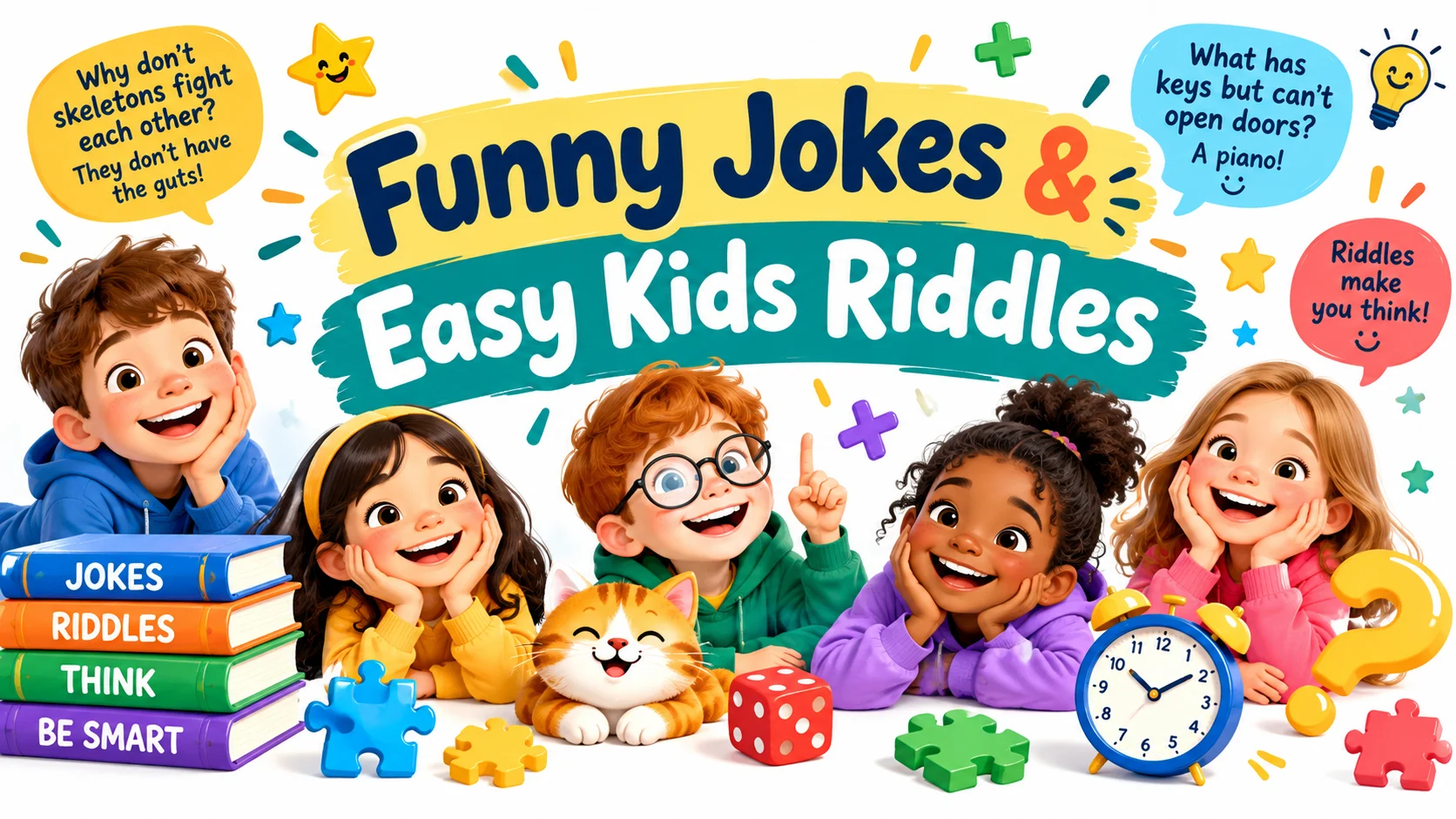
Funny jokes make children laugh, while easy kids riddles turn that fun into a guessing challenge. Riddles use clues, wordplay, logic, numbers, animals, and everyday objects to encourage children to think creatively. The collection below combines short jokes with original, family friendly riddles suitable for home, classrooms, parties, and playtime.
Looking for funny jokes and kids riddles easy enough for children to enjoy? You’re in the right place. These riddles are short, playful, and designed to make kids think without becoming frustrating.
Some answers are obvious, some require a second look, and a few use a little wordplay. Read each question aloud, hide the answer, and let everyone guess before revealing it.
Funny Jokes and Easy Kids Riddles
Start with these quick riddles when you want something simple enough for younger children but funny enough to get a few laughs.
Riddle 1:
What has four legs, a seat, and never gets tired of sitting?
Answer: A chair.
Riddle 2:
What gets wetter the more it helps you get dry?
Answer: A towel.
Riddle 3:
Why did the pencil bring a suitcase to school?
Answer: Because it was ready for a sharp trip!
Riddle 4:
What has a face and two hands but cannot clap?
Answer: A clock.
Riddle 5:
Why did the book go to bed early?
Answer: It had too many chapters to get through!
Riddle 6:
What can you catch but never throw?
Answer: A cold.
Riddle 7:
Why was the computer cold?
Answer: It left its Windows open.
Riddle 8:
What has many teeth but cannot bite?
Answer: A comb.
Fun idea: Read these aloud and give children five seconds to guess. The short time limit makes even simple riddles more exciting.
Easy Animal Riddles for Kids
Animals are perfect for kids riddles easy because children can use familiar features such as sounds, movement, size, and habitats as clues.
Riddle 1:
I have whiskers, four paws, and love to chase tiny moving things. Who am I?
Answer: A cat.
Riddle 2:
I carry my house wherever I go, but I never pay rent. Who am I?
Answer: A snail.
Riddle 3:
I have feathers, wings, and a beak, but I am not an airplane. Who am I?
Answer: A bird.
Riddle 4:
I say “moo” and give people milk. Who am I?
Answer: A cow.
Riddle 5:
I have a long trunk but I am not a suitcase. Who am I?
Answer: An elephant.
Riddle 6:
I hop instead of walk and love carrots in many stories. Who am I?
Answer: A rabbit.
Riddle 7:
I have eight arms but I never need eight sleeves. Who am I?
Answer: An octopus.
Riddle 8:
I can change my color and have a long sticky tongue. Who am I?
Answer: A chameleon.
Classroom activity: Let children draw the animal after solving each riddle. This combines reading, reasoning, and creativity.
Funny Object Riddles
Everyday objects make excellent beginner riddles because children can connect the clues to things they see around them.
Riddle 1:
I have pages but I am not a tree. What am I?
Answer: A book.
Riddle 2:
I have a neck but no head. What am I?
Answer: A bottle.
Riddle 3:
I have one eye but cannot see. What am I?
Answer: A needle.
Riddle 4:
I have keys but open no doors. What am I?
Answer: A piano.
Riddle 5:
I have a tongue but cannot taste. What am I?
Answer: A shoe.
Riddle 6:
I go up and down but stay in the same place. What am I?
Answer: Stairs.
Riddle 7:
I have hands but no arms and a face but no eyes. What am I?
Answer: A clock.
Riddle 8:
I can be opened, closed, and slammed, but I am not a book.
Answer: A door.
Try this: Ask children to invent a riddle about an object in the room. Give one point for the best clue and another for the most creative wording.
Clever Wordplay Riddles
Word riddles encourage children to listen carefully to the exact wording. These are especially fun for older kids who enjoy jokes with unexpected answers.
Riddle 1:
What kind of room has no walls, windows, or doors?
Answer: A mushroom.
Riddle 2:
What has a ring but no finger?
Answer: A telephone.
Riddle 3:
What starts with T, ends with T, and has T inside?
Answer: A teapot.
Riddle 4:
What word becomes shorter when you add two letters to it?
Answer: Short.
Riddle 5:
What can travel around the world while staying in one corner?
Answer: A stamp.
Riddle 6:
What has a bottom at the top?
Answer: Your legs when you do a handstand.
Riddle 7:
What has a head and a tail but no body?
Answer: A coin.
Riddle 8:
What can be broken without being touched?
Answer: A promise.
Why they work: Wordplay riddles teach children that a question can have a different meaning from the one they initially expect.
Simple Logic Riddles
Logic riddles ask children to slow down and examine the clues instead of immediately guessing.
Riddle 1:
A basket has five apples. You take two apples. How many apples do you have?
Answer: Two. You took two apples.
Riddle 2:
A farmer has three ducks. Each duck lays one egg. How many eggs are there?
Answer: Three eggs.
Riddle 3:
You have one match and enter a dark room containing a candle, a lamp, and a fireplace. What do you light first?
Answer: The match.
Riddle 4:
A boy has three brothers. Each brother has one sister. How many sisters does the boy have?
Answer: One sister.
Riddle 5:
What can you put into a bucket to make it weigh less?
Answer: A hole.
Riddle 6:
If a rooster lays an egg on top of a roof, which side will the egg roll down?
Answer: Neither. Roosters do not lay eggs.
Riddle 7:
You see a house with all four walls facing south. A bear walks past the house. What color is the bear?
Answer: White, because the house must be near the North Pole.
Riddle 8:
A bus is full of passengers, but nobody is sitting on it. How is that possible?
Answer: Everyone is standing.
Thinking tip: Before answering a logic riddle, ask: “Am I assuming something that the question never actually said?”
Easy Math Riddles
Math riddles can make simple numbers more entertaining by turning calculations into small puzzles.
Riddle 1:
I am a number. Add 2 to me and you get 7. What number am I?
Answer: 5.
Riddle 2:
There are 10 candies. You eat 3. How many candies remain?
Answer: 7.
Riddle 3:
What number comes next: 2, 4, 6, 8, ___?
Answer: 10.
Riddle 4:
You have four groups of two balloons. How many balloons do you have?
Answer: 8.
Riddle 5:
A box has 12 crayons. Six are red and the rest are blue. How many are blue?
Answer: 6.
Riddle 6:
What number becomes larger when you turn it upside down?
Answer: 6, which can become 9.
Riddle 7:
If one cat has four paws, how many paws do three cats have?
Answer: 12.
Riddle 8:
I am an odd number. Remove one letter from my name and I become even. What number am I?
Answer: Seven. Remove the “s” and “even” remains.
Classroom use: These riddles can be used as warm up questions before a mathematics lesson or as a quick five minute activity.
Nature and Food Riddles
Nature and food provide familiar subjects that younger children can identify quickly.
Riddle 1:
I am yellow, curved, and monkeys are often pictured eating me. What am I?
Answer: A banana.
Riddle 2:
I fall from the sky but I am not a bird. What am I?
Answer: Rain.
Riddle 3:
I shine during the day and help make the world bright. What am I?
Answer: The sun.
Riddle 4:
I am white, cold, and can melt in your hand. What am I?
Answer: Snow.
Riddle 5:
I have layers and can make you cry when you cut me.
Answer: An onion.
Riddle 6:
I am red or green, grow on trees, and can keep a doctor away in a famous saying.
Answer: An apple.
Riddle 7:
I have a shell, contain a yolk, and often appear at breakfast.
Answer: An egg.
Riddle 8:
I am made by bees and taste sweet. What am I?
Answer: Honey.
Family challenge: Put these riddles on small pieces of paper and place them in a bowl. Each family member picks one and reads it aloud.
Tricky Family Riddles
These riddles are useful for family game nights because they are easy to understand but contain a small twist.
Riddle 1:
What belongs to you but other people use it more than you do?
Answer: Your name.
Riddle 2:
If you have me, you want to share me. If you share me, you no longer have me. What am I?
Answer: A secret.
Riddle 3:
What has cities, roads, and rivers but no people, cars, or water?
Answer: A map.
Riddle 4:
What goes through towns and over hills but never moves?
Answer: A road.
Riddle 5:
What disappears as soon as you say its name?
Answer: Silence.
Riddle 6:
What is always in front of you but cannot be seen?
Answer: The future.
Riddle 7:
The more you take away from me, the bigger I become. What am I?
Answer: A hole.
Riddle 8:
What has no life but can grow, has no lungs but needs air, and has no mouth but can die?
Answer: Fire.
Party idea: Divide players into two teams. Give each team 30 seconds per riddle. One point goes to the team that solves it first.
How to Use Funny Jokes and Kids Riddles Easy
Riddles are more enjoyable when children get a chance to participate rather than simply reading the answers.
Try these ideas:
- Morning activity: Start the day with one quick riddle.
- Classroom warm up: Use a logic or math riddle before a lesson.
- Family night: Let each person choose a riddle.
- Birthday parties: Put riddles into a guessing game.
- Road trips: Use short riddles that don’t require paper.
- Lunch boxes: Write one riddle on a small note.
- Social posts: Share the question first and reveal the answer later.
- Reading practice: Let younger children read the clues aloud.
- Creative writing: Ask children to invent their own riddles.
- Friendly competition: Award points for correct answers and creative explanations.
For younger children, choose familiar objects, animals, colors, and foods. For older children, introduce wordplay, logic, and lateral thinking puzzles.
Quick Riddle Challenge
Ready for a mini challenge? Don’t scroll for the answers immediately.
- What has teeth but cannot eat?
- What gets wetter as it dries?
- What has a face but no eyes?
- What can be caught but never thrown?
- What has keys but cannot open a door?
Answers:
- Comb
- Towel
- Clock
- A cold
- Piano
The best part of a riddle isn’t always getting the answer immediately. Sometimes the funniest moment is hearing everyone’s first guess!
People Also Ask
1. What are funny jokes and kids riddles?
Funny jokes are short humorous statements or questions designed to make people laugh, while kids riddles are guessing puzzles built around clues. Combining both gives children an entertaining way to laugh, guess answers, and practice creative thinking.
2. How do you solve easy kids riddles?
Start by reading every clue carefully. Look for familiar objects, word meanings, numbers, sounds, or unusual wording. Don’t assume information that isn’t given. If the first answer doesn’t fit every clue, reconsider it before making your final guess.
3. Are easy riddles good for kids?
Yes. Easy riddles can be an enjoyable activity for children because they encourage observation, vocabulary, reasoning, and creative thinking. Parents and teachers can choose riddles according to the child’s reading ability and age.
4. What makes a good kids riddle?
A good kids riddle has clear clues, one intended answer, age appropriate language, and enough mystery to make the child think. The answer should make sense when revealed rather than depending on an obscure fact or confusing wording.
5. Where can I use funny jokes and kids riddles?
You can use them at home, in classrooms, birthday parties, family gatherings, road trips, lunch notes, children’s activities, and social media posts. Short riddles work especially well when you need an activity that requires little preparation.
6. What is an easy riddle for a beginner?
An easy beginner riddle describes something familiar, such as an animal, food, household object, or number. For example, “What has many teeth but cannot bite?” has the simple answer “a comb,” making it suitable for younger solvers.
7. What age are kids riddles suitable for?
Kids riddles can be adapted for many ages. Preschoolers usually enjoy picture based and very simple object riddles, while elementary age children can handle wordplay, math, logic, and trick questions with more complex clues.
8. Can riddles help children learn?
Yes. Riddles can support learning by encouraging children to interpret language, identify clues, compare possibilities, and explain their reasoning. Teachers can use them as short classroom warm ups without turning every riddle into a formal lesson.
9. How can I make riddles more fun for children?
Turn solving into a game. Set a short time limit, let children work in teams, award points, or allow players to create their own riddles. You can also reveal one clue at a time to build suspense.
10. What is the difference between a joke and a riddle?
A joke is primarily designed to create humor, while a riddle asks the audience to discover an answer from clues. Some riddles are funny, and some jokes use questions, so the two formats can overlap while having different main purposes.
Conclusion
Funny jokes and kids riddles easy enough for beginners can turn an ordinary moment into a fun guessing game. From animals and everyday objects to math, wordplay, logic, and tricky family challenges, riddles give children plenty of opportunities to think and laugh. Try a few at home, in the classroom, at a party, or during family game night. Hide the answers, let everyone make a guess, and see who can solve the puzzle first. And once you’ve finished this collection, challenge your friends and family to create a few original riddles of their own!

Dominic Rafe is a humor writer and content creator at Punzite.com specializing in witty puns, clever jokes and entertaining wordplay. With a passion for creating fun and engaging content, he helps bring fresh laughter and creative humor to readers around the world.