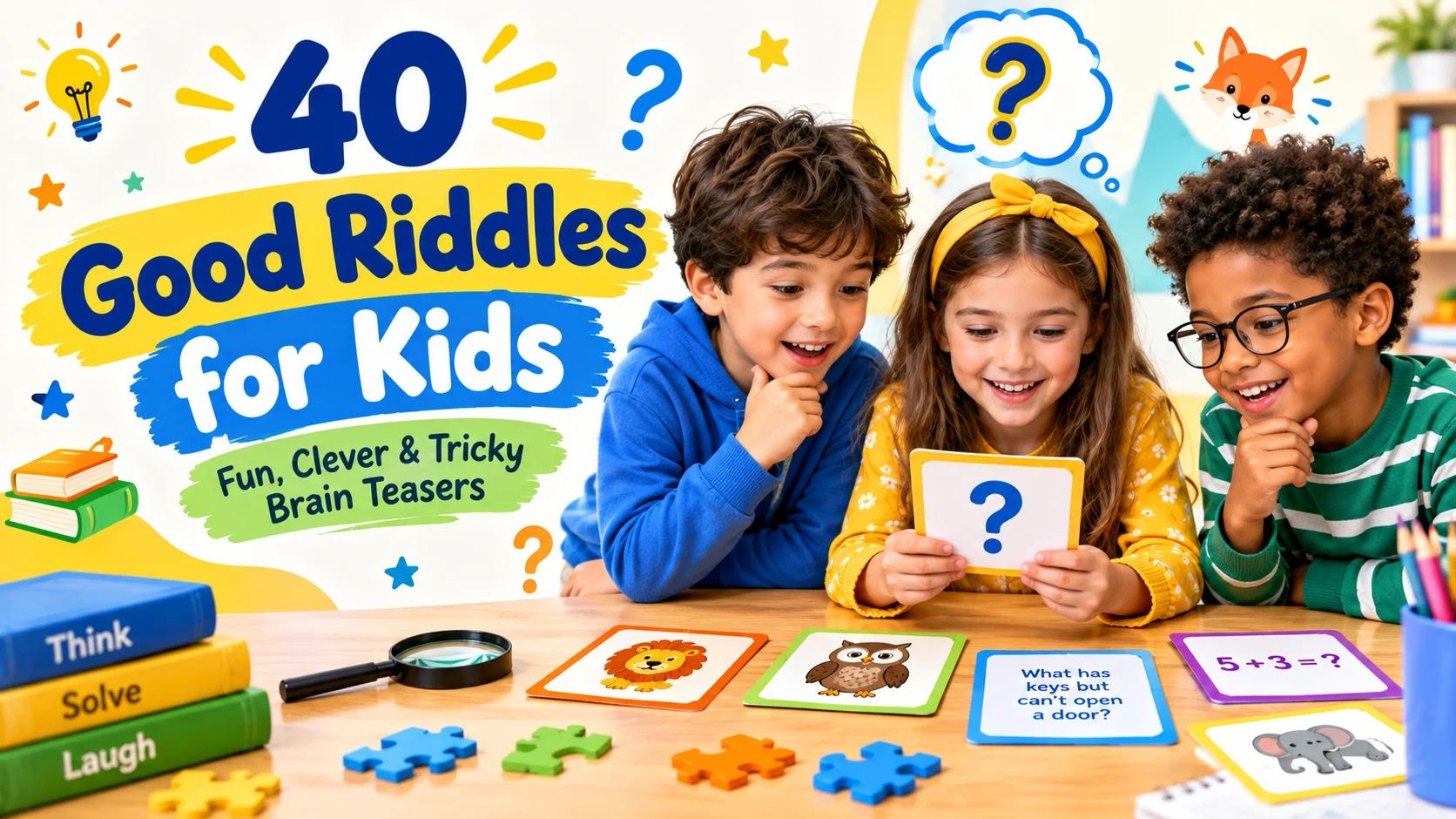
Good riddles for kids are short, playful puzzles that challenge children to use clues, logic, vocabulary, observation, and creative thinking. The best ones have a clear answer, familiar subjects, and just enough misdirection to create an exciting “aha!” moment. They work well at home, school, parties, road trips, and family game nights.
Looking for good riddles for kids that are actually fun to solve? You’re in the right place.
A great riddle doesn’t need complicated words or obscure facts. It simply makes a familiar thing look unfamiliar for a moment. Children can guess, discuss clues, make silly guesses, and celebrate when the answer finally clicks.
Riddles can also be used as quick classroom warm-ups, screen-free activities, conversation starters, or family challenges. Current kids’ riddle collections commonly organize puzzles by difficulty, age, humor, animals, math, and wordplay.
Below are 40 original riddles, arranged from easy warm-ups to trickier brain teasers.
Easy Riddles for Kids
These are great starting points for younger children. The clues use familiar objects and simple ideas.
Riddle 1:
I have pages but I cannot walk.
I have a cover but I cannot sleep.
What am I?
Answer: A book.
Riddle 2:
I have four legs, but I never run.
You might put your dinner on me.
What am I?
Answer: A table.
Riddle 3:
I have teeth, but I never bite.
You use me to fix messy hair.
What am I?
Answer: A comb.
Riddle 4:
I can be opened, but I am not a door.
I can contain words, but I cannot talk.
What am I?
Answer: A book.
Riddle 5:
I follow you when the sun is shining, but disappear when darkness takes over. What am I?
Answer: A shadow.
Quick tip: Let younger children hear the riddle twice before offering a hint. The goal is the “aha!” moment, not speed.
Funny Riddles for Kids
Funny riddles are especially useful when you want laughter along with the thinking. Humor and wordplay are common elements in popular children’s riddle collections. (RiddleTrove)
Riddle 6:
What kind of key can open a banana?
Answer: A monkey’s key because monkeys “key” into bananas?
Better guess: this is a playful nonsense riddle the intended answer is a monkey.
Riddle 7:
Why did the pencil bring a friend to school?
Answer: Because it wanted someone to draw conclusions with!
Riddle 8:
What do you call a sleepy dinosaur?
Answer: A dino-snore.
Riddle 9:
Why did the cookie sit in the shade?
Answer: It didn’t want to become a hot cookie!
Riddle 10:
What does a tiny cloud wear when it gets cold?
Answer: A little thunder-jacket!
For very young children, funny riddles work best when the punchline is short and easy to repeat.
Animal and Nature Riddles
Animals, weather, plants, and nature make excellent riddle subjects because children can picture the answers easily.
Riddle 11:
I carry my house on my back,
I move slowly across the ground.
Who am I?
Answer: A snail.
Riddle 12:
I have wings, but I am not an airplane.
I sleep upside down.
What am I?
Answer: A bat.
Riddle 13:
I am green in a pond,
I can jump very far,
and I say “ribbit.”
What am I?
Answer: A frog.
Riddle 14:
I fall from the sky, but I am not a bird.
I can make puddles on the ground.
What am I?
Answer: Rain.
Riddle 15:
I have a trunk but no suitcase.
I have big ears but cannot listen like you do.
What am I?
Answer: An elephant.
Animal and nature riddles are particularly useful for younger children because the clues can connect directly to things they have seen, read about, or discussed in class.
Object and What-Am-I Riddles
“What am I?” riddles encourage children to collect clues before making a guess.
Riddle 16:
I am round,
I have numbers,
and I help you know when it is time to go.
What am I?
Answer: A clock.
Riddle 17:
I have one eye, but I cannot see.
I can help put thread where it belongs.
What am I?
Answer: A needle.
Riddle 18:
I can hold water,
but I am full of tiny holes.
What am I?
Answer: A sponge.
Riddle 19:
I have a neck but no head.
You might find me in the kitchen.
What am I?
Answer: A bottle.
Riddle 20:
You can write on me, erase me, and write again.
What am I?
Answer: A whiteboard.
Try this: After each answer, ask the child, “Which clue gave it away?” That turns a guessing game into a simple reasoning exercise.
Word and Language Riddles
Word riddles are especially good for older children because the answer may depend on how a word is interpreted.
Riddle 21:
What word becomes shorter when you add two letters to it?
Answer: “Short” → “shorter.”
Riddle 22:
What can you hear but never see?
Answer: A sound.
Riddle 23:
What has many words but never says a word?
Answer: A dictionary.
Riddle 24:
What has a beginning and an ending but no middle?
Answer: The word “beginning” and the word “ending” each have beginnings and endings; the intended trick is that the letters at the ends matter.
Answer: The letters at the ends of a word.
Riddle 25:
I can be read from left to right, but I can also make sense when read backward. What am I?
Answer: A palindrome.
Wordplay riddles teach children to look beyond the first meaning of a sentence. That is one reason they can be enjoyable even when the answer seems obvious at first.
Math Riddles for Kids
Math riddles turn numbers into puzzles rather than exercises.
Riddle 26:
I am an even number.
Take away one letter from my name and I become odd.
What number am I?
Answer: Seven “even” here is the trick: the wordplay does not describe the numerical property.
This one is intentionally tricky; for younger children, use the next riddles first.
Riddle 27:
You have 5 apples and give 2 away. How many apples do you have left?
Answer: 3 apples.
Riddle 28:
I am a number greater than 5 but less than 8. What am I?
Answer: 6 or 7.
Riddle 29:
There are 3 birds on a fence. Two fly away. How many are left?
Answer: 1.
Riddle 30:
I have two digits.
My first digit is 3.
My second digit is 2 more than my first.
What number am I?
Answer: 35.
For children learning mathematics, the strongest riddles usually test reasoning without requiring advanced calculations.
Logic and Clever Riddles
These require children to slow down and examine every word.
Riddle 31:
A child has three socks in a drawer: two blue and one red. Without looking, what is the smallest number of socks the child must take to guarantee getting two socks of the same color?
Answer: 3 socks.
Riddle 32:
A farmer has chickens and cows. He counts 6 heads and 16 legs. How many chickens and cows are there?
Answer: 4 chickens and 2 cows.
Riddle 33:
You have one candle and enter a dark room containing a lamp, a fireplace, and a stove. What do you light first?
Answer: The candle.
Riddle 34:
A box has no lid and no lock, but something golden is hidden inside. What could it be?
Answer: An egg.
Riddle 35:
The more carefully you look at me, the less of me you can see. What am I?
Answer: Darkness.
Logic riddles are excellent for family challenges because adults can solve alongside children rather than simply giving them the answer.
Tricky Challenge Riddles
Ready for a harder round? Read each one slowly. The trick is often hidden in a single word.
Riddle 36:
A bus is full of passengers. Nobody gets off, but suddenly there isn’t a single passenger on the bus. Why?
Answer: Everyone on the bus is married, so there isn’t a “single” passenger.
Riddle 37:
You see a house with every wall facing south. A bear walks past the house. What color is the bear?
Answer: White. The house is at the North Pole.
Riddle 38:
What becomes larger when you take something away from it?
Answer: A hole.
Riddle 39:
A child walks into a room with a door. The door is locked from the inside, but the child can still enter without breaking it. How?
Answer: The child has the key.
Riddle 40:
What belongs to you, but other people use it more than you do?
Answer: Your name.
Challenge rule: Give children at least 20–30 seconds before revealing the answer. The thinking time is part of the game.
How to Use Riddles With Kids
Good riddles can work almost anywhere:
- At breakfast: Start the day with one easy riddle.
- In the classroom: Use a riddle as a lesson opener or transition activity.
- On road trips: Take turns asking one another riddles.
- At parties: Give each child a riddle card.
- At family game night: Keep score or play in teams.
- At bedtime: Finish with a calm “What am I?” puzzle.
- For screen-free time: Use riddles when children need a quick activity without a device.
One useful approach is to give a hint rather than the answer. For example, if the answer is “elephant,” say, “It’s an animal,” then “It’s very large,” before revealing it.
Age and difficulty also matter. Recent children’s riddle resources commonly separate easier puzzles for younger children from harder wordplay and logic challenges for older children.
Why Good Riddles Work
A good riddle gives children a small problem with a satisfying solution.
Solving one can involve:
- listening carefully;
- understanding vocabulary;
- noticing multiple meanings;
- comparing clues;
- remembering information;
- testing possible answers;
- explaining why an answer fits.
Riddles are also social. A child can solve one independently, work with a sibling, challenge a parent, or discuss an answer with classmates.
The best approach is to keep the experience playful. If a child needs a hint, give one. If an answer is wrong, ask which clue made it seem possible. That keeps the focus on curiosity rather than getting every answer correct.
People Also Ask
1. What are good riddles for kids?
Good riddles for kids are age-appropriate puzzles with familiar subjects, clear clues, and one intended answer. They can be funny, logical, mathematical, or based on wordplay. The best riddles are challenging enough to encourage thinking without becoming frustrating.
2. How do you solve riddles for kids?
Start by identifying every clue in the riddle. Think about the literal meaning first, then consider whether a word could have another meaning. Try familiar objects and ideas before complicated possibilities, and use the clues to eliminate answers that do not fit.
3. Are riddles good for children?
Yes, riddles can be a useful form of playful thinking. They encourage children to listen, interpret clues, make predictions, and explain their reasoning. They can also support vocabulary and flexible thinking while remaining a simple entertainment activity.
4. What makes a good kids’ riddle?
A good kids’ riddle has clear clues, a solvable answer, and an enjoyable surprise. It should match the child’s age and vocabulary. Younger children generally benefit from concrete objects and animals, while older children can handle more wordplay and multi-step logic.
5. Where can I use riddles for kids?
You can use riddles at home, in classrooms, at parties, during road trips, or during family game nights. They are especially convenient because they require little or no equipment. One person can simply read a riddle aloud and let everyone guess.
6. What age are these riddles suitable for?
These riddles are mainly suitable for children around ages 5–12, depending on difficulty. The easy animal and object riddles work well for younger children, while the word, math, logic, and tricky riddles are better suited to older children.
7. How can I make riddles easier for a child?
Give one extra clue instead of revealing the answer. For example, tell the child whether the answer is an animal, object, food, or place. You can also give the first letter of the answer or eliminate one possible wrong choice.
8. How can I make a riddle harder?
Hide the most obvious clue and use indirect descriptions. You can also introduce a second step, use a double meaning, or ask children to combine two clues. Avoid making the answer dependent on obscure facts that children could not reasonably know.
9. Can riddles be used in the classroom?
Yes, riddles work well as short classroom activities. Teachers can use one as a warm-up, vocabulary exercise, transition activity, team challenge, or end-of-class brain teaser. Students can also create their own riddles from familiar classroom objects.
10. How can kids create their own riddles?
Start with an answer and write three clues about it. Make the first clue broad, the second more specific, and the final clue decisive. Then test the riddle on someone else to make sure there is one clear intended answer.
Conclusion
Good riddles for kids are more than just fun questions they’re a simple way to encourage curiosity, creativity, and clever thinking. From easy brain teasers to funny and tricky riddles, each one gives children a chance to think carefully, make connections, and enjoy the excitement of finding the answer.
Whether you’re looking for riddles for a classroom activity, family game night, road trip, birthday party, or simply a screen-free activity at home, these kid-friendly riddles are an entertaining choice for children of different ages and skill levels.
So, pick a riddle, let the guessing begin, and give kids plenty of time to think before revealing the answer. The best part isn’t just getting it right it’s the smile, surprise, and “Aha!” moment that comes with solving it!
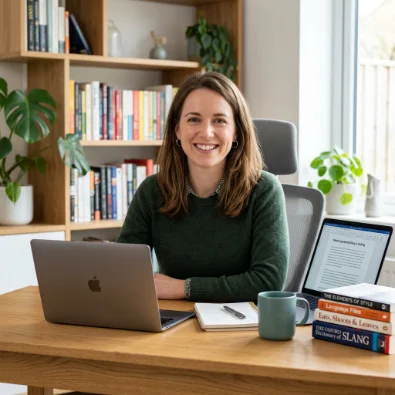
Sara Mitchell is a content writer at Punzite.com who specializes in internet slang, word meanings and language trends. She creates clear, engaging and well-researched content that helps readers understand modern digital communication with ease.