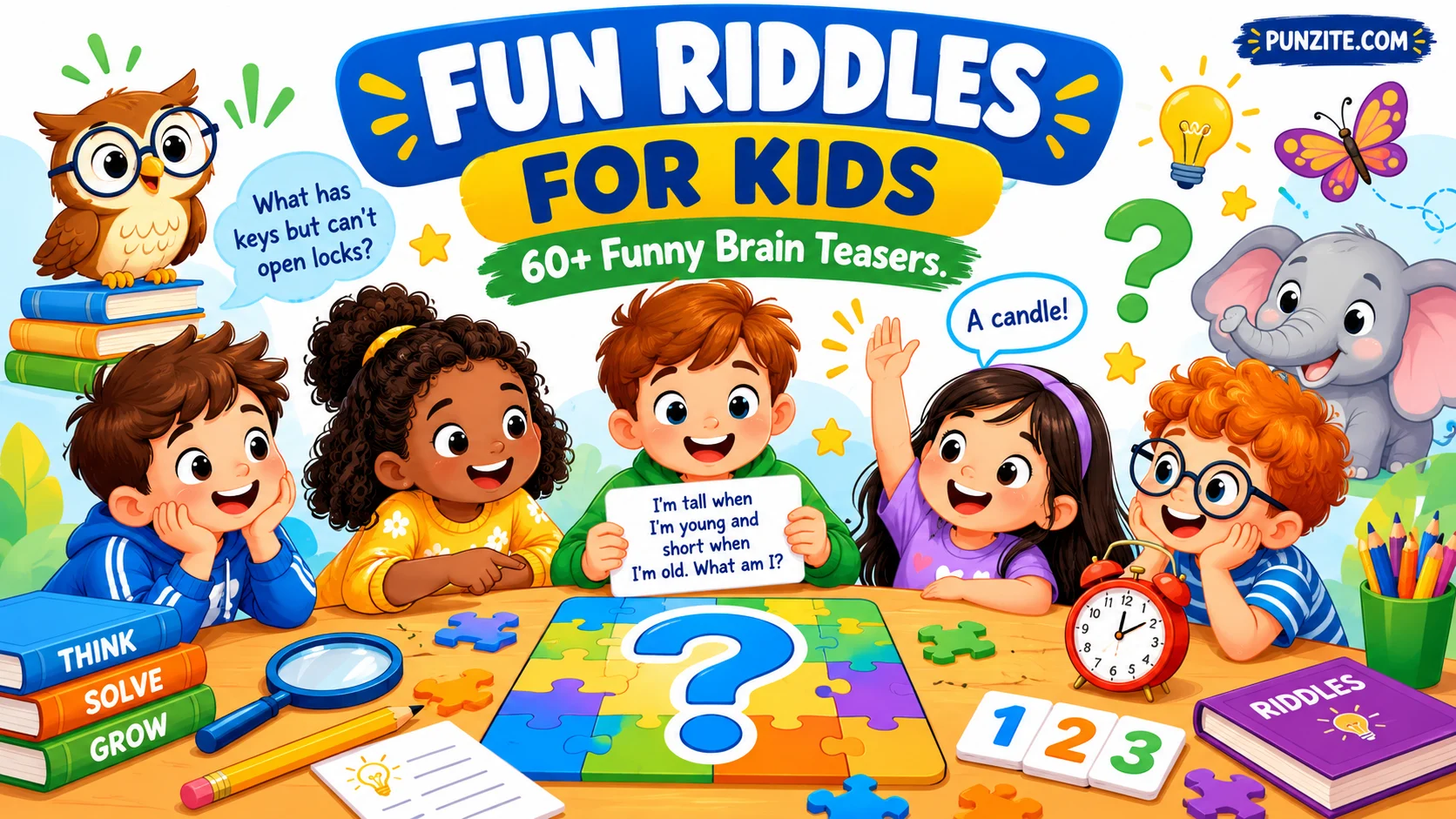
Fun riddles for kids are short puzzles that use clues, wordplay, logic, or observation to make children think and guess an answer. They can be funny, educational, easy, or tricky. Kids can solve them alone or enjoy them with parents, teachers, siblings, and friends.
Ready to make kids think, laugh, and shout, “I know it!”?
These fun riddles for kids turn ordinary moments into little brain challenges. They’re great for classrooms, family game nights, road trips, birthday parties, rainy afternoons, lunch breaks, and whenever someone needs a quick dose of curiosity.
The collection includes easy riddles for beginners, animal mysteries, funny wordplay, simple math challenges, clever logic puzzles, and tricky questions that reward careful thinking.
Some answers will be obvious. Others may make kids pause and reconsider their first guess.
The best part? Every riddle has a clear intended answer, so the challenge stays fun instead of frustrating.
Easy Riddles for Kids
Start here if your little puzzlers are new to riddles. These questions use familiar objects and simple clues.
Riddle 1:
I have four legs, but I never walk. I have a flat top, but I never wear a hat. What am I?
Answer: A table.
Riddle 2:
I have hands but cannot clap. I have a face but cannot smile. What am I?
Answer: A clock.
Riddle 3:
I get smaller every time I take a bath. What am I?
Answer: A bar of soap.
Riddle 4:
I have pages but I’m not a tree. I have a cover but I’m not a blanket. What am I?
Answer: A book.
Riddle 5:
I can be opened, but I’m not a door. I can have pages, but I’m not a book. What am I?
Answer: A notebook.
Riddle 6:
I follow you during the day but disappear when the lights go out. What am I?
Answer: Your shadow.
Riddle 7:
I have a neck but no head. You can fill me with water. What am I?
Answer: A bottle.
Funny Riddles for Kids
These are designed to produce a laugh along with the answer. Give kids time to guess before revealing the punchline.
Riddle 8:
Why did the pencil get invited to the party?
Answer: Because it was looking sharp.
Riddle 9:
What kind of tree can you carry in your hand?
Answer: A palm tree.
Riddle 10:
What has ears but cannot hear?
Answer: A corn cob.
Riddle 11:
What do you call a sleeping bull?
Answer: A bulldozer.
Riddle 12:
What kind of room has no doors, windows, or furniture?
Answer: A mushroom.
Riddle 13:
What did one wall say to the other wall?
Answer: “I’ll meet you at the corner.”
Riddle 14:
What has lots of teeth but never visits the dentist?
Answer: A comb.
Riddle 15:
Why did the math book look worried?
Answer: It had too many problems.
Animal Riddles for Kids
Animal riddles are perfect for younger children because the clues often connect to animals they already know.
Riddle 16:
I say “moo,” I give milk, and I spend my day munching grass. Who am I?
Answer: A cow.
Riddle 17:
I have a long trunk, big ears, and a very good memory. Who am I?
Answer: An elephant.
Riddle 18:
I can hop, I have strong back legs, and I carry my baby in a pouch. Who am I?
Answer: A kangaroo.
Riddle 19:
I have eight arms, live underwater, and can squeeze through surprisingly small spaces. Who am I?
Answer: An octopus.
Riddle 20:
I am covered in feathers, I have wings, and I can sing from a tree. Who am I?
Answer: A bird.
Riddle 21:
I am slow, I carry my home on my back, and I leave a shiny trail. Who am I?
Answer: A snail.
Riddle 22:
I change from a caterpillar into a beautiful flying insect. Who am I?
Answer: A butterfly.
Object Riddles for Kids
Look around the room before answering these. Sometimes the most ordinary objects make the best riddles.
Riddle 23:
I become shorter as I work, but I can help you write. What am I?
Answer: A pencil.
Riddle 24:
I have a screen, buttons, and a battery. You can use me to call someone far away. What am I?
Answer: A phone.
Riddle 25:
I open when the rain comes down and close when the sunshine returns. What am I?
Answer: An umbrella.
Riddle 26:
I have two blades, but I am not a bird. I can cut paper, but I cannot eat it. What am I?
Answer: Scissors.
Riddle 27:
I keep food cold but never eat any of it. What am I?
Answer: A refrigerator.
Riddle 28:
I have bristles and a handle, and I help make your teeth clean. What am I?
Answer: A toothbrush.
Riddle 29:
I have wheels and pedals, but no engine. You can ride me to the park. What am I?
Answer: A bicycle.
Wordplay Riddles for Kids
These riddles play with language. Read each question carefully because the wording itself may contain the clue.
Riddle 30:
What word becomes shorter when you add two letters to it?
Answer: “Short.” Add “er” and it becomes “shorter.”
Riddle 31:
What has a beginning, an end, and an “e” in the middle?
Answer: The word “beginning”?
Answer clarification: The intended answer is “the word ‘end’” only if treating the clue as wordplay. Better yet, this one is a trick: the word “middle” has “d” at neither end.
Answer: This is a language trick the clue itself asks you to think about the word rather than an object.
Riddle 32:
What word sounds like something you use to see, but is also something you can agree with?
Answer: “I” / “aye.”
Riddle 33:
What has a ring but no finger?
Answer: A telephone.
Riddle 34:
What word can you hear even though it has no sound?
Answer: A written word you read in your mind.
Riddle 35:
What starts with T, ends with T, and has T inside it?
Answer: A teapot.
Riddle 36:
What can you catch but never throw?
Answer: A cold.
Math Riddles for Kids
Numbers become more exciting when they are wrapped inside a mystery.
Riddle 37:
I am an even number. Take away one letter from my name and I become odd. What number am I?
Answer: Seven. Remove the “s” and you get “even”?
Answer clarification: This classic wordplay can vary by wording, so here is the intended version: “What number becomes even when you remove its first letter?” Answer: Seven, because “seven” becomes “even.”
Riddle 38:
You have 3 apples and give 1 away. How many apples do you have left?
Answer: 2 apples.
Riddle 39:
A basket has 5 oranges. You take 2. How many oranges do you have?
Answer: 2. You took 2, so you have 2.
Riddle 40:
What number comes next: 2, 4, 6, 8, __?
Answer: 10.
Riddle 41:
I am a number between 1 and 10. I am odd and greater than 5. What could I be?
Answer: 7 or 9.
Riddle 42:
If two cats each catch two toy mice, how many toy mice do they catch altogether?
Answer: 4.
Riddle 43:
You have 10 candies and give half to a friend. How many candies do you keep?
Answer: 5.
Logic Riddles for Kids
Logic riddles encourage children to slow down, identify the important clue, and avoid jumping to the first answer.
Riddle 44:
A farmer has 3 chickens. Each chicken lays one egg. How many eggs are laid?
Answer: 3 eggs.
Riddle 45:
A room has three chairs. One chair is empty, one has a teddy bear, and one has a book. How many chairs are still in the room?
Answer: 3 chairs.
Riddle 46:
You are running a race and pass the person in second place. What place are you in?
Answer: Second place.
Riddle 47:
A box contains red, blue, and yellow balls. Without looking, what is the safest way to guarantee picking a ball?
Answer: Reach into the box and take one. Any ball you pick is still a ball.
Riddle 48:
There are four birds on a fence. Two fly away. How many remain?
Answer: 2 birds.
Riddle 49:
A child has one brother and one sister. How many children are in the family if these are the only siblings?
Answer: 3 children.
Riddle 50:
You have three boxes labeled Apples, Oranges, and Mixed. Every label is wrong. What should you check first to begin fixing the labels?
Answer: Pick one item from the box labeled “Mixed,” because that label must be wrong and the result helps identify the other boxes.
Tricky Riddles for Kids
These are not necessarily difficult. They simply encourage careful reading.
Riddle 51:
A rooster lays an egg on top of a roof. Which way does the egg roll?
Answer: It doesn’t. Roosters don’t lay eggs.
Riddle 52:
How many months have 28 days?
Answer: All 12 months.
Riddle 53:
If you have one match and enter a dark room containing a candle, a lamp, and a fireplace, what do you light first?
Answer: The match.
Riddle 54:
A bus driver goes the wrong way down a one-way street but does not break the law. How?
Answer: The driver is walking.
Riddle 55:
What gets wetter the more it dries?
Answer: A towel.
Riddle 56:
If an electric train is traveling north, which way does its smoke go?
Answer: Nowhere. Electric trains don’t produce smoke.
Riddle 57:
A child walks outside in heavy rain without an umbrella but doesn’t get a single hair wet. Why?
Answer: The child has no hair.
Family and Classroom Riddle Challenge
These riddles work especially well when one person reads the question aloud and everyone else races to solve it.
Riddle 58:
I have a face and two hands, but no arms or legs. What am I?
Answer: A clock.
Riddle 59:
I can travel around the world while staying in one corner. What am I?
Answer: A stamp.
Riddle 60:
I have cities but no houses, forests but no trees, and rivers but no water. What am I?
Answer: A map.
Riddle 61:
The more you take from me, the more you leave behind. What am I?
Answer: Footsteps.
Riddle 62:
I have one eye but cannot see. What am I?
Answer: A needle.
Riddle 63:
I can be cracked, made, told, and played. What am I?
Answer: A joke.
Riddle 64:
What has a head and a tail but no body?
Answer: A coin.
How to Turn These Riddles Into a Game
Riddles become even more fun when children have a reason to keep guessing.
For a family game, read one riddle aloud and give everyone 20 seconds to answer. Award one point for a correct answer and a bonus point if someone explains how they solved it.
For classrooms, write the riddle on the board and let students discuss possible answers before revealing the solution. You can also use riddles as a quick warm-up activity before a lesson.
For parties, place riddles inside folded cards and let guests choose one at random.
For road trips, skip the screen and take turns asking riddles from memory.
Riddle Challenge: Don’t Peek at the Answers!
Want to make the challenge harder?
Cover the answer section with your hand or have one person act as the quizmaster. Read five riddles in a row and record every guess before revealing the solutions.
A fun scoring system is:
- 1 point: Correct answer
- 2 points: Correct answer with an explanation
- 3 points: Correct answer before everyone else
- Bonus point: Make the group laugh while solving it
The goal isn’t just to win. The best part is hearing the strange guesses people invent along the way.
Why Kids Enjoy Riddles
Riddles combine curiosity and play. A child hears a question, forms a prediction, tests the clues, and changes their thinking if the first idea doesn’t work.
Easy riddles can build confidence because children experience quick successes. Trickier riddles encourage careful reading and flexible thinking. Word riddles can also introduce children to double meanings, sounds, spelling, and language.
Most importantly, riddles create a simple reason to talk, laugh, and think together.
How to Make Your Own Riddles
Making riddles can be just as entertaining as solving them.
Start with an ordinary object, animal, number, or activity. Think about three things that make it recognizable. Then turn those characteristics into clues.
For example, if your answer is a pencil, you might describe its shape, its ability to write, and the fact that it becomes shorter with use.
Try not to reveal the answer too quickly. Give enough information to make the solution possible, but leave one surprising clue for the final line.
A good children’s riddle should feel challenging for a moment and satisfying when the answer is revealed.
People Also Ask
What are fun riddles for kids?
Fun riddles for kids are short puzzles designed to make children think, guess, and laugh. They can involve animals, objects, numbers, words, logic, or surprising clues. Good children’s riddles are understandable, age-appropriate, solvable, and entertaining enough to use at home, school, parties, or family gatherings.
How do you solve riddles for kids?
Start by identifying the important clues instead of guessing immediately. Consider whether the question uses wordplay or a double meaning. Read every word carefully, eliminate answers that contradict the clues, and try thinking about ordinary objects in an unusual way.
Are riddles good for kids?
Yes, riddles can be an engaging way for kids to practice reasoning, vocabulary, observation, and flexible thinking. They also encourage conversation and playful problem-solving. Easy riddles can build confidence, while logic and tricky riddles can encourage children to examine assumptions.
What makes a good kids’ riddle?
A good kids’ riddle has a clear answer supported by its clues. It should be challenging without being frustrating, use language children can understand, and provide a satisfying moment when the solution is revealed. Humor, surprise, and familiar subjects can make riddles even more engaging.
Where can I use fun riddles for kids?
Fun riddles can be used at home, in classrooms, during birthday parties, on road trips, at family gatherings, or as quick conversation games. Teachers can use them as warm-ups, while parents can use them during screen-free activities or family game nights.
What age are these fun riddles for kids suitable for?
These riddles are mainly suitable for elementary-school-age children, although difficulty varies. Younger children can start with the easy animal and object riddles, while older children may enjoy the wordplay, math, logic, and tricky challenges.
Are easy riddles better for younger children?
Easy riddles are often a good starting point for younger children because familiar answers help them understand how riddles work. Once they become comfortable identifying clues, they can move toward wordplay, logic, math, and trick questions.
Can riddles be used in the classroom?
Yes, riddles can work well as classroom warm-ups, brain breaks, vocabulary activities, or group challenges. Teachers can put a riddle on the board, let students discuss possible solutions, and ask them to explain which clues helped them reach the answer.
How can families play a riddle game?
One person reads a riddle while everyone else guesses. Players can receive one point for each correct answer, with bonus points for explaining their reasoning. For younger children, allow extra clues so the game remains enjoyable rather than frustrating.
What are the easiest types of riddles for kids?
Animal, object, and simple observation riddles are usually among the easiest because children can connect the clues to familiar things. As children gain confidence, wordplay, math, logic, and tricky riddles provide more challenging puzzles.
Conclusion
These fun riddles for kids are more than quick questions they’re tiny challenges that encourage curiosity, careful thinking, creativity, and laughter. Use the easy riddles to warm up, move into animal and word puzzles, and finish with tricky or logic challenges. They’re perfect for classrooms, family game nights, parties, road trips, and rainy afternoons. Pick a few favorites, challenge your friends or family, and see who can solve them fastest. Just remember: sometimes the funniest part of a riddle is the wildly wrong answer someone gives before getting it right!

Sara Mitchell is a content writer at Punzite.com who specializes in internet slang, word meanings and language trends. She creates clear, engaging and well-researched content that helps readers understand modern digital communication with ease.