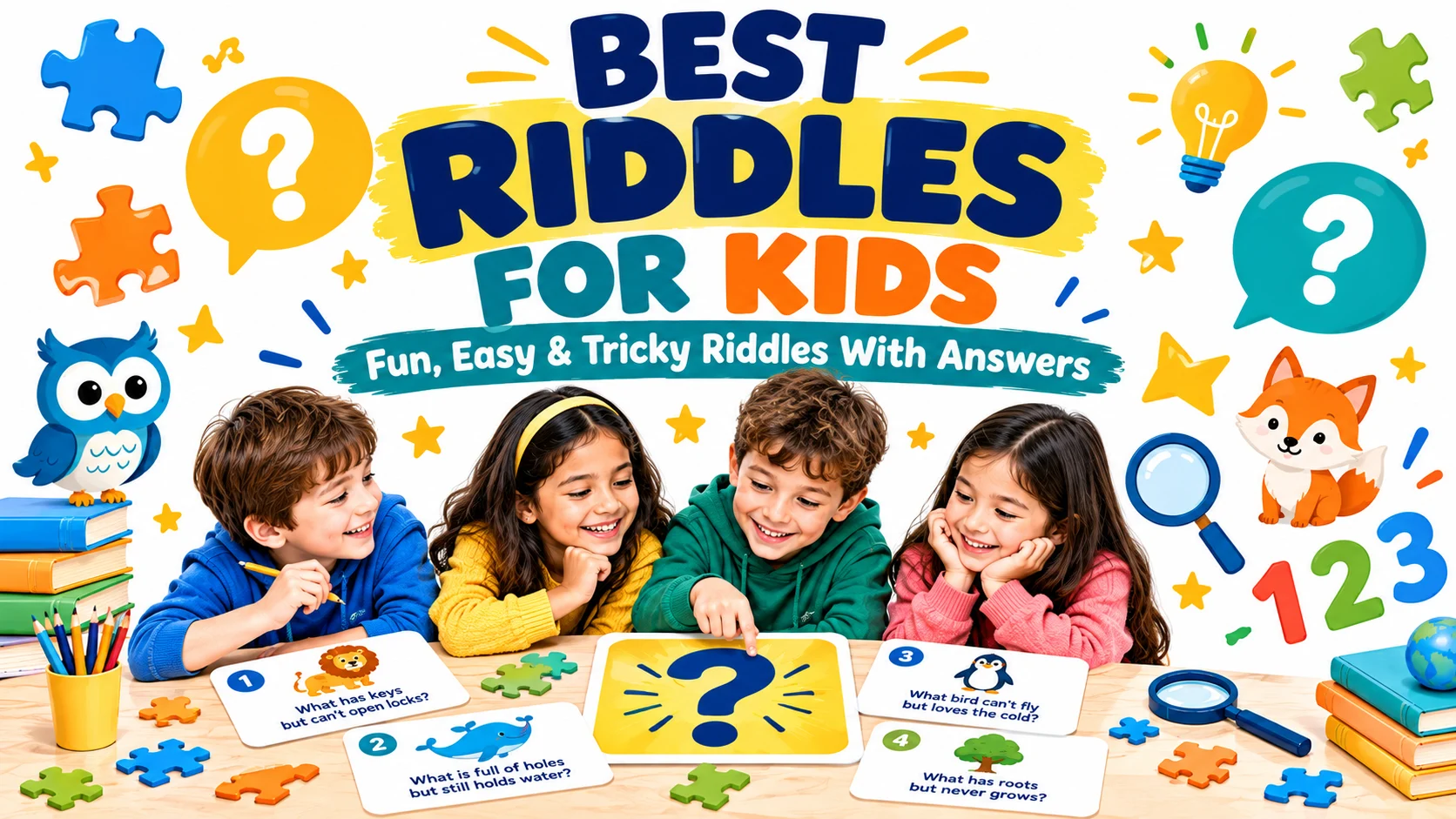
Riddles for kids with answers are short, fun puzzles that challenge children to think, observe clues, recognize patterns, and use creative reasoning. They can be used at home, in classrooms, at parties, or during family game time. This collection includes easy, funny, clever, tricky, animal, math, and logic riddles.
Ready to put those little brains to work?
These riddles for kids with answers turn ordinary questions into fun thinking challenges. Some are incredibly easy, while others use wordplay, patterns, or a little misdirection to make kids stop and think.
Riddles are also easy to use. Parents can ask them during family time, teachers can add them to classroom activities, and kids can challenge their friends to see who solves them first.
Try reading each riddle aloud before revealing the answer. And remember: the best part isn’t always getting it right it’s figuring out how the clues lead to the solution.
Easy Riddles for Kids
These beginner-friendly riddles are perfect for younger children or anyone warming up their brain.
Riddle 1:
I have four legs, but I never run. You can eat dinner on me when the day is done. What am I?
Answer: A table.
Riddle 2:
I am yellow, curved, and easy to peel. Monkeys may love me as a tasty meal. What am I?
Answer: A banana.
Riddle 3:
I have hands but cannot clap. What am I?
Answer: A clock.
Riddle 4:
I get wetter as I help you get dry. What am I?
Answer: A towel.
Riddle 5:
I have pages but I cannot walk. You can open me to discover a world. What am I?
Answer: A book.
Riddle 6:
I am round, I bounce, and children love to kick me. What am I?
Answer: A ball.
Riddle 7:
I have many teeth but never eat. What am I?
Answer: A comb.
Riddle 8:
I shine during the day and disappear when night arrives. What am I?
Answer: The sun.
Riddle 9:
I can be opened, but I am not a door. I can contain stories, but I am not a book. What am I?
Answer: A website.
Riddle 10:
I have a face and two hands, but no eyes or fingers. What am I?
Answer: A clock.
Funny Riddles for Kids
A good riddle becomes even better when the answer makes everyone laugh.
Riddle 11:
Why did the pencil bring an umbrella to school?
Answer: Because it heard there might be a little drizzle of ideas!
Riddle 12:
What kind of tree can you carry in your hand?
Answer: A palm tree.
Riddle 13:
What has ears but cannot hear?
Answer: A bowl of corn.
Riddle 14:
Why did the banana go to the doctor?
Answer: Because it wasn’t peeling well!
Riddle 15:
What do you call a sleeping bull?
Answer: A bulldozer.
Riddle 16:
Why did the computer go to the doctor?
Answer: It had a virus.
Riddle 17:
What animal is always at a baseball game?
Answer: A bat.
Riddle 18:
What do you call cheese that isn’t yours?
Answer: Nacho cheese.
Riddle 19:
Why was the math book sad?
Answer: It had too many problems.
Riddle 20:
What do you call a bear with no teeth?
Answer: A gummy bear.
Animal Riddles for Kids
Animals make excellent riddle subjects because children can use familiar characteristics to find the answer.
Riddle 21:
I have whiskers, four paws, and I might purr when I’m happy. What am I?
Answer: A cat.
Riddle 22:
I am huge, have a trunk, and use my ears like fans. What am I?
Answer: An elephant.
Riddle 23:
I have feathers, wings, and a beak. I can sing without using words. What am I?
Answer: A bird.
Riddle 24:
I hop instead of walk and carry my baby in a pouch. What am I?
Answer: A kangaroo.
Riddle 25:
I have eight arms and live underwater. What am I?
Answer: An octopus.
Riddle 26:
I am slow, carry my house on my back, and leave a shiny trail. What am I?
Answer: A snail.
Riddle 27:
I say “moo” and give people milk. What am I?
Answer: A cow.
Riddle 28:
I have stripes and look a little like a horse. What am I?
Answer: A zebra.
Riddle 29:
I am known for being tall, have a very long neck, and eat leaves from high branches. What am I?
Answer: A giraffe.
Riddle 30:
I can change colors to blend into my surroundings. What am I?
Answer: A chameleon.
Tricky Riddles for Kids
These riddles use careful wording. Read them twice before guessing!
Riddle 31:
What has one eye but cannot see?
Answer: A needle.
Riddle 32:
What can travel around the world while staying in one corner?
Answer: A stamp.
Riddle 33:
The more you take away from me, the bigger I become. What am I?
Answer: A hole.
Riddle 34:
What has a neck but no head?
Answer: A bottle.
Riddle 35:
What has a thumb and four fingers but isn’t alive?
Answer: A glove.
Riddle 36:
What can you catch but never throw?
Answer: A cold.
Riddle 37:
What has words but never speaks?
Answer: A dictionary.
Riddle 38:
What has a bed but never sleeps?
Answer: A river.
Riddle 39:
What gets smaller every time it takes a bath?
Answer: A bar of soap.
Riddle 40:
What begins with T, ends with T, and has T inside it?
Answer: A teapot.
Clever Word Riddles for Kids
Wordplay encourages children to look beyond the obvious meaning of a question.
Riddle 41:
What word becomes shorter when you add two letters to it?
Answer: Short. Add “er” and it becomes “shorter.”
Riddle 42:
What starts with P, ends with E, and contains thousands of letters?
Answer: A post office.
Riddle 43:
What word sounds the same when you remove its first letter and still has the same pronunciation?
Answer: Knot and not.
Riddle 44:
What five-letter word becomes shorter when you add two letters?
Answer: Short. The wordplay refers to the meaning rather than simply the letter count.
Riddle 45:
What has a beginning, an end, and a middle, but no start or finish?
Answer: A story.
Riddle 46:
What word can you find in the middle of “summer” and the beginning of “sun”?
Answer: “Sum.”
Riddle 47:
What is full of letters but never goes to school?
Answer: A mailbox.
Riddle 48:
What has a head and a tail but no body?
Answer: A coin.
Riddle 49:
What word contains a lot of water but never gets wet?
Answer: “Watermelon” as a word.
Riddle 50:
What can be cracked, made, told, and played?
Answer: A joke.
Math Riddles for Kids
Math riddles make numbers feel more like a game than a worksheet.
Riddle 51:
I am an odd number. Take away one letter and I become even. What number am I?
Answer: Seven. Remove the “s” and you get “even.”
Riddle 52:
You have three apples and take away two. How many apples do you have?
Answer: Two, the two you took.
Riddle 53:
What number comes next: 2, 4, 6, 8, ___?
Answer: 10.
Riddle 54:
If you have five cookies and give two away, how many are left?
Answer: Three.
Riddle 55:
What number has the same number of letters as its value?
Answer: Four.
Riddle 56:
I am greater than 5 but less than 9. I am even. What am I?
Answer: 6 or 8.
Riddle 57:
There are four birds on a fence. One flies away. How many remain?
Answer: Three.
Riddle 58:
What comes next: 5, 10, 15, 20, ___?
Answer: 25.
Riddle 59:
If one hand has five fingers, how many fingers do two hands have?
Answer: Ten.
Riddle 60:
I have three sides and three corners. What shape am I?
Answer: A triangle.
Nature Riddles for Kids
Take the guessing game outdoors with riddles about things children see every day.
Riddle 61:
I fall from clouds but never climb back up. What am I?
Answer: Rain.
Riddle 62:
I am bright, warm, and high above you during the day. What am I?
Answer: The sun.
Riddle 63:
I can be white, gray, or dark, and I float across the sky. What am I?
Answer: A cloud.
Riddle 64:
I grow from the ground and can become very tall. Birds may build homes in me. What am I?
Answer: A tree.
Riddle 65:
I appear after rain and have many colors. What am I?
Answer: A rainbow.
Riddle 66:
You cannot see me, but you can feel me moving the leaves. What am I?
Answer: Wind.
Riddle 67:
I am cold, white, and fall from the sky in winter. What am I?
Answer: Snow.
Riddle 68:
I sparkle at night but disappear when morning comes. What am I?
Answer: A star.
Riddle 69:
I flow from mountains toward the sea. What am I?
Answer: A river.
Riddle 70:
I am the hard outer part of Earth that you walk on. What am I?
Answer: Ground.
School Riddles for Kids
These are great for classroom warm-ups, brain breaks, and school games.
Riddle 71:
I have a point and leave marks, but I am not a finger. What am I?
Answer: A pencil.
Riddle 72:
I am full of lines but cannot write. Students read me in class. What am I?
Answer: A notebook.
Riddle 73:
I have numbers and hands but never do homework. What am I?
Answer: A clock.
Riddle 74:
Teachers use me to write where everyone can see. What am I?
Answer: A board.
Riddle 75:
I erase mistakes but don’t know what a mistake is. What am I?
Answer: An eraser.
Riddle 76:
I can hold many books but never read one. What am I?
Answer: A bookshelf.
Riddle 77:
I have a sharp point but cannot hurt anyone when used correctly. What am I?
Answer: A pencil.
Riddle 78:
I carry students but don’t carry books by myself. What am I?
Answer: A school bus.
Riddle 79:
I ring to tell students when class has started or ended. What am I?
Answer: A school bell.
Riddle 80:
I am filled with questions, but I am not curious. What am I?
Answer: A test.
Harder Brain Teasers for Kids
Ready for another level? These require a little more reasoning.
Riddle 81:
A farmer has 10 sheep. All but 3 run away. How many sheep remain?
Answer: Three.
Riddle 82:
You enter a dark room with a candle, a lamp, and a fireplace. You have one match. What do you light first?
Answer: The match.
Riddle 83:
What belongs to you but other people use it more than you do?
Answer: Your name.
Riddle 84:
I am always in front of you but can never be seen. What am I?
Answer: The future.
Riddle 85:
A room has four corners. A cat sits in each corner. Each cat sees three cats. How many cats are there?
Answer: Four.
Riddle 86:
What can fill a room but takes up no space?
Answer: Light.
Riddle 87:
If you throw a red stone into a blue lake, what does it become?
Answer: Wet.
Riddle 88:
What goes up but never comes down?
Answer: Your age.
Riddle 89:
What has cities, roads, and rivers but no people, cars, or water?
Answer: A map.
Riddle 90:
What has a lot of keys but cannot open a single door?
Answer: A piano.
Short Riddles for Quick Challenges
Need a fast brain teaser? Try these.
Riddle 91:
I fly without wings. What am I?
Answer: Time.
Riddle 92:
I have a ring but no finger. What am I?
Answer: A telephone.
Riddle 93:
I have roots but no feet. What am I?
Answer: A plant.
Riddle 94:
I am full of holes but can hold water. What am I?
Answer: A sponge.
Riddle 95:
I have a tail and fly at night. What am I?
Answer: A bat.
Riddle 96:
I have a shell but am not a nut. What am I?
Answer: A turtle.
Riddle 97:
I am black when clean and white when dirty. What am I?
Answer: A chalkboard.
Riddle 98:
I have four wheels and take you places. What am I?
Answer: A car.
Riddle 99:
I make a sound when you press me, but I am not a musical instrument. What am I?
Answer: A doorbell.
Riddle 100:
I am something you can hold without using your hands. What am I?
Answer: Your breath.
Family Riddle Challenge
Turn these riddles into a mini family competition. One person reads the riddle while everyone else gets a few seconds to guess.
Riddle 101:
What has a mouth but never eats?
Answer: A river.
Riddle 102:
What has legs but cannot walk?
Answer: A chair.
Riddle 103:
What has an eye but cannot see and is used for sewing?
Answer: A needle.
Riddle 104:
What can run but never walks?
Answer: Water.
Riddle 105:
What has many stories but cannot talk?
Answer: A library.
How to Make Riddles More Fun for Kids
Riddles don’t have to be a one-question-and-done activity. Try turning them into games.
Give everyone a guessing limit. Allow each player two or three guesses before revealing the answer.
Use teams. Divide a classroom or family into small groups and award a point for each correct answer.
Hide the answers. Read several riddles first, then reveal the solutions afterward.
Let kids write their own riddles. Creating a riddle requires children to think about clues, descriptions, and possible interpretations.
Use different difficulty levels. Start with easy riddles and gradually introduce trickier ones.
Make it a timed challenge. Give older children 30 seconds to solve each brain teaser.
Why Are Riddles Good for Kids?
Riddles can turn thinking practice into an enjoyable activity. Depending on the type of riddle, children may practice vocabulary, observation, logical reasoning, pattern recognition, mathematical thinking, and creative problem-solving.
They’re also flexible. A parent can ask one during a car ride, a teacher can use one as a classroom warm-up, or children can challenge friends during a party.
The key is to keep the activity playful rather than treating every riddle like a test.
How to Use These Riddles at Home or School
At home: Pick five riddles during family game night and let everyone guess.
In the classroom: Use one as a morning warm-up, brain break, or transition activity.
At parties: Put riddles on cards and let children take turns drawing one.
On road trips: Ask short riddles that don’t require any materials.
For writing practice: Ask children to create their own riddle and exchange it with a friend.
For social sharing: Choose short riddles and challenge friends to answer before revealing the solution.
People Also Ask
What are riddles for kids with answers?
Riddles for kids with answers are short puzzles designed around clues that lead to a specific solution. They can cover animals, objects, numbers, nature, words, and everyday situations. The answer is provided so children can check their reasoning after attempting each challenge.
How do you solve riddles for kids?
Start by reading every clue carefully and identifying what the clues have in common. Think about different meanings of important words, then eliminate answers that do not fit. For tricky riddles, reread the question because the wording itself may contain the key.
Are riddles good for kids?
Yes. Age-appropriate riddles can make reasoning, vocabulary, observation, and problem-solving practice more entertaining. They also provide an easy activity for families, classrooms, parties, and playtime without requiring special equipment.
What makes a good riddle for children?
A good children’s riddle has understandable language, useful clues, and a clear intended answer. It should be challenging enough to encourage thinking without relying on obscure knowledge or confusing wording.
Where can I use riddles for kids?
You can use children’s riddles at home, in classrooms, during road trips, at birthday parties, family game nights, camps, and children’s activities. Short riddles also work well as conversation starters or quick brain breaks.
What age are these kids’ riddles suitable for?
These riddles cover several difficulty levels, so the appropriate age depends on the child’s reading ability and experience with puzzles. Younger children can start with the easy and animal riddles, while older children can try the tricky, math, and logic challenges.
How many riddles should kids solve at once?
There is no fixed number. Five to ten riddles can make a quick activity, while a longer game can use 20 or more. Let children stop when the activity stops being enjoyable rather than treating the number as a requirement.
Can these riddles be used in classrooms?
Yes. Teachers can use suitable riddles as warm-ups, brain breaks, vocabulary activities, discussion starters, or team challenges. Math and word riddles can also complement age-appropriate lessons.
Are these riddles suitable for family game night?
Yes. Family-friendly riddles are easy to turn into a group guessing game. Take turns reading questions, give everyone time to think, and award points for correct answers if your family enjoys competition.
How can kids create their own riddles?
Start with a familiar object or idea, list several features that describe it, and turn those features into clues. Avoid giving away the answer too quickly, then test the riddle on someone else to make sure the clues lead to the intended solution.
Conclusion
Riddles for kids with answers are a simple way to add curiosity and playful thinking to everyday activities. From easy animal questions to tricky logic challenges, there’s something here for different ages and skill levels.
Use them at home, in the classroom, during parties, or whenever you need a quick brain break. Pick a few, hide the answers, and let the guessing begin. And once kids master these challenges, encourage them to write riddles of their own and challenge everyone else.
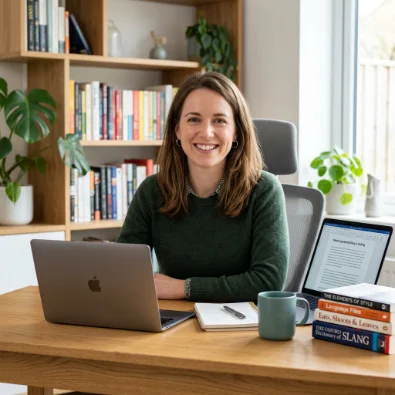
Sara Mitchell is a content writer at Punzite.com who specializes in internet slang, word meanings and language trends. She creates clear, engaging and well-researched content that helps readers understand modern digital communication with ease.