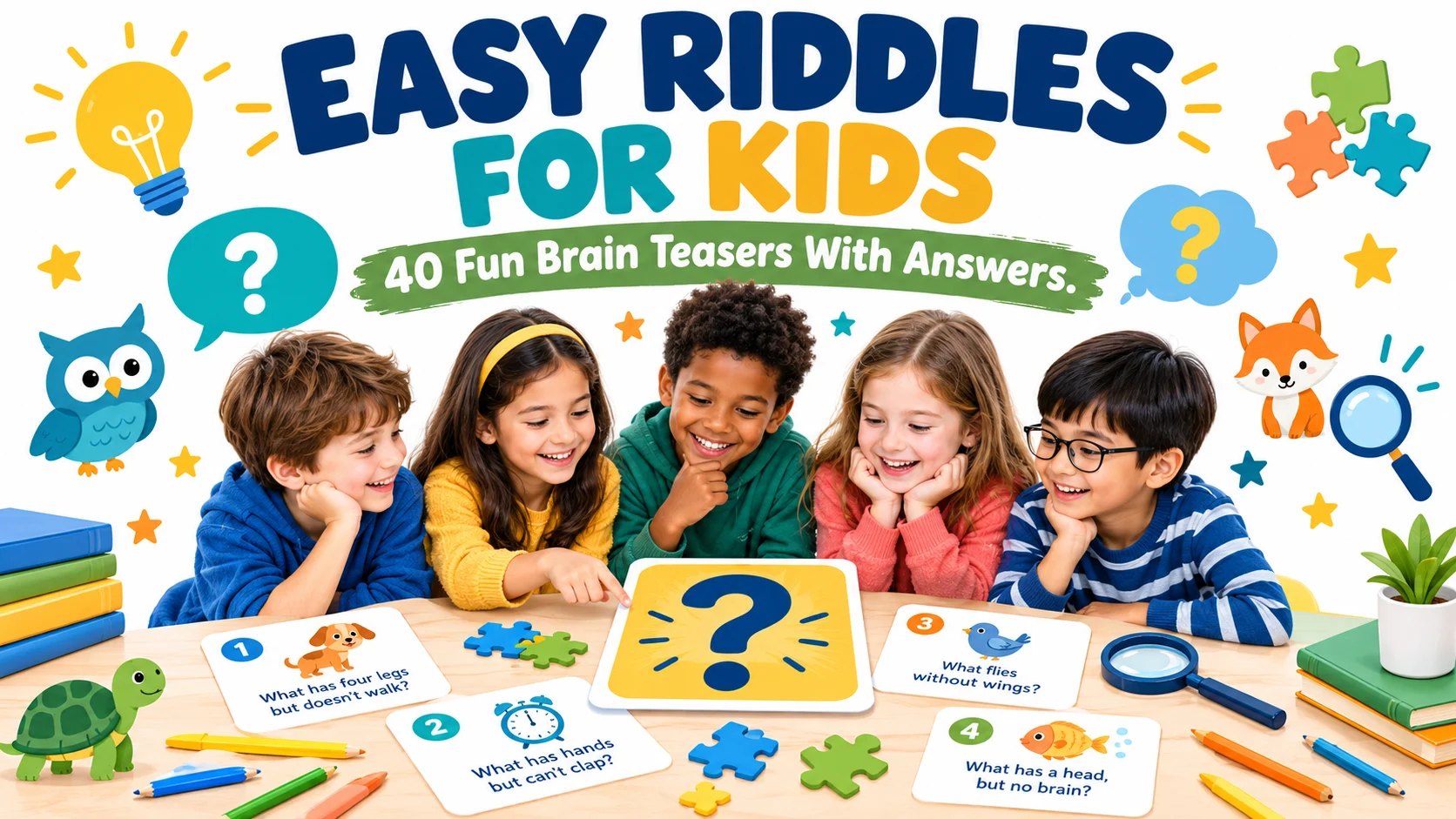
Easy riddles for kids are short, playful questions with simple clues that encourage children to think, guess, and solve problems. They can introduce young learners to wordplay, observation, logic, and creative thinking while keeping them entertained at home, in classrooms, or during family and party games.
Ready for a little brain workout without making things too difficult? These easy riddles for kids are designed to make children think, smile, and shout out their guesses.
Each riddle has a clear answer, simple wording, and a fun challenge. Some are about animals and nature, while others use objects, numbers, school situations, and clever wordplay.
Parents can use them for family game nights, teachers can add them to classroom activities, and kids can challenge their friends. Read each question carefully, think about the clues, and try to solve it before checking the answer!
Easy Everyday Riddles
These simple object riddles are perfect for younger children and beginners. Look around the room for inspiration!
Riddle 1:
I have a face and two hands, but I cannot clap. What am I?
Answer: A clock.
Riddle 2:
I have many keys, but I cannot open a single door. What am I?
Answer: A piano.
Riddle 3:
I get smaller every time I take a bath. What am I?
Answer: A bar of soap.
Riddle 4:
I have one eye, but I cannot see. What am I?
Answer: A needle.
Riddle 5:
I have teeth, but I never bite. What am I?
Answer: A comb.
Easy Animal Riddles
Animal riddles are an easy way to get kids excited about guessing. Can you identify these creatures from their clues?
Riddle 6:
I say “moo” and give you milk. Who am I?
Answer: A cow.
Riddle 7:
I have a long trunk and big ears. Who am I?
Answer: An elephant.
Riddle 8:
I hop on two strong legs and carry my baby in a pouch. Who am I?
Answer: A kangaroo.
Riddle 9:
I have eight arms and live in the ocean. Who am I?
Answer: An octopus.
Riddle 10:
I am small, furry, and love to chase cheese in stories. What am I?
Answer: A mouse.
Easy Nature Riddles
These nature-themed riddles encourage kids to notice things they see outdoors.
Riddle 11:
I shine in the daytime and help keep Earth warm. What am I?
Answer: The sun.
Riddle 12:
I fall from clouds and make puddles on the ground. What am I?
Answer: Rain.
Riddle 13:
I grow from the ground, have a trunk, and wear green leaves. What am I?
Answer: A tree.
Riddle 14:
I appear in the sky after rain and can have many colors. What am I?
Answer: A rainbow.
Riddle 15:
I am white, cold, and fall from clouds in winter. What am I?
Answer: Snow.
Easy School Riddles
Turn classroom time into a quick guessing game with these school-themed brain teasers.
Riddle 16:
I have pages but I am not a tree. You can read me at school. What am I?
Answer: A book.
Riddle 17:
I have a point and help you write, but I am not a finger. What am I?
Answer: A pencil.
Riddle 18:
I can erase your mistakes but I cannot erase a memory. What am I?
Answer: An eraser.
Riddle 19:
I have four legs but I never walk. Students often sit at me. What am I?
Answer: A desk.
Riddle 20:
I hang on a wall and show what the teacher wants everyone to see. What am I?
Answer: A board.
Easy Food Riddles
Hungry for some guessing? These food riddles are short enough for younger children and fun enough for the whole family.
Riddle 21:
I am yellow, curved, and monkeys are famous for loving me. What am I?
Answer: A banana.
Riddle 22:
I am round, red, and often sliced for a salad. What am I?
Answer: A tomato.
Riddle 23:
I am cold, sweet, and can come in chocolate or vanilla. What am I?
Answer: Ice cream.
Riddle 24:
I am made from kernels and pop when heated. What am I?
Answer: Popcorn.
Riddle 25:
I am orange, crunchy, and rabbits are often pictured eating me. What am I?
Answer: A carrot.
Easy Math Riddles
Math riddles can make basic number practice feel more like a game.
Riddle 26:
I am a number greater than 3 and less than 5. What am I?
Answer: 4.
Riddle 27:
You have 2 apples and receive 3 more. How many apples do you have?
Answer: 5.
Riddle 28:
I am an even number between 6 and 10. What am I?
Answer: 8.
Riddle 29:
If you have 10 balloons and 2 fly away, how many remain?
Answer: 8.
Riddle 30:
What number comes next: 2, 4, 6, 8, ___?
Answer: 10.
Funny and Tricky Riddles
Not every riddle needs a complicated solution. Sometimes the fun comes from seeing an ordinary thing in an unexpected way.
Riddle 31:
What has a head and a tail but no body?
Answer: A coin.
Riddle 32:
What can you catch but never throw?
Answer: A cold.
Riddle 33:
What has a neck but no head?
Answer: A bottle.
Riddle 34:
What gets wet while making other things dry?
Answer: A towel.
Riddle 35:
What has words but never speaks?
Answer: A book.
Quick Family Challenge Riddles
Try these with siblings, parents, classmates, or friends. Read the question aloud and give everyone a few seconds to think before revealing the answer.
Riddle 36:
I have a thumb and four fingers, but I am not alive. What am I?
Answer: A glove.
Riddle 37:
I travel around the world while staying in one corner. What am I?
Answer: A stamp.
Riddle 38:
I have a bed but never sleep, and I have a mouth but never eat. What am I?
Answer: A river.
Riddle 39:
I can be cracked, made, told, and played. What am I?
Answer: A joke.
Riddle 40:
I am full of holes, but I can still hold water. What am I?
Answer: A sponge.
How to Use Riddles With Kids
Riddles work especially well when they’re treated as games rather than tests. Let children guess freely, and don’t reveal the answer too quickly.
Here are a few easy ways to use them:
- Morning activity: Start the day with one quick riddle.
- Classroom warm-up: Use a riddle before a lesson.
- Family game night: Take turns reading riddles aloud.
- Road trips: Keep a few short riddles ready for travel.
- Birthday parties: Turn riddles into a guessing competition.
- Rainy-day activities: Use them as screen-free entertainment.
- Learning practice: Choose math, word, or observation riddles.
- Friend challenges: Have children create their own riddles for others.
For younger children, read the riddle slowly and emphasize the important clues. For older kids, hide the answer and let them explain why they chose their guess.
Riddle Challenge: Can You Make Your Own?
Once kids have solved several riddles, challenge them to write one of their own.
A simple formula is:
Choose an object → Think of three clues → Write a question → Test it on a friend.
For example, a child might choose a pencil, describe its shape and purpose, and then ask others to identify it.
Creating riddles can be just as valuable as solving them because children have to think about clues, descriptions, language, and how another person might interpret their words.
People Also Ask
What are easy riddles for kids?
Easy riddles for kids are simple questions that use clues to describe an object, animal, number, or idea. They are designed to be understandable for children while encouraging them to think carefully, make connections, and find a logical answer.
How do you solve an easy riddle?
Start by identifying the important clues instead of guessing immediately. Think about objects, animals, places, or ideas that match several clues. If a guess only fits one clue, keep thinking. The best answer should make sense with the complete riddle.
Are riddles good for kids?
Yes, age-appropriate riddles can make thinking practice entertaining. They encourage children to pay attention to clues, use language, make connections, and explain their reasoning. Riddles can also provide a simple screen-free activity for classrooms, families, parties, and playtime.
What makes a good kids’ riddle?
A good kids’ riddle has clear language, clues that point toward one intended answer, and an appropriate level of difficulty. It should be challenging enough to encourage thinking without depending on confusing wording or information children are unlikely to know.
Where can I use easy riddles for kids?
You can use easy riddles at home, in classrooms, during family game nights, on road trips, at birthday parties, or as quick activities between lessons. They also work well as conversation starters or challenges that children can share with friends.
What age are easy riddles suitable for?
Easy riddles can work for a wide range of children, especially younger learners and beginners. The right difficulty depends on reading ability, vocabulary, and experience. Very young children may benefit from spoken riddles with familiar objects, animals, and everyday situations.
Can riddles help children learn?
Riddles can support learning by encouraging children to examine clues, understand language, make connections, and think creatively. Teachers can also select riddles connected to vocabulary, numbers, science, animals, or classroom topics to make practice more engaging.
How can parents make riddles more fun?
Parents can turn riddles into a friendly guessing game. Give children time to think, celebrate creative guesses, and ask them to explain their reasoning. You can also take turns creating riddles so children become both solvers and riddle writers.
Are these riddles suitable for classroom activities?
Yes. Short, family-friendly riddles can work as warm-ups, brain breaks, transition activities, or informal challenges. Teachers can display one riddle on a board, read it aloud, and let students discuss possible answers before revealing the intended solution.
How can I make riddles harder for older kids?
To increase difficulty, use less obvious clues, introduce wordplay, combine several concepts, or create riddles that require multiple steps. You can also remove visual hints and ask older children to explain the reasoning behind their answers.
Conclusion
These easy riddles for kids turn ordinary objects, animals, numbers, food, and everyday experiences into playful brain challenges. They’re simple enough for beginners but still give children a chance to practice observation, reasoning, creativity, and problem-solving.
Pick a few riddles for a classroom warm-up, family game, party, road trip, or quick challenge with friends. And once you’ve solved them all, try creating a few of your own. The best riddle is the one that makes someone pause, think, and smile when they finally discover the answer.