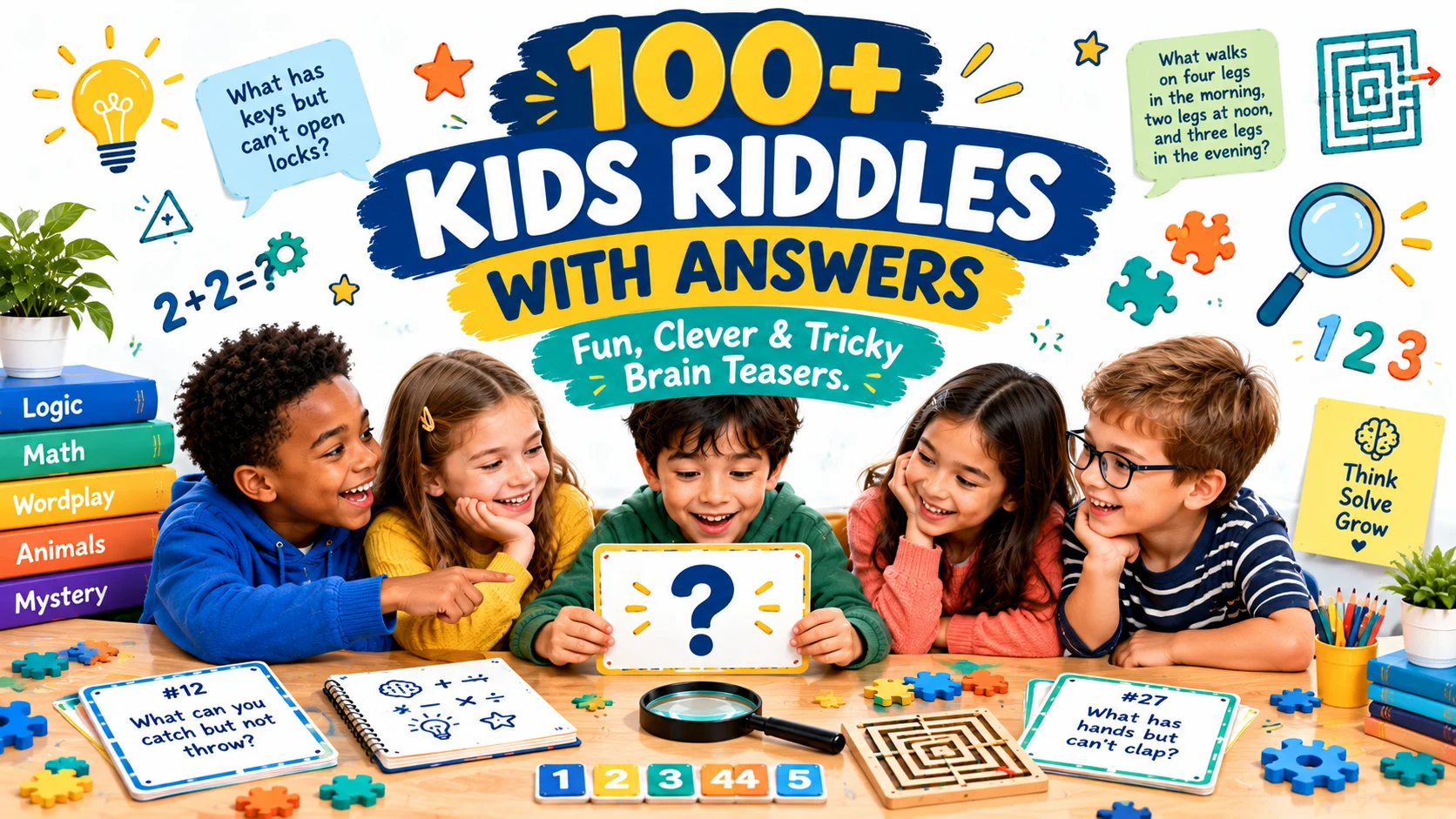
Kids riddles are short puzzles that challenge children to think creatively, recognize clues, and discover an answer. They can be funny, easy, tricky, or educational. These riddles are great for classrooms, family game nights, road trips, parties, and anytime kids want a fun mental challenge.
Looking for kids riddles that are actually fun to solve? You’re in the right place. A good riddle makes children stop, think, guess, laugh, and sometimes say, “Ohhh, I get it!”
Riddles can also encourage observation, vocabulary, logic, and creative thinking without feeling like homework. We’ve gathered original riddles across different difficulty levels and topics, including animals, objects, nature, wordplay, math, and everyday situations.
Ready to test your brain? Try answering each one before checking the solution!
Easy Kids Riddles
Start with these simple riddles. They’re designed to build confidence while still giving young minds something to think about.
Riddle 1
I have hands but cannot clap. What am I?
Answer: A clock.
Riddle 2
I have many teeth but cannot bite. What am I?
Answer: A comb.
Riddle 3
I get wetter the more I dry. What am I?
Answer: A towel.
Riddle 4
I have a face and two hands, but I cannot smile or wave. What am I?
Answer: A clock.
Riddle 5
I am full of holes, but I can still hold water. What am I?
Answer: A sponge.
Riddle 6
I have four legs but never go for a walk. What am I?
Answer: A table.
Riddle 7
I can fly without wings and cry without eyes. What am I?
Answer: A cloud.
Funny Kids Riddles
Sometimes the best riddles are the ones that make kids laugh after they hear the answer.
Riddle 8
What has ears but cannot hear a joke?
Answer: A cornfield.
Riddle 9
What kind of tree can you carry in your hand?
Answer: A palm tree.
Riddle 10
What has a head and a tail but no body?
Answer: A coin.
Riddle 11
Why did the pencil go to school?
Answer: Because it wanted to be a little sharper.
Riddle 12
What room has no doors, windows, or furniture?
Answer: A mushroom.
Riddle 13
What has one eye but cannot see?
Answer: A needle.
Riddle 14
What can you catch but never throw?
Answer: A cold.
Animal Riddles for Kids
Animals make excellent riddle subjects because children can use familiar characteristics to work out the answer.
Riddle 15
I have a long neck and eat leaves high in trees. Who am I?
Answer: A giraffe.
Riddle 16
I say “meow,” chase little toys, and like to nap. Who am I?
Answer: A cat.
Riddle 17
I have feathers, two wings, and I can sing from a tree. Who am I?
Answer: A bird.
Riddle 18
I carry my home on my back and move very slowly. Who am I?
Answer: A snail.
Riddle 19
I live in water, have fins, and breathe through gills. Who am I?
Answer: A fish.
Riddle 20
I am black and white, love bamboo, and look like a giant teddy bear. Who am I?
Answer: A panda.
Riddle 21
I have eight arms and live in the ocean. Who am I?
Answer: An octopus.
Tricky Kids Riddles
These riddles use misdirection, so read every word carefully before answering.
Riddle 22
A farmer has three apples and takes away two. How many apples does the farmer have?
Answer: Two. He took two apples.
Riddle 23
What gets bigger when you take something away from it?
Answer: A hole.
Riddle 24
If you have one match and enter a dark room containing a candle, a lamp, and a fireplace, what do you light first?
Answer: The match.
Riddle 25
What can travel around the world while staying in one corner?
Answer: A stamp.
Riddle 26
What has a neck but no head?
Answer: A bottle.
Riddle 27
What comes down but never goes up?
Answer: Rain.
Riddle 28
What belongs to you but other people use it more than you do?
Answer: Your name.
Clever Brain Teasers for Kids
These challenges encourage children to look beyond the most obvious answer.
Riddle 29
I am always in front of you, but you can never see me. What am I?
Answer: The future.
Riddle 30
I have words but never speak. I have pages but never walk. What am I?
Answer: A book.
Riddle 31
The more you take, the more you leave behind. What are they?
Answer: Footsteps.
Riddle 32
I can be cracked, made, told, and played. What am I?
Answer: A joke.
Riddle 33
I have keys but cannot open a door. What am I?
Answer: A piano.
Riddle 34
I have a thumb and four fingers, but I am not alive. What am I?
Answer: A glove.
Riddle 35
I disappear as soon as you say my name. What am I?
Answer: Silence.
Nature Riddles for Kids
Nature riddles turn familiar things like rain, sunlight, trees, and shadows into little mysteries.
Riddle 36
I shine during the day and give Earth light and warmth. What am I?
Answer: The Sun.
Riddle 37
I follow you on a sunny day but disappear in the dark. What am I?
Answer: Your shadow.
Riddle 38
I fall from the sky, help flowers grow, and make puddles. What am I?
Answer: Rain.
Riddle 39
I am tall, have a trunk, branches, and leaves. What am I?
Answer: A tree.
Riddle 40
I sparkle at night and look tiny because I am very far away. What am I?
Answer: A star.
Riddle 41
You cannot see me, but you can feel me when I blow past you. What am I?
Answer: Wind.
Riddle 42
I am frozen water that can fall from clouds in tiny white pieces. What am I?
Answer: Snow.
Math Riddles for Kids
Math riddles make numbers feel more like games than exercises.
Riddle 43
I am an even number. Take one letter away from my name, and I become a word meaning nothing. What number am I?
Answer: One. Remove the “o” and you get “ne” this is a wordplay riddle rather than a standard mathematical clue.
Riddle 44
You have five candies and give two away. How many candies remain?
Answer: Three.
Riddle 45
What number comes next: 2, 4, 6, 8, __?
Answer: 10.
Riddle 46
I am greater than 5 but less than 7. What number am I?
Answer: 6.
Riddle 47
If one triangle has three sides, how many sides do two separate triangles have altogether?
Answer: Six.
Riddle 48
You have 10 balloons and 3 fly away. How many are left?
Answer: Seven.
School and Classroom Riddles
Teachers can use these riddles as warm-up activities, brain breaks, discussion starters, or quick challenges.
Riddle 49
I have a sharp point but I am not a needle. I leave gray marks behind. What am I?
Answer: A pencil.
Riddle 50
I can erase mistakes but I am not a superhero. What am I?
Answer: An eraser.
Riddle 51
I have pages, but I am not a storybook. You use me to write your thoughts. What am I?
Answer: A notebook.
Riddle 52
I stand at the front of the classroom and may be covered with writing. What am I?
Answer: A board.
Riddle 53
I have many colors and help you draw pictures. What am I?
Answer: Colored pencils.
Riddle 54
I carry your books but never read them. What am I?
Answer: A backpack.
Riddle 55
I help you measure a line but never walk along it. What am I?
Answer: A ruler.
Family and Party Riddles
Riddles are easy to turn into a group game. Take turns reading one aloud and give everyone a few seconds to guess.
Riddle 56
What has a ring but no finger?
Answer: A telephone.
Riddle 57
What has a bottom at the top?
Answer: Your legs when you do a headstand.
Riddle 58
What has a bed but never sleeps?
Answer: A river.
Riddle 59
What can run but never walk?
Answer: Water.
Riddle 60
What has a mouth but never eats?
Answer: A river.
Riddle 61
What has a lock but no key?
Answer: A canal.
Riddle 62
What can be opened but has no door?
Answer: A book.
How to Use Kids Riddles
Kids riddles can be more than a quick source of entertainment. They can become simple activities for home, school, parties, and family gatherings.
At Home
Parents can use a few riddles during breakfast, family game nights, car trips, or before bedtime. Let children explain how they reached an answer rather than simply telling them whether they are right.
In the Classroom
Teachers can use riddles as short brain breaks or warm-up activities. Easy riddles work well for younger students, while logic and wordplay riddles can provide an extra challenge for older children.
At Parties
Write riddles on cards and let children take turns drawing one. Give everyone a few seconds to think before revealing the answer.
During Road Trips
Short riddles are perfect for keeping children entertained without needing screens, toys, or complicated equipment.
For Learning
Riddles can encourage:
- Vocabulary development
- Creative thinking
- Observation
- Logical reasoning
- Problem-solving
- Listening skills
- Verbal communication
The key is to keep the activity enjoyable. A riddle should feel like a puzzle, not a test.
Tips for Making Riddles More Fun
Give Kids Time to Think
Don’t reveal the answer immediately. A few extra seconds can turn an easy question into a satisfying challenge.
Ask for the Reason
After a child answers, ask, “What clue gave it away?” This encourages reasoning instead of guessing.
Mix Difficulty Levels
Use a combination of easy, medium, and tricky riddles. Too many difficult questions can become frustrating, while only easy riddles may not provide enough challenge.
Let Kids Create Their Own
After solving several riddles, ask children to invent one. Creating clues requires them to think about an object from a completely different perspective.
People Also Ask
What are kids riddles?
Kids riddles are short puzzles designed to make children think about clues and discover an answer. They can involve animals, objects, numbers, nature, words, or everyday situations and may range from very easy to surprisingly tricky.
How do you solve kids riddles?
Read every clue carefully, think about different meanings of the words, and consider ordinary objects or situations first. If the answer seems impossible, look for a hidden assumption or piece of wordplay in the question.
Are riddles good for kids?
Yes. Age-appropriate riddles can make thinking practice entertaining while encouraging observation, vocabulary, reasoning, creativity, and problem-solving. They work especially well as short activities because children can solve them without needing special equipment.
What makes a good kids riddle?
A good kids riddle has clear clues, an understandable answer, and enough challenge to make the solver think. It should avoid confusing wording and multiple equally reasonable answers while remaining fun and appropriate for its intended age group.
Where can kids use riddles?
Kids can use riddles at home, in classrooms, during parties, on road trips, at family gatherings, or as quick brain breaks. Teachers and parents can also use them to encourage discussion and creative thinking.
What age are kids riddles suitable for?
Kids riddles can be adapted for different ages. Very young children generally benefit from simple object and animal riddles, while older children can handle more complex wordplay, logic, math, and lateral-thinking challenges.
Are easy riddles better for younger children?
Easy riddles are often a good starting point for younger children because they build confidence and let them experience the satisfaction of solving a puzzle. As their skills develop, you can gradually introduce trickier challenges.
How can I make riddles educational?
Choose riddles connected to vocabulary, numbers, science, nature, or observation. After each answer, discuss the clues and reasoning. This turns a simple guessing game into an opportunity to practice thinking and communication.
Can riddles be used in the classroom?
Yes. Teachers can use short riddles as warm-ups, brain breaks, transition activities, or group challenges. They can also ask students to write their own riddles, which adds a creative writing and reasoning component.
How can I create a good riddle for children?
Start with a familiar answer, choose two or three distinctive characteristics, and turn those characteristics into clues. Keep the wording simple, test the riddle on a child or another reader, and remove clues that make the answer ambiguous.
Conclusion
The best kids riddles turn ordinary objects, animals, numbers, and everyday situations into little mysteries. Whether you’re looking for a classroom brain break, a family game, a party activity, or simply something fun to solve, riddles give children a chance to think, laugh, and get creative.
Start with the easy challenges, move toward the trickier ones, and let kids explain how they found each answer. Then challenge them to create riddles of their own. After all, solving the puzzle is fun but creating the puzzle can be even more fun.