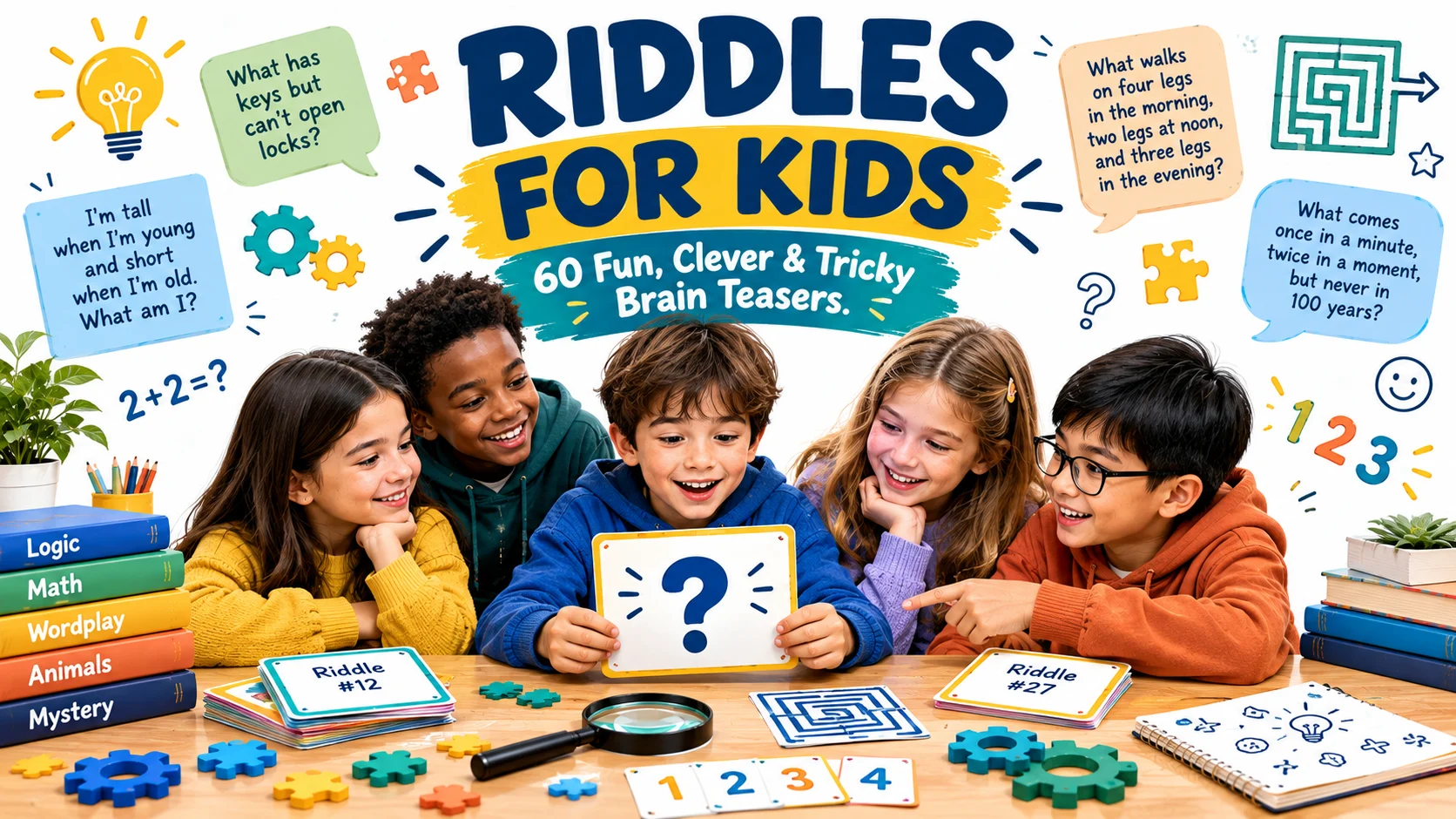
Riddles for kids are fun brain teasers that encourage children to think creatively, notice clues, understand words, and solve problems. They can be easy, funny, tricky, or challenging and are perfect for classrooms, family game nights, parties, road trips, and everyday play.
Looking for a fun way to make kids think, laugh, and say, “Wait what?”
These riddles for kids turn simple questions into mini brain challenges. Some have obvious answers, while others use wordplay, clever clues, or a little misdirection to make young minds stop and think.
This collection includes 60 original riddles for kids with answers, covering animals, food, nature, school, everyday objects, numbers, logic, and funny situations.
Kids can solve them individually, challenge friends, or turn them into a family or classroom game.
Ready?
Read the riddle, think carefully, and try to solve it before looking at the answer!
Easy Riddles for Kids
These beginner-friendly riddles are great for younger children and anyone who is just discovering the fun of brain teasers.
1. The Morning Friend
I come out when the night goes away.
I make everything bright.
What am I?
Answer: The sun.
2. The Little Shadow
I follow you outside but never walk beside you.
What am I?
Answer: Your shadow.
3. The Big Blanket
I cover the ground in winter and melt when spring arrives.
What am I?
Answer: Snow.
4. The Night Light
I shine at night but have no batteries.
Sometimes I look round, and sometimes I look like a slice.
What am I?
Answer: The moon.
5. The Flying Friend
I have wings but I am not an airplane.
I can sing but I don’t use a microphone.
What am I?
Answer: A bird.
6. The Rainy Helper
I open above your head when raindrops begin to fall.
What am I?
Answer: An umbrella.
7. The Tiny Sparkle
I am small, bright, and can be seen in the night sky.
There are many of me.
What am I?
Answer: A star.
8. The Walking Home
I carry my house everywhere I go.
What am I?
Answer: A snail.
Funny Riddles for Kids
These playful riddles are made for giggles, silly guesses, and family joke time.
9. The Funny Pencil
Why did the pencil go to school?
Answer: Because it wanted to get sharper!
10. The Hungry Clock
Why did the clock go to the kitchen?
Answer: It wanted to get a second helping.
11. The Musical Vegetable
Which vegetable is always ready to perform?
Answer: A beet, because it has a great beat!
12. The Sleepy Book
Why did the book go to bed early?
Answer: It was tired of being read all day.
13. The Cool Teacher
Why did the teacher wear sunglasses?
Answer: Because her students were so bright!
14. The Lost Shoe
Why couldn’t the shoe find its friend?
Answer: It was looking for its sole mate.
15. The Nervous Computer
Why was the computer nervous?
Answer: It had too many bytes to worry about.
16. The Hungry Tomato
Why did the tomato turn red?
Answer: It saw the salad dressing!
Animal Riddles for Kids
From pets to wild animals, these riddles let kids use familiar animal clues to discover the answer.
17. The Striped Animal
I have black and white stripes and look a little like a horse.
Who am I?
Answer: A zebra.
18. The Long Neck
I am very tall and use my long neck to reach leaves high in trees.
Who am I?
Answer: A giraffe.
19. The Slow Traveler
I move slowly and carry a shell on my back.
Who am I?
Answer: A turtle.
20. The Ocean Giant
I live in the ocean and am one of the largest animals on Earth.
Who am I?
Answer: A whale.
21. The Eight-Legged Artist
I have eight legs and can make a web without using a needle.
Who am I?
Answer: A spider.
22. The Night Flyer
I sleep during the day and fly around at night.
I use sound to help find my way.
Who am I?
Answer: A bat.
23. The Black-and-White Swimmer
I look like I am wearing a tiny black-and-white suit and love cold oceans.
Who am I?
Answer: A penguin.
24. The Clever Mimic
I have feathers, can learn sounds, and some of my kind can copy human speech.
Who am I?
Answer: A parrot.
School Riddles for Kids
These school-themed brain teasers are useful for classrooms, lunch breaks, or a quick thinking game between lessons.
25. The School Tool
I have many pages but I am not a newspaper.
You can learn things from me.
What am I?
Answer: A book.
26. The Writing Helper
I can write on paper, but I don’t have fingers.
You can erase what I make.
What am I?
Answer: A pencil.
27. The Classroom Clock
I have numbers and hands, but I cannot clap.
What am I?
Answer: A clock.
28. The Colorful Box
I contain many colors and help you make pictures.
What am I?
Answer: A box of crayons.
29. The Quiet Reader
I can tell you stories without speaking aloud.
What am I?
Answer: A book.
30. The Helpful Eraser
I make mistakes disappear without using magic.
What am I?
Answer: An eraser.
31. The School Bell
I ring when class begins or ends, but I never go to class.
What am I?
Answer: A school bell.
32. The Backpack
I carry books, pencils, lunch, and other school supplies, but I never go to school by myself.
What am I?
Answer: A backpack.
Food Riddles for Kids
These tasty riddles use familiar foods, flavors, shapes, and kitchen clues.
33. The Yellow Fruit
I am yellow on the outside, soft inside, and monkeys are famous for loving me.
What am I?
Answer: A banana.
34. The Red Fruit
I can be red, green, or yellow.
You might find me in a lunchbox, and doctors are often associated with eating one a day.
What am I?
Answer: An apple.
35. The Popcorn Mystery
I start as tiny hard kernels but become fluffy when heated.
What am I?
Answer: Popcorn.
36. The Breakfast Star
I can be scrambled, fried, or boiled.
I come in a shell.
What am I?
Answer: An egg.
37. The Cold Treat
I can be chocolate, vanilla, strawberry, or many other flavors.
I melt when I get too warm.
What am I?
Answer: Ice cream.
38. The Orange Snack
I am round, orange, and easy to peel into little sections.
What am I?
Answer: An orange.
39. The Crunchy Snack
I am made from potatoes, come in many flavors, and make a satisfying crunch.
What am I?
Answer: A potato chip.
40. The Sweet Surprise
I can be wrapped, unwrapped, and eaten, but I disappear once you enjoy me.
What am I?
Answer: Candy.
Nature Riddles for Kids
These riddles turn everyday sights from nature into simple brain challenges.
41. The Wind
You cannot see me, but you can feel me.
I can make leaves dance.
What am I?
Answer: Wind.
42. The Cloud
I float in the sky but have no wings.
Sometimes I carry rain.
What am I?
Answer: A cloud.
43. The Rainbow
I appear after rain and paint the sky with several colors.
What am I?
Answer: A rainbow.
44. The Mountain
I can be covered with trees, rocks, or snow.
I stand much taller than the land around me.
What am I?
Answer: A mountain.
45. The River
I travel across the land but never use a car.
What am I?
Answer: A river.
46. The Tree
I have roots underground, a trunk, branches, and leaves.
What am I?
Answer: A tree.
47. The Flower
I can be colorful and fragrant, but I cannot walk away from where I grow.
What am I?
Answer: A flower.
48. The Raindrop
I fall from clouds but don’t have a parachute.
What am I?
Answer: A raindrop.
Tricky Riddles for Kids
These riddles are a little sneakier. Read the clues carefully before choosing an answer.
49. The Race
You are running a race. You pass the person in second place.
What position are you now in?
Answer: Second place.
50. The Three Apples
There are three apples on a table. You take two.
How many apples do you have?
Answer: Two. You took two apples.
51. The Dark Room
You enter a dark room carrying one match. There is a candle, a lamp, and a fireplace.
What do you light first?
Answer: The match.
52. The Wet Towel
The more I dry something, the wetter I become.
What am I?
Answer: A towel.
53. The Empty Hole
The more you take away from me, the bigger I become.
What am I?
Answer: A hole.
54. The Clock
What has hands but cannot hold your hand?
Answer: A clock.
55. The Keyboard
I have keys but no locks.
I have space but no room.
What am I?
Answer: A keyboard.
56. The Name
It belongs to you, but other people use it more than you do.
What is it?
Answer: Your name.
Clever Logic Riddles for Kids
These brain teasers encourage children to slow down and think about what the clues actually say.
57. The Five Birds
Five birds are sitting on a branch. A loud noise scares them.
How many are left?
Answer: It depends on what happens after the noise. The riddle doesn’t say all five must fly away.
58. The Birthday Puzzle
A child is five years old but has celebrated only one birthday.
How could that happen?
Answer: The child could have been born on February 29 and only have a calendar birthday every leap year.
59. The Two Fathers
Two fathers and two sons go fishing. Each person catches one fish, but they bring home only three fish.
How?
Answer: There are three people: a grandfather, his son, and his grandson.
60. The One-Eyed Object
I have one eye but cannot see.
What am I?
Answer: A needle.
How to Use Riddles for Kids
Riddles can become more than a list of questions. They can turn into quick games at home, school, parties, or family gatherings.
At Home
Take turns reading riddles during dinner or family game night. Let everyone guess before revealing the answer.
In the Classroom
Teachers can use short riddles as warm-up activities, vocabulary exercises, reading breaks, or creative-thinking challenges.
At Parties
Write riddles on cards and let children draw one at random. Give a small point for each correct answer.
During Road Trips
Riddles are an easy screen-free activity. One person reads the riddle while everyone else competes to solve it.
With Younger Kids
Start with easy animal, food, and object riddles. Once children become comfortable, introduce trickier logic and wordplay riddles.
Make It a Challenge
For older children, give each player 30 seconds to answer. Keep score and award a bonus point when someone explains why their answer works.
Why Are Riddles Good for Kids?
Riddles combine entertainment with thinking. A child has to listen carefully, understand the clues, consider possibilities, and connect ideas before choosing an answer.
Different types of riddles encourage different skills:
- Word riddles encourage language awareness.
- Logic riddles encourage reasoning.
- Math riddles encourage numerical thinking.
- Observation riddles encourage attention to detail.
- Funny riddles make learning feel playful.
- Tricky riddles encourage children to question assumptions.
The goal isn’t to get every answer right. Sometimes the most useful part is discussing how the child reached the answer.
People Also Ask
1. What are riddles for kids?
Riddles for kids are short puzzles or questions that use clues, wordplay, logic, or descriptions to lead children toward an answer. They can be easy, funny, tricky, educational, or challenging.
2. What are some good riddles for kids?
Good riddles for kids have clear clues, age-appropriate language, logical answers, and an enjoyable challenge. Animal, food, school, nature, object, wordplay, and simple logic riddles are popular choices.
3. How do you solve a riddle for kids?
Read every clue carefully, identify the important details, think about different meanings, and test possible answers against all the clues. Don’t choose an answer simply because it sounds familiar.
4. What age are kids’ riddles suitable for?
Kids’ riddles can work for many ages. Easy object and animal riddles suit younger children, while wordplay, logic, math, and tricky riddles can challenge older children.
5. Why do kids like riddles?
Kids often enjoy riddles because they combine curiosity, guessing, humor, and discovery. Solving one creates a small challenge followed by the satisfaction of finding an unexpected or clever answer.
6. Are riddles educational for kids?
Yes. Riddles can encourage children to practice listening, vocabulary, reasoning, observation, problem-solving, and creative thinking while keeping the activity playful and engaging.
7. How can parents use riddles at home?
Parents can read one riddle at a time during meals, family game nights, car trips, or bedtime. Let children explain their reasoning instead of focusing only on whether the answer is correct.
8. Can teachers use riddles in the classroom?
Yes. Teachers can use age-appropriate riddles as warm-ups, vocabulary activities, discussion starters, brain breaks, or short critical-thinking exercises.
9. How can I make riddles more challenging?
Give children less time, remove unnecessary hints, mix different riddle types, or ask them to explain the reasoning behind their answers. You can also introduce harder logic and wordplay riddles.
10. What is the best way to present riddles to children?
Present one riddle at a time, leave space for children to think, and reveal the answer afterward. For groups, turning riddles into a friendly points-based game can make them more engaging.
Conclusion
These riddles for kids are a simple way to add curiosity, laughter, and creative thinking to everyday activities. With easy, funny, animal, school, food, nature, tricky, and logic riddles, there’s something for different ages and interests.
Use them at home, in classrooms, during parties, or on road trips. Most importantly, give kids time to think before revealing the answer.
Sometimes a wrong guess is just the beginning of a better idea.
Pick a riddle, challenge a friend, and let the brain-teasing begin!
Sara Mitchell is a content writer at Punzite.com who specializes in internet slang, word meanings and language trends. She creates clear, engaging and well-researched content that helps readers understand modern digital communication with ease.