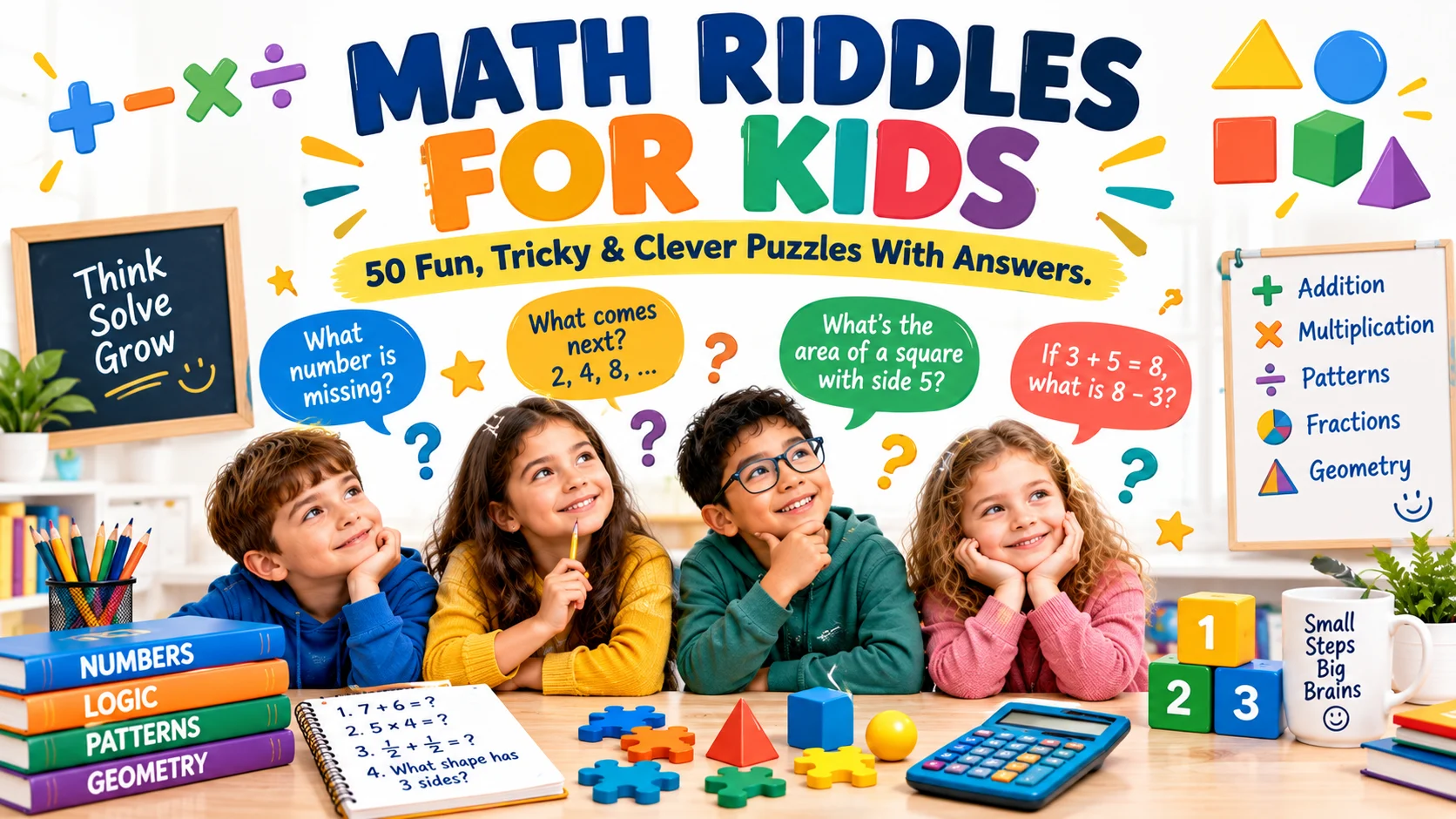
Math riddles for kids are playful puzzles that use numbers, calculations, patterns, shapes, measurements, and logic to create a challenge. They turn ordinary math practice into a guessing game, helping children practice skills while thinking creatively. These riddles range from easy counting puzzles to trickier challenges for older elementary students.
Math can feel much more exciting when a child gets to discover the answer instead of simply completing a worksheet.
Looking for math riddles for kids that are actually fun to solve? You’re in the right place.
These puzzles combine simple mathematics with curiosity, clues, patterns, and clever twists. Some can be solved in seconds, while others require children to slow down and think carefully about what the question is really asking.
Parents can use them during family time, teachers can add them to classroom warm-ups, and kids can challenge friends to see who can solve the most.
The collection below moves from easy number challenges to multiplication, fractions, geometry, patterns, and tricky logic puzzles. Try solving each one before checking the answer!
Easy Math Riddles for Kids
These beginner-friendly riddles are great for younger children who are learning basic numbers, counting, comparing quantities, and simple arithmetic.
Riddle 1
I am a number greater than 6 but smaller than 8. What number am I?
Answer: 7
Why: Only 7 sits between 6 and 8.
Riddle 2
I have 4 red pencils and 3 blue pencils. How many pencils do I have altogether?
Answer: 7 pencils
Why: Add 4 and 3 to get 7.
Riddle 3
I am twice as big as 5. What number am I?
Answer: 10
Why: Double 5 is 10.
Riddle 4
A little box has 9 toy cars. Two cars roll away. How many cars remain?
Answer: 7 cars
Why: 9 minus 2 equals 7.
Riddle 5
I am an even number between 10 and 16. I am also 2 more than 12. What am I?
Answer: 14
Why: 12 + 2 = 14, and 14 is even.
These simple puzzles work especially well as quick warm-ups because children can focus on understanding the clue rather than handling complicated calculations.
Addition and Subtraction Math Riddles
Addition and subtraction riddles turn familiar arithmetic into small stories. They are useful for practicing totals, differences, missing numbers, and everyday counting.
Riddle 6
Mia has 6 stickers. Her friend gives her 5 more. She then gives 2 stickers to her brother. How many stickers does Mia have now?
Answer: 9 stickers
Why: 6 + 5 = 11, and 11 − 2 = 9.
Riddle 7
I am thinking of a number. When you add 8 to me, you get 15. What number am I?
Answer: 7
Why: 7 + 8 = 15.
Riddle 8
A basket contains 17 oranges. Five are used to make juice. How many oranges are left?
Answer: 12 oranges
Why: 17 − 5 = 12.
Riddle 9
Three birds sit on a fence. Four more land beside them. Then two fly away. How many birds remain?
Answer: 5 birds
Why: 3 + 4 = 7, and 7 − 2 = 5.
Riddle 10
What number must you add to 13 to make 20?
Answer: 7
Why: 13 + 7 = 20.
Quick Challenge: Ask children to create their own addition or subtraction riddle using toys, fruit, pencils, or coins. Creating the puzzle makes them think about the mathematics from the opposite direction.
Multiplication and Division Riddles
These riddles are designed for children who are becoming comfortable with multiplication tables, equal groups, sharing, and basic division.
Riddle 11
There are 4 baskets, and each basket contains 3 apples. How many apples are there altogether?
Answer: 12 apples
Why: 4 × 3 = 12.
Riddle 12
I am a number that becomes 24 when you multiply me by 4. What number am I?
Answer: 6
Why: 6 × 4 = 24.
Riddle 13
A teacher has 30 pencils and puts them equally into 5 boxes. How many pencils go into each box?
Answer: 6 pencils
Why: 30 ÷ 5 = 6.
Riddle 14
Six children each have 2 balloons. How many balloons do they have altogether?
Answer: 12 balloons
Why: 6 × 2 = 12.
Riddle 15
I have 18 candies and share them equally among 3 friends. How many candies does each friend receive?
Answer: 6 candies
Why: 18 ÷ 3 = 6.
A useful classroom trick is to let students solve these mentally first and then explain the operation they used. The explanation can be more valuable than simply announcing the number.
Number Patterns and Sequences
Pattern riddles encourage children to look for relationships rather than calculate only one equation. They are especially useful for developing number sense and logical thinking.
Riddle 16
What number comes next?
5, 10, 15, 20, ___
Answer: 25
Why: Each number increases by 5.
Riddle 17
Find the missing number:
2, 6, 10, 14, ___
Answer: 18
Why: Four is added each time.
Riddle 18
What comes next?
30, 27, 24, 21, ___
Answer: 18
Why: Three is subtracted from each number.
Riddle 19
Complete the pattern:
1, 3, 6, 10, 15, ___
Answer: 21
Why: The increases are +2, +3, +4, +5, so the next increase is +6.
Riddle 20
A number pattern begins:
4, 8, 16, 32, ___
What comes next?
Answer: 64
Why: Each number is doubled.
Pattern Tip: If a child gets stuck, ask, “What changed from one number to the next?” That simple question often reveals the rule without giving away the answer.
Fractions, Time, and Money Riddles
Math appears everywhere in daily life. These puzzles introduce children to fractions, clocks, money, and practical mathematical reasoning.
Riddle 21
A pizza is cut into 8 equal slices. Leo eats 2 slices. What fraction of the pizza did he eat?
Answer: 1/4
Why: Leo ate 2 out of 8 slices, which simplifies to 1/4.
Riddle 22
What is half of 18?
Answer: 9
Why: 18 divided by 2 equals 9.
Riddle 23
A toy costs $7. You pay with $10. How much change should you receive?
Answer: $3
Why: $10 − $7 = $3.
Riddle 24
A movie starts at 3:00 and lasts 2 hours. What time does it finish?
Answer: 5:00
Why: Two hours after 3:00 is 5:00.
Riddle 25
A chocolate bar has 12 equal pieces. Sam eats one-third of the bar. How many pieces does Sam eat?
Answer: 4 pieces
Why: One-third of 12 is 4.
These riddles are particularly useful because children can connect abstract math with familiar situations such as snacks, shopping, clocks, and sharing.
Geometry and Shape Riddles
Geometry riddles help children notice sides, corners, angles, symmetry, and properties of familiar shapes.
Riddle 26
I have 3 sides and 3 corners. What shape am I?
Answer: Triangle
Why: A triangle has three sides and three vertices.
Riddle 27
I have 4 equal sides and 4 corners. What shape am I?
Answer: Square
Why: A square has four equal sides and four right-angle corners.
Riddle 28
I have 4 sides, but only my opposite sides are equal. What shape am I?
Answer: Rectangle
Why: A rectangle has two pairs of equal opposite sides.
Riddle 29
I have no straight sides and no corners. What shape am I?
Answer: Circle
Why: A circle is curved all the way around and has no vertices.
Riddle 30
A triangle has two sides that are 5 centimeters long and a third side that is 7 centimeters long. What is its perimeter?
Answer: 17 centimeters
Why: 5 + 5 + 7 = 17 centimeters.
Geometry Challenge: Give children household objects and ask them to identify their approximate shapes. A clock can suggest a circle, a book can suggest a rectangle, and a box can introduce three-dimensional shapes.
Tricky Math Riddles for Kids
These challenges require more than quick arithmetic. Read every word carefully because the wording itself may contain the important clue.
Riddle 31
There are 10 birds sitting in a tree. A loud noise scares 3 away. How many birds are still sitting in the tree?
Answer: 7 birds
Why: Three leave, so 10 − 3 = 7.
Riddle 32
I am a number. If you add 4 to me and then double the result, you get 20. What number am I?
Answer: 6
Why: 6 + 4 = 10, and 10 × 2 = 20.
Riddle 33
A farmer has 4 rows of plants. Each row contains 5 plants. He removes 3 plants. How many plants remain?
Answer: 17 plants
Why: There are 4 × 5 = 20 plants initially. After removing 3, 20 − 3 = 17.
Riddle 34
I am a two-digit number. My tens digit is 4, and my ones digit is 3 more than my tens digit. What number am I?
Answer: 47
Why: The tens digit is 4. Three more than 4 is 7, so the number is 47.
Riddle 35
A number is greater than 20 and less than 30. Its digits add up to 7. What number is it?
Answer: 25
Why: 2 + 5 = 7, and 25 falls between 20 and 30.
These puzzles are good for older elementary students because they require children to translate words into mathematical steps rather than simply perform one operation.
Math Challenge Riddles for Family and Classroom Fun
Ready for another level? These puzzles combine arithmetic, reasoning, comparison, and multiple clues. They work well as group challenges because children can explain different ways of reaching the same answer.
Riddle 36
I am thinking of a number. I am greater than 10, less than 20, and divisible by 3. I am also an even number. What number am I?
Answer: 12 or 18
Why: Both 12 and 18 meet all three conditions. This riddle intentionally has two valid answers, showing why every clue matters.
Riddle 37
A class has 24 students. They form equal teams of 4. How many teams can they make?
Answer: 6 teams
Why: 24 ÷ 4 = 6.
Riddle 38
I am thinking of a number between 30 and 40. My ones digit is twice my tens digit. What number am I?
Answer: 36
Why: The tens digit is 3, and twice 3 is 6, giving 36.
Riddle 39
You have three numbers: 6, 8, and 10. Add the first two and subtract the third. What number remains?
Answer: 4
Why: 6 + 8 = 14, and 14 − 10 = 4.
Riddle 40
A box contains 5 bags. Each bag has 6 marbles. You give away 8 marbles. How many marbles are left?
Answer: 22 marbles
Why: First find the total: 5 × 6 = 30. Then subtract 8: 30 − 8 = 22.
How to Use Math Riddles for Kids
Math riddles do not have to be limited to homework time. They can become quick thinking games throughout the day.
At home: Ask one riddle during breakfast, dinner, or a family game night. Let everyone guess before revealing the answer.
In the classroom: Use a riddle as a five-minute warm-up before a math lesson. Students can solve individually and then explain their reasoning to a partner.
For siblings: Turn the riddles into a friendly challenge. Give each child a chance to read a puzzle and let the others solve it.
For road trips: Number riddles are easy to ask without paper, pencils, or screens.
For social sharing: Choose a short puzzle, hide the answer below it, and invite friends to comment with their guesses.
The goal should be curiosity rather than pressure. If a child cannot solve a puzzle immediately, offer a small hint instead of giving away the answer.
Why Math Riddles Can Make Practice More Engaging
A traditional calculation asks a child to perform a mathematical operation. A riddle adds another layer: the child first has to understand the clue and decide what mathematical idea is relevant.
That combination can encourage children to practice:
- Number recognition
- Mental arithmetic
- Logical reasoning
- Pattern recognition
- Problem-solving
- Mathematical vocabulary
- Careful reading
- Explaining their reasoning
Math riddles are not a replacement for structured mathematics instruction. Instead, they can provide a playful way to reinforce skills children are already learning.
A Simple Math Riddle Game
Try this five-step game with children:
Step 1: Choose a difficulty level.
Step 2: Read one riddle aloud.
Step 3: Give the child time to think before offering a hint.
Step 4: Ask them to explain how they reached the answer.
Step 5: Let the child create a new riddle for someone else.
The final step is especially useful because writing a good math riddle requires understanding the numbers, clues, and answer.
People Also Ask
1. What are math riddles for kids?
Math riddles for kids are puzzles that combine mathematics with clues, stories, patterns, or wordplay. They can involve addition, subtraction, multiplication, division, fractions, shapes, sequences, and logic. Their goal is to make children think about mathematical ideas in a playful way.
2. How do you solve math riddles for kids?
Start by reading the entire riddle carefully and identifying the important numbers and clues. Decide which mathematical operation or pattern may apply, solve step by step, and then check whether your answer satisfies every clue in the question.
3. Are math riddles good for kids?
Yes, math riddles can provide engaging practice with number sense, arithmetic, patterns, reasoning, and problem-solving. They work particularly well as short activities at home or school because children can practice mathematical thinking without completing a long worksheet.
4. What makes a good math riddle for children?
A good math riddle has clear wording, an understandable challenge, enough information to reach the intended answer, and a solution that can be explained logically. The difficulty should also match the child’s mathematical experience so the puzzle feels challenging without being frustrating.
5. Where can I use math riddles for kids?
Math riddles can be used at home, in classrooms, during tutoring, on road trips, at family game nights, or as short brain breaks. Teachers can use them as lesson warm-ups, while parents can use them for informal practice and conversation.
6. What age are math riddles suitable for?
Math riddles can be adapted for many ages. Younger children can start with counting, simple addition, subtraction, and shapes, while older elementary students can tackle multiplication, fractions, patterns, geometry, and multi-step logic puzzles.
7. Can math riddles help children learn multiplication?
Yes. Multiplication riddles can turn equal groups and repeated quantities into short puzzles. Asking children to explain why an answer works can reinforce multiplication facts while also connecting multiplication with real-world situations such as sharing objects or organizing groups.
8. How can teachers use math riddles in class?
Teachers can use one or two riddles as warm-ups, early-finisher activities, partner challenges, or discussion prompts. Students can solve individually and then explain their reasoning. Creating original riddles can also provide an engaging way to review mathematical concepts.
9. How can parents make math riddles more fun?
Parents can let children choose the difficulty, read riddles aloud, offer hints instead of immediate answers, and encourage children to explain their reasoning. Turning the activity into a family challenge can make short math practice feel more like play.
10. What should I do if a child cannot solve a math riddle?
Give one small clue at a time rather than revealing the answer immediately. Ask what information the child already knows, identify the numbers together, and break the problem into smaller steps. The objective is to develop reasoning while keeping the experience positive.
Conclusion
Math riddles for kids turn numbers, patterns, shapes, and everyday calculations into small challenges that feel more like games than exercises. From easy addition puzzles to tricky sequences and geometry questions, these riddles give children different ways to practice mathematical thinking.
Try a few at home, use them as classroom warm-ups, or challenge friends and family to solve them. The best part is not simply getting the answer it is discovering how the clues fit together.
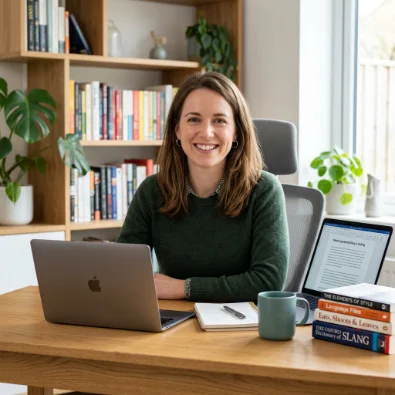
Sara Mitchell is a content writer at Punzite.com who specializes in internet slang, word meanings and language trends. She creates clear, engaging and well-researched content that helps readers understand modern digital communication with ease.