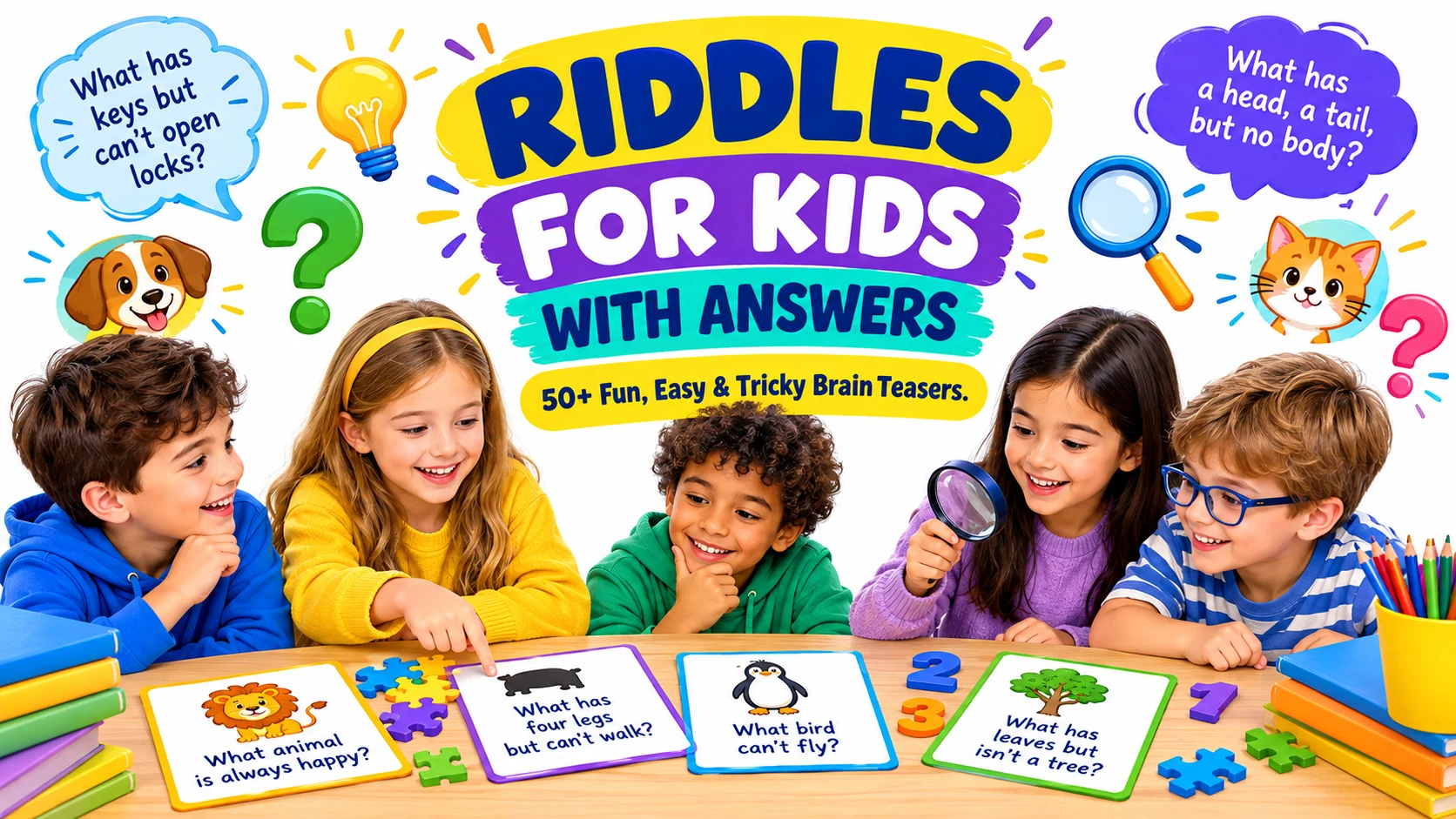
Riddles for kids with answers are short, playful puzzles that encourage children to think, observe clues, recognize patterns, and use creativity to discover a solution. The collection below includes easy, funny, clever, tricky, animal, word, math, and logic riddles suitable for home, school, parties, and family game time.
Easy riddles are a great starting point for younger children and beginners. They introduce the basic idea of reading clues, making guesses, and checking whether an answer fits.
Riddle 1: I have four legs, but I never run. I can hold your books, but I never read. What am I?
Answer: A table.
Solution: A table has legs and can hold books, but it cannot move or read.
Riddle 2: I am yellow, curved, and easy to peel. Monkeys are often pictured eating me. What am I?
Answer: A banana.
Solution: The clues describe the familiar shape, color, and peel of a banana.
Riddle 3: I have pages but cannot walk, and I can tell you stories without speaking. What am I?
Answer: A book.
Solution: Books contain pages and stories that readers discover through words.
Riddle 4: I fall from the sky but never get hurt. I can make puddles on the ground. What am I?
Answer: Rain.
Solution: Rain falls from clouds and collects on the ground as water.
Riddle 5: I shine during the day and help make the world bright. What am I?
Answer: The sun.
Solution: The sun provides daylight and warmth.
Try this: Cover the answers and let children guess independently. Give one clue at a time if they get stuck.
Funny Riddles for Kids
Funny riddles work especially well when children are playing together. The unexpected answer often creates the biggest laugh.
Riddle 6: What kind of room has no doors, no windows, and no furniture?
Answer: A mushroom.
Solution: The word “room” is hidden inside “mushroom.”
Riddle 7: What has ears but cannot hear a single word?
Answer: Corn.
Solution: Corn has structures commonly called ears, but they cannot actually hear.
Riddle 8: What can you catch but never throw?
Answer: A cold.
Solution: You can catch a cold, but it is not something you can physically throw.
Riddle 9: What has a face and two hands but cannot clap?
Answer: A clock.
Solution: A clock has a face and hands that show the time.
Riddle 10: What gets wetter the more it helps you get dry?
Answer: A towel.
Solution: A towel absorbs water while drying you.
Laugh challenge: Ask everyone to give their funniest guess before revealing the answer. Sometimes the wrong answers are even more entertaining than the right one.
Animal Riddles for Children
Animal riddles help children connect descriptive clues with animals they already know. They can also encourage vocabulary and observation skills.
Riddle 11: I carry my home wherever I go, but I never pack a suitcase. Who am I?
Answer: A snail.
Solution: A snail carries its shell as a natural home.
Riddle 12: I have stripes, but I am not a shirt. I look a little like a horse. Who am I?
Answer: A zebra.
Solution: Zebras are famous for their black-and-white stripes and horse-like appearance.
Riddle 13: I can change my colors to blend into my surroundings. Who am I?
Answer: A chameleon.
Solution: Chameleons are known for changing color as part of their communication and environmental response.
Riddle 14: I have eight arms but never give hugs. I live underwater and can squirt ink. Who am I?
Answer: An octopus.
Solution: An octopus has eight arms and can release ink when threatened.
Riddle 15: I am tiny, busy, and famous for working with my colony. I can carry things bigger than I look. Who am I?
Answer: An ant.
Solution: Ants are small social insects that cooperate to gather food and maintain their colonies.
Family game idea: One person describes an animal without saying its name while everyone else tries to solve the riddle.
Clever and Tricky Riddles for Kids
These riddles require children to slow down and examine the wording carefully. The answer is logical, but the clue may encourage an unexpected interpretation.
Riddle 16: You have me once in a minute, twice in a moment, but never in a thousand years. What am I?
Answer: The letter M.
Solution: “Minute” contains one M, “moment” contains two Ms, and “thousand years” contains none.
Riddle 17: I am always in front of you, but you can never see me. What am I?
Answer: The future.
Solution: The future lies ahead, but it cannot be seen before it happens.
Riddle 18: A child walks into a room and sees three apples on a table. They take two. How many apples do they have?
Answer: Two.
Solution: The child took two apples, so they are holding two.
Riddle 19: What has many keys but cannot open a single door?
Answer: A piano.
Solution: A piano has many keys, but they create musical notes rather than unlocking doors.
Riddle 20: What belongs to you but is used more often by other people?
Answer: Your name.
Solution: Other people frequently use your name when talking to or about you.
Thinking tip: Encourage children to identify the exact words that contain the clue before they make a guess.
Word Riddles and Language Puzzles
Word riddles turn spelling, letters, and meanings into puzzles. They are especially useful for classroom warm-ups and language activities.
Riddle 21: What word becomes shorter when you add two letters to it?
Answer: Short.
Solution: Adding “er” turns “short” into “shorter,” which describes something less long.
Riddle 22: I begin with T, end with T, and have T inside me. What am I?
Answer: A teapot.
Solution: “Teapot” begins and ends with T and contains “tea,” which sounds like the letter T.
Riddle 23: What letter appears once in “apple,” twice in “pepper,” and never in “orange”?
Answer: P.
Solution: “Apple” has one P, “pepper” has two Ps, and “orange” has none.
Riddle 24: What starts with C, ends with E, and contains a whole city inside it?
Answer: A city map.
Solution: A map can contain an entire city’s streets and landmarks while the phrase begins with C and ends with P, making the clue a playful word puzzle.
Riddle 25: I can be written, spoken, broken, and kept. What am I?
Answer: A promise.
Solution: You can write or speak a promise, break a promise, or keep a promise.
Classroom idea: Have students create their own word riddles using spelling patterns, letters, homophones, or double meanings.
Math Riddles for Kids
Math riddles make numbers feel more like games than exercises. These puzzles encourage children to calculate carefully while paying attention to the wording.
Riddle 26: I am an even number. Take away one letter from my name and I become odd. What number am I?
Answer: Seven.
Solution: “Seven” is odd, while “even” is the clue to the transformation concept; this is a wordplay challenge rather than a numerical calculation.
Riddle 27: I have three apples. You take two from me. How many apples do you have?
Answer: Two.
Solution: You took two apples, so you have two.
Riddle 28: There are four birds sitting on a branch. One flies away. How many remain on the branch?
Answer: Three.
Solution: If one bird leaves four birds, three are left.
Riddle 29: A box contains five red balls and five blue balls. Without looking, what is the smallest number of balls you must take to guarantee two are the same color?
Answer: Three.
Solution: With three balls, at least two must share a color because there are only two colors.
Riddle 30: I am a number greater than 10 and less than 20. My digits add up to 10. What number am I?
Answer: 19.
Solution: 19 is between 10 and 20, and 1 + 9 equals 10.
Learning tip: Let children explain how they reached an answer instead of only saying whether the answer is correct.
Logic and Brain Teasers for Kids
Logic riddles reward careful reasoning. They are excellent for family challenges, classroom activities, and quiet thinking time.
Riddle 31: A farmer has chickens and rabbits. There are 10 heads and 28 legs altogether. How many rabbits are there?
Answer: 4 rabbits.
Solution: Four rabbits have 16 legs, and six chickens have 12 legs. Together that makes 28 legs and 10 heads.
Riddle 32: You enter a dark room with one candle, one lamp, and one fireplace. You have one match. What do you light first?
Answer: The match.
Solution: You need to light the match before you can light anything else.
Riddle 33: A boy has five toys and gives all but two away. How many toys does he keep?
Answer: Two.
Solution: “All but two” means two remain with him.
Riddle 34: Two children were born on the same day, in the same year, to the same parents, but they are not twins. How is that possible?
Answer: They are part of triplets or another multiple birth.
Solution: Two of three or more siblings can share the same birth details without being twins.
Riddle 35: What can travel around the world while staying in one corner?
Answer: A stamp.
Solution: A stamp can remain in the corner of an envelope while the envelope travels around the world.
Challenge mode: Give children 30 seconds to think silently before anyone says an answer. This prevents quick guessers from giving away the solution.
Hard and Tricky Riddles for Kids
Older children and experienced puzzle-solvers may enjoy riddles that require multiple steps or a fresh perspective.
Riddle 36: A house has four walls, and every wall faces south. A bear walks past the house. What color is the bear?
Answer: White.
Solution: A house whose walls all face south can be near the North Pole, where the bear would be a polar bear.
Riddle 37: You have two ropes. Each takes exactly one hour to burn, but they do not burn at a constant speed. How can you measure 45 minutes?
Answer: Light both ends of one rope and one end of the other.
Solution: The first rope burns completely in 30 minutes. Then light the second end of the remaining rope; its remaining burn time becomes 15 minutes, giving 45 minutes total.
Riddle 38: A man pushes his car to a hotel and immediately knows he is bankrupt. Why?
Answer: He is playing Monopoly.
Solution: The “car” is a Monopoly game piece, and landing at a hotel can cause a player to owe more money than they have.
Riddle 39: You see a boat filled with people, but there is not a single person on board. How can that be?
Answer: Everyone on the boat is married.
Solution: There is not a “single” person because everyone is married.
Riddle 40: What disappears the moment you say its name?
Answer: Silence.
Solution: Speaking breaks the silence, so saying the word destroys the condition it describes.
Expert challenge: Ask children to explain why the wording works. Understanding the trick is more valuable than simply memorizing the answer.
Riddles for Family, Classroom, and Party Games
Riddles become even more enjoyable when they are used as social games. They can work as quick classroom warm-ups, family challenges, road-trip activities, birthday entertainment, or party competitions.
Riddle 41: I have no mouth, but I can answer when you call. What am I?
Answer: An echo.
Solution: An echo repeats a sound without having a mouth.
Riddle 42: I have a neck but no head. I have a body but no legs. What am I?
Answer: A bottle.
Solution: A bottle has a neck and body, but no human head or legs.
Riddle 43: I am full of holes, but I can still hold water. What am I?
Answer: A sponge.
Solution: A sponge contains many small spaces while absorbing and holding water.
Riddle 44: I move without legs and have a bed but never sleep. What am I?
Answer: A river.
Solution: A river moves through its channel, which is sometimes called its riverbed.
Riddle 45: I have teeth but cannot eat. What am I?
Answer: A comb.
Solution: The teeth of a comb separate and arrange hair.
Game idea: Divide players into teams. Give one point for a correct answer and a bonus point when someone explains the clue correctly.
How to Use Riddles for Kids With Answers
Riddles can be more than a source of quick entertainment. Used thoughtfully, they can encourage children to reason, communicate, listen carefully, and explain their ideas.
At home, parents can use a few riddles during breakfast, family game night, road trips, or before bedtime. Teachers can use them as warm-up questions before lessons or as short activities between longer tasks.
For younger children, begin with easy object and animal riddles. As their confidence grows, introduce wordplay, logic, and trickier puzzles. The goal is not to make every riddle difficult. A good riddle should create a satisfying “I get it!” moment.
For parties and group activities, read the riddle aloud and give everyone a limited amount of time to answer. For classrooms, students can write their own riddles and challenge classmates to solve them.
Riddles can also make excellent conversation starters for siblings, grandparents, friends, and classmates. The best part is that they require little preparation and can be played almost anywhere.
How to Solve Riddles for Kids
Solving a riddle becomes easier when children learn to examine clues rather than guessing randomly.
1. Read every word carefully.
A single word can completely change the meaning of a riddle.
2. Look for descriptive clues.
Think about size, color, shape, location, movement, sound, or purpose.
3. Consider different meanings.
Some riddles use words such as “keys,” “hands,” “ears,” or “legs” in an unexpected way.
4. Avoid overthinking easy clues.
If a simple answer matches every clue, it may be the intended solution.
5. Test your answer.
Ask whether your answer explains all parts of the riddle.
6. Explain your reasoning.
Being able to explain why an answer works is an important part of solving puzzles.
The most enjoyable riddles usually balance challenge and clarity. Children should have enough information to eventually reach one logical answer without needing outside knowledge.
Benefits of Riddles for Children
Riddles offer a playful way to practice several useful thinking skills.
Critical thinking: Children learn to examine information before reaching a conclusion.
Problem-solving: Riddles encourage them to test possible answers against multiple clues.
Language development: Word riddles expose children to vocabulary, spelling, double meanings, and sentence structure.
Observation: Descriptive riddles encourage children to notice characteristics they might otherwise overlook.
Creativity: Some puzzles require children to consider unusual interpretations.
Communication: Explaining an answer teaches children to express their reasoning clearly.
Social interaction: Group riddles encourage turn-taking, discussion, friendly competition, and collaboration.
For these reasons, riddles can fit naturally into both educational and recreational activities. The key is to match the difficulty with the child’s age, reading ability, and experience.
Quick Riddle Challenge for Kids
Ready for a final mini-challenge? Try these without looking back at the answers.
Riddle 46: I have one eye but cannot see. What am I?
Answer: A needle.
Solution: The hole in a needle is called its eye.
Riddle 47: I am lighter than a feather, but nobody can hold me for very long. What am I?
Answer: Their breath.
Solution: A person can hold their breath, but only temporarily.
Riddle 48: I have a head and a tail but no body. What am I?
Answer: A coin.
Solution: A coin can have a heads side and a tails side.
Riddle 49: I get bigger when I eat, but I die when I drink. What am I?
Answer: Fire.
Solution: Fire grows when it consumes fuel but can be extinguished by water.
Riddle 50: The more you take from me, the more I leave behind. What am I?
Answer: Footsteps.
Solution: As you take steps, you leave more footprints or footsteps behind you.
Final challenge: Choose your favorite three riddles and challenge someone who thinks they can solve anything!
People Also Ask
1. What are riddles for kids with answers?
Riddles for kids with answers are short puzzles designed to make children think, guess, and solve clues. They can involve animals, objects, words, numbers, logic, or funny situations. Including the answer helps children understand the reasoning after making their own guess.
2. How do you solve riddles for kids?
Start by reading every clue carefully and identifying the important words. Think about literal and unusual meanings, consider several possible answers, and then test each one against all the clues. The best answer should explain the complete riddle logically.
3. Are riddles good for kids?
Yes, riddles can be a fun way to practice reasoning, vocabulary, observation, creativity, and problem-solving. They also encourage children to explain their thinking. The best results come from choosing age-appropriate riddles that are challenging without being frustrating.
4. What makes a good riddle for children?
A good children’s riddle has clear clues, one intended answer, simple enough language, and an interesting twist. It should be challenging enough to encourage thinking but logical enough that children can understand the solution once it is revealed.
5. Where can I use riddles for kids?
You can use children’s riddles at home, in classrooms, during family game nights, on road trips, at birthday parties, or as quick conversation games. Teachers can also use them as lesson warm-ups, while parents can use them for screen-free entertainment.
SEO FAQ
6. What age are kids’ riddles suitable for?
Kids’ riddles can be adapted for almost any school-age group. Younger children generally benefit from easy animal, object, and observation riddles, while older children can handle wordplay, mathematics, logic, and multi-step challenges.
7. How can teachers use riddles in the classroom?
Teachers can use riddles as five-minute warm-ups, vocabulary activities, brain breaks, team challenges, or writing exercises. Students can also create their own riddles, exchange them with classmates, and explain why their answers fit the clues.
8. How can parents make riddles more fun?
Parents can turn riddles into friendly competitions, family challenges, or bedtime games. Give children time to think before revealing the answer, offer hints when needed, and ask them to explain their reasoning instead of focusing only on whether they guessed correctly.
9. What are the easiest riddles for younger children?
The easiest riddles usually describe familiar objects, animals, food, weather, or everyday experiences. Simple clues about color, shape, sound, or function make these puzzles accessible to beginners while still encouraging children to make connections.
10. How can I make riddles harder for older kids?
To increase difficulty, use multiple clues, wordplay, logical constraints, mathematical relationships, or deliberate misdirection. Avoid making the answer arbitrary. A challenging riddle should still have enough information for a careful solver to reach one defensible answer.
Conclusion
Riddles for kids with answers are a simple way to turn everyday moments into opportunities for curiosity, laughter, and thoughtful problem-solving. From easy animal puzzles to clever wordplay and challenging logic questions, the right riddle can entertain children while encouraging them to look at clues from different angles. Use these riddles at home, in classrooms, during family gatherings, or whenever you need a quick screen-free activity. Start with the easiest challenges, let children explain their reasoning, and gradually introduce trickier puzzles. Pick a few favorites, challenge your friends and family, and see who can solve them without peeking at the answers!