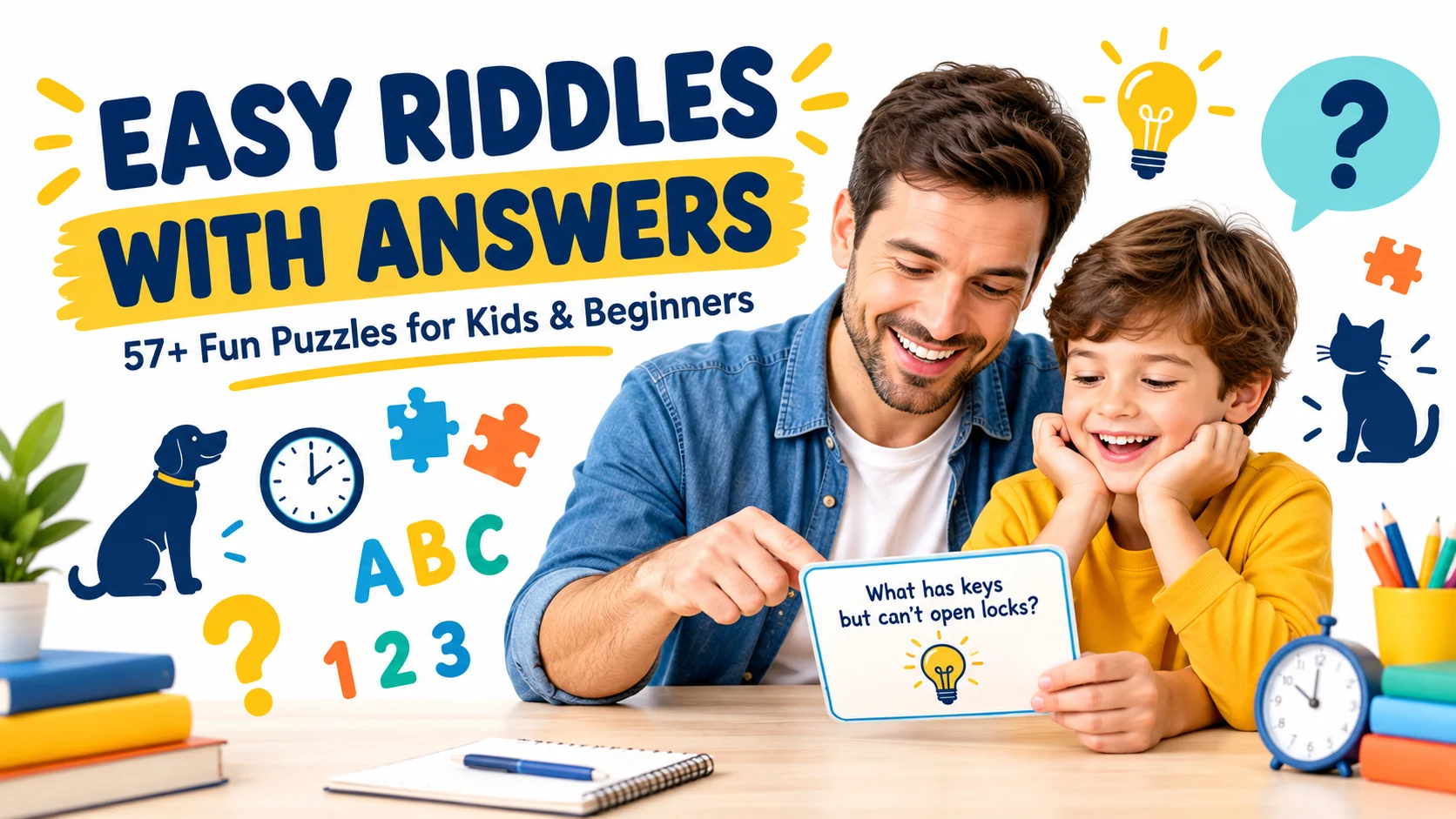
Easy riddles with answers are short, beginner-friendly puzzles designed to make you think without requiring complicated knowledge or advanced logic. They often use familiar objects, animals, words, numbers, and everyday situations, making them great for kids, families, classrooms, parties, and anyone who enjoys a quick brain teaser.
If you love puzzles that make you pause, smile, and say, “Oh, of course!” you’re in the right place. These easy riddles with answers are designed for beginners, kids, families, teachers, and casual puzzle fans.
You’ll find simple what-am-I riddles, wordplay puzzles, animal riddles, logic questions, math riddles, tricky brain teasers, and everyday mysteries. Try solving each one before checking the answer.
Whether you need a classroom activity, a family game, a party challenge, or something fun to share with friends, these riddles offer an easy way to turn a few spare minutes into a thinking game.
Easy Riddles for Kids and Beginners
These riddles use familiar ideas and straightforward clues, making them a good starting point for young solvers and anyone new to riddles.
Riddle 1: I have hands but cannot clap. I have a face but cannot smile. What am I?
Answer: A clock.
Riddle 2: I am full of holes, but I can still hold water. What am I?
Answer: A sponge.
Riddle 3: I have four legs, but I never go for a walk. What am I?
Answer: A table.
Riddle 4: I become smaller every time I take a bath. What am I?
Answer: A bar of soap.
Riddle 5: I have pages but I am not a tree. I can tell stories but cannot speak. What am I?
Answer: A book.
Riddle 6: I have one eye, but I cannot see. What am I?
Answer: A needle.
Funny Easy Riddles
A good riddle does not always need to be serious. These playful questions add a little humor while keeping the solutions simple.
Riddle 7: What has ears but cannot hear a single secret?
Answer: A cup.
Riddle 8: Why did the pencil bring an umbrella to school?
Answer: Because it was afraid of getting a little point wet!
Riddle 9: What kind of room has no doors, windows, or furniture?
Answer: A mushroom.
Riddle 10: What has a neck but no head and can still wear a cap?
Answer: A bottle.
Riddle 11: What gets wetter the more it dries?
Answer: A towel.
Riddle 12: What can run around a yard without moving?
Answer: A fence.
Easy What-Am-I Riddles
“What am I?” riddles are among the easiest formats to play because the clues gradually point toward one familiar answer.
Riddle 13: I shine during the day, warm your face, and disappear when night arrives. What am I?
Answer: The sun.
Riddle 14: I fall from the sky, make puddles on the ground, and can make your umbrella very useful. What am I?
Answer: Rain.
Riddle 15: I am soft, fluffy, and often found floating across the sky. What am I?
Answer: A cloud.
Riddle 16: I have teeth but never eat food. What am I?
Answer: A comb.
Riddle 17: I have a tail but I am not an animal. I can fly high but have no wings. What am I?
Answer: A kite.
Riddle 18: I follow you during the day but disappear when the light is gone. What am I?
Answer: Your shadow.
Easy Animal Riddles
Animal riddles are especially useful for children because the clues can connect with animals they already recognize.
Riddle 19: I say “meow,” chase little toys, and like to nap in sunny places. What am I?
Answer: A cat.
Riddle 20: I bark, wag my tail, and may happily fetch a ball. What am I?
Answer: A dog.
Riddle 21: I have a long trunk and large ears, but I am not a tree. What am I?
Answer: An elephant.
Riddle 22: I can hop, have long ears, and enjoy munching vegetables. What am I?
Answer: A rabbit.
Riddle 23: I have feathers, two wings, and I can sing from a tree. What am I?
Answer: A bird.
Riddle 24: I carry my home on my back and move very slowly. What am I?
Answer: A turtle.
Easy Word Riddles
Word riddles encourage readers to think about spelling, letters, sounds, and meanings rather than physical objects.
Riddle 25: What word becomes shorter when you add two letters to it?
Answer: “Short” becomes “shorter” when “er” is added.
Riddle 26: What letter appears once in “cat,” twice in “letter,” and never in “dog”?
Answer: The letter T.
Riddle 27: What word begins with E, ends with E, and contains only one letter?
Answer: An envelope.
Riddle 28: What can you find at the beginning of “end” and at the end of “begin”?
Answer: The letter N.
Riddle 29: What five-letter word becomes shorter when you remove its first letter?
Answer: “Stone” becomes “tone.”
Riddle 30: What starts with a P, ends with an E, and contains thousands of letters?
Answer: A post office.
Easy Logic Riddles
Simple logic riddles help beginners practice paying attention to the exact wording of a question.
Riddle 31: You have three apples and take away two. How many apples do you have?
Answer: Two, because you took two apples.
Riddle 32: A farmer has five ducks. Two walk away. How many ducks are still on the farm?
Answer: Three.
Riddle 33: A room has four corners. There is one cat in each corner. How many cats are in the room?
Answer: Four.
Riddle 34: You enter a dark room with one match. There is a candle, a lamp, and a fireplace. What do you light first?
Answer: The match.
Riddle 35: A basket contains six oranges. Six children each take one orange. How can one orange remain in the basket?
Answer: The last child takes the orange together with the basket.
Riddle 36: If yesterday was Monday, what day is tomorrow?
Answer: Wednesday.
Easy Math Riddles
These quick math riddles are designed to make numbers feel more like games than homework.
Riddle 37: I am an even number greater than 4 and less than 8. What am I?
Answer: 6.
Riddle 38: I have two digits. My first digit is 3 and my second digit is twice my first digit. What number am I?
Answer: 36.
Riddle 39: You have 10 candies and give 3 away. How many candies do you have left?
Answer: 7.
Riddle 40: What number comes next: 2, 4, 6, 8, ___?
Answer: 10.
Riddle 41: I am a number that stays the same when you multiply me by 1. What number could I be?
Answer: Any number.
Riddle 42: If one pair of socks has two socks, how many socks are in three pairs?
Answer: Six socks.
Easy Tricky Riddles
Tricky riddles are not necessarily difficult. Their challenge comes from noticing a small detail or interpreting the wording differently.
Riddle 43: A rooster lays an egg on top of a roof. Which side does the egg roll down?
Answer: Neither. Roosters do not lay eggs.
Riddle 44: What gets bigger the more you take away from it?
Answer: A hole.
Riddle 45: What has a head and a tail but no body?
Answer: A coin.
Riddle 46: If you throw a red stone into the blue sea, what does it become?
Answer: Wet.
Riddle 47: What has many keys but cannot open a single door?
Answer: A piano.
Riddle 48: What can travel around the world while staying in one corner?
Answer: A stamp.
Easy Riddles for Family, Classroom and Parties
The best easy riddles are flexible. You can use them during family game nights, classroom warm-ups, birthday parties, road trips, lunch breaks, or casual conversations.
Riddle 49: What has a thumb and four fingers but is not alive?
Answer: A glove.
Riddle 50: What goes up when the rain comes down?
Answer: An umbrella.
Riddle 51: What has a bed but never sleeps?
Answer: A river.
Riddle 52: What has a ring but no finger?
Answer: A telephone.
Riddle 53: What has a mouth but never eats?
Answer: A river.
Riddle 54: What can you catch but never throw?
Answer: A cold.
Riddle 55: What has a head but never thinks?
Answer: A nail.
Riddle 56: What has a tongue but cannot taste?
Answer: A shoe.
These work especially well as quick classroom brain breaks. A teacher can read one aloud, give students thirty seconds to think, and then let several students explain how they reached the answer.
For family games, try giving one point for the correct answer and an extra point when someone explains the clue correctly. At parties, riddles can become a quick elimination game or team challenge.
Quick Challenge: Can You Solve These?
Ready for a slightly bigger challenge? Try solving these without looking at the answers immediately.
Riddle 57: I am always in front of you, but you can never see me. What am I?
Answer: The future.
Riddle 58: The more you use me, the more I disappear. What am I?
Answer: A pencil.
Riddle 59: I have no voice, but I can answer when you speak. What am I?
Answer: An echo.
Riddle 60: I am light enough to float in the air, but you cannot hold me for long. What am I?
Answer: Your breath.
Riddle 61: I can be cracked, made, told, and played. What am I?
Answer: A joke.
Riddle 62: I have a face and two hands, but I never shake hands. What am I?
Answer: A clock.
Riddle 63: I am found in the middle of “water” but not at the beginning or end. What am I?
Answer: The letter T.
Riddle 64: You can see me once in a minute, twice in a moment, but never in a thousand years. What am I?
Answer: The letter M.
Riddle 65: What has cities, roads, and rivers but no people, cars, or water?
Answer: A map.
Riddle 66: What begins with a question and ends with an answer, but is not a conversation?
Answer: A riddle.
How to Make Easy Riddles More Fun
You do not need complicated rules to turn these puzzles into a game. Try reading the riddle aloud and giving everyone 15–30 seconds to solve it.
For younger children, offer one clue if nobody gets the answer. For older players, keep the answer hidden until someone commits to a guess.
You can also use riddles as:
- Classroom warm-up activities
- Family game-night challenges
- Birthday-party entertainment
- Road-trip games
- Icebreakers
- Lunch-break activities
- Brain breaks
- Social-media posts
- Text-message challenges
- Kids’ activity sheets
For social media, post the riddle first and reveal the answer in a later slide, comment, or follow-up post. This gives readers a reason to stop, think, and interact.
People Also Ask
1. What are easy riddles with answers?
Easy riddles with answers are beginner-friendly puzzles that use simple clues and familiar subjects. They may focus on objects, animals, words, numbers, or everyday situations. The goal is to reach one clear answer without requiring advanced knowledge or complicated reasoning.
2. How do you solve easy riddles?
Start by reading every word carefully and identifying the main clues. Think about common objects, animals, words, or situations that fit the clues. If the riddle sounds unusual, check whether it uses wordplay or a small trick before choosing your final answer.
3. Are easy riddles good for kids?
Yes, easy riddles are excellent for kids when the language and subject are age-appropriate. They can encourage vocabulary development, observation, reasoning, listening skills, and creative thinking while keeping learning entertaining. Parents and teachers can also use them as short brain-break activities.
4. What makes a good easy riddle?
A good easy riddle has clear clues, one intended answer, simple language, and enough challenge to make the solver think. The answer should feel satisfying once revealed. Strong riddles avoid unnecessary ambiguity and do not depend on obscure facts.
5. Where can I use easy riddles with answers?
You can use easy riddles at home, in classrooms, during family game nights, at parties, on road trips, in group activities, or on social media. They are especially useful when you want a quick activity that requires little preparation.
6. What age are easy riddles suitable for?
Easy riddles can work for many ages, but simple versions are particularly suitable for young children and beginners. For preschoolers, choose short clues about familiar animals and objects. Older children can handle wordplay, logic puzzles, and slightly trickier questions.
7. Are riddles educational for children?
Yes, riddles can support learning by encouraging children to listen carefully, interpret clues, build vocabulary, recognize patterns, and explain their reasoning. They are most effective when used as a fun supplement to learning rather than as a replacement for structured instruction.
8. What is the easiest type of riddle?
What-am-I riddles about familiar objects are often among the easiest for beginners. Simple animal riddles and basic observation riddles are also accessible because the solver can connect clues with things they already know.
9. How can I make a riddle game more exciting?
Set a short time limit, award points for correct answers, divide players into teams, or offer optional clues. You can also ask players to explain their reasoning. For children, using pictures or familiar objects can make the game even more engaging.
10. Can easy riddles be used in the classroom?
Absolutely. Teachers can use easy riddles as warm-ups, brain breaks, vocabulary activities, speaking exercises, or quick transitions between lessons. Asking students to explain why an answer fits can turn a simple riddle into a useful reasoning and communication activity.
Conclusion
Easy riddles with answers are a simple way to make everyday moments more playful while encouraging observation, vocabulary, logic, and creative thinking. From funny wordplay to animal clues, simple math, and clever trick questions, there is a puzzle here for almost every age and occasion.
Use them with kids, challenge your family, entertain friends, or share your favorites online. The best part is simple: you do not need to be a puzzle expert to enjoy them. Pick a riddle, hide the answer, and see who can solve it first!