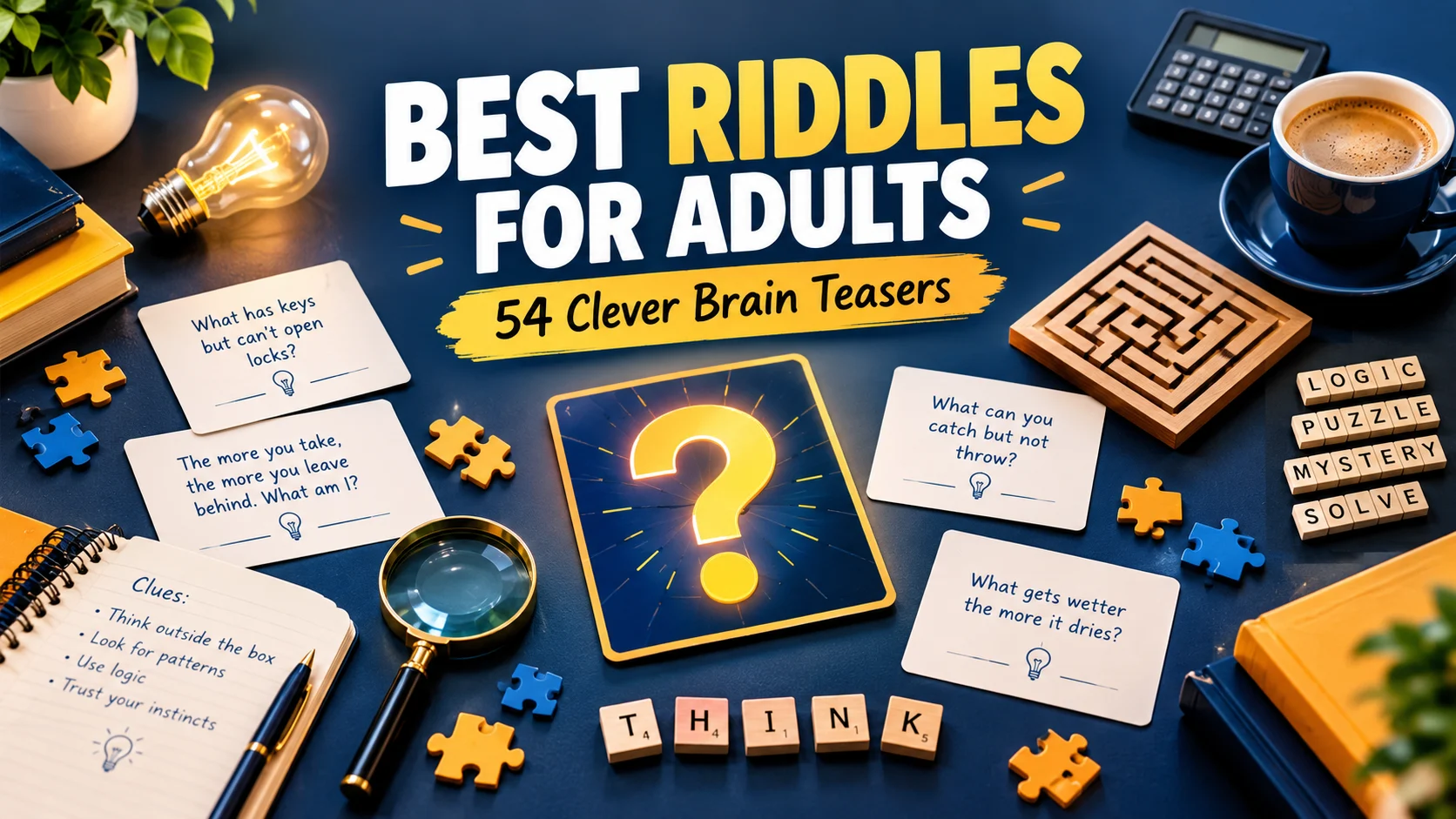
The best riddles for adults combine clever clues, logical thinking, wordplay, observation, and unexpected twists. They should be challenging enough to make you pause but clear enough that the answer feels satisfying. This collection includes 54 original riddles ranging from easy warm-ups to tricky brain teasers.
If you enjoy puzzles that make you stop, rethink a clue, and suddenly say “Oh, now I get it,” you’re in the right place. These best riddles for adults mix clever wordplay, logic, numbers, observation, mystery, and everyday situations.
Some are quick warm-ups. Others are designed to make you question your first assumption. Try solving each one before looking at the answer, and challenge a friend when you find one that really makes you think.
Easy Riddles for Adults
Start here if you want clever questions without an immediate headache. These are simple enough for a warm-up but still have satisfying answers.
Riddle 1:
I have pages but cannot read, a spine but no bones, and a cover that never gets cold. What am I?
Answer: A book.
Riddle 2:
I follow you everywhere during the day but disappear when the light disappears. What am I?
Answer: Your shadow.
Riddle 3:
I have a face but cannot smile, and two hands but cannot clap. What am I?
Answer: A clock.
Riddle 4:
I can be cracked, told, and shared, but I cannot be held. What am I?
Answer: A joke.
Riddle 5:
I become smaller every time I do my job, yet nobody complains about losing me. What am I?
Answer: A bar of soap.
Riddle 6:
I have a tongue but never speak. I can help you walk, but I have no feet. What am I?
Answer: A shoe.
Clever Wordplay Riddles
These riddles depend on language rather than complicated calculations. Read every word carefully because the wording is part of the puzzle.
Riddle 7:
I can be written, spoken, broken, kept, or given. What am I?
Answer: A promise.
Riddle 8:
What word becomes shorter when you add two letters to it?
Answer: “Short” becomes “shorter.”
Riddle 9:
I can be found in a calendar, a calculator, and a classroom, but never in a cloud. What am I?
Answer: The letter “c.”
Riddle 10:
I start with a question and end with an answer, but I am not a conversation. What am I?
Answer: A riddle.
Riddle 11:
What can you lose without dropping anything and find without looking?
Answer: Your train of thought.
Riddle 12:
I am something you can give away while keeping it completely. What am I?
Answer: Your word.
Funny Riddles for Adults
These are designed for laughs as much as solving. They work especially well at dinner tables, parties, group chats, and game nights.
Riddle 13:
Why does the calendar always look stressed at the end of the month?
Answer: It has too many dates.
Riddle 14:
I am always getting older but never complain about wrinkles. What am I?
Answer: A photograph.
Riddle 15:
What has a lot of buttons but absolutely no patience?
Answer: A remote control.
Riddle 16:
Why did the coffee bring a notebook to the meeting?
Answer: It had a lot of grounds to cover.
Riddle 17:
What is the one room where adults spend hours but rarely want to stay?
Answer: A waiting room.
Riddle 18:
What kind of table never needs a chair?
Answer: A timetable.
Logic Riddles for Adults
These require you to connect clues instead of simply guessing. Take your time and avoid adding information that the riddle never gives you.
Riddle 19:
A box contains three red cards and three blue cards. Without looking, how many cards must you take to guarantee two cards of the same color?
Answer: Three cards. With only two colors, three draws guarantee a matching pair.
Riddle 20:
A meeting begins at 2:00 and lasts exactly 45 minutes. You arrive 10 minutes before it ends. What time do you arrive?
Answer: 2:35.
Riddle 21:
Four friends each shake hands with every other friend exactly once. How many handshakes happen?
Answer: Six.
Riddle 22:
You have five identical-looking keys and only one opens a lock. What is the fewest number of tries needed to guarantee finding the correct key if you can test only one key at a time?
Answer: Four tries.
Riddle 23:
A room has four corners. A cat sits in each corner. Each cat can see the other three cats. How many cats are there?
Answer: Four cats.
Riddle 24:
You have one candle, one lamp, and one fireplace. You have only one match. What should you light first?
Answer: The match.
Hard Riddles for Adults
Ready for something tougher? These riddles hide important details in ordinary wording and reward careful reasoning.
Riddle 25:
A woman has three daughters. Each daughter has exactly one brother. How many children does the woman have?
Answer: Four. The three daughters share the same brother.
Riddle 26:
A number becomes twice as large when you remove its first letter. What number is it?
Answer: One hundred. Remove the “h” from “hundred” and you get “undred,” so this is a wordplay challenge rather than ordinary arithmetic; the intended answer is one hundred only under the wordplay interpretation.
Riddle 27:
You are given three switches outside a closed room. Inside are three lamps, each controlled by one switch. You may enter the room only once. How can you identify which switch controls each lamp?
Answer: Turn one switch on for several minutes, then turn it off. Turn a second switch on and enter. The lit lamp belongs to the second switch; the warm but unlit lamp belongs to the first; the remaining lamp belongs to the third.
Riddle 28:
A clock shows exactly 3:15. Without using a digital clock, what is the approximate angle between its hour and minute hands?
Answer: About 7.5 degrees.
Riddle 29:
You have a balance scale and eight identical-looking coins. One coin is heavier. What is the fewest number of weighings needed to guarantee finding it?
Answer: Two weighings.
Riddle 30:
A man walks into a store, spends exactly $10, and leaves with more money than he entered with. How?
Answer: He entered the store with less than $10 worth of goods and received change from a purchase paid with a larger bill.
Tricky Riddles With Unexpected Answers
These are built around assumptions. The trick is not necessarily difficult it is noticing what the question actually says.
Riddle 31:
A plane crashes exactly on the border between two countries. Where do they bury the survivors?
Answer: They don’t. Survivors are alive.
Riddle 32:
You see a house with every window facing south. A bear walks past the house. What color is the bear?
Answer: White. The house must be near the North Pole.
Riddle 33:
A driver travels down a one-way street in the wrong direction but does not break any traffic law. How?
Answer: The driver is walking.
Riddle 34:
You enter a dark room carrying one match. There is a candle, a fireplace, and an oil lamp. What do you light first?
Answer: The match.
Riddle 35:
A man pushes his car to a hotel and immediately loses his fortune. What happened?
Answer: He was playing a board game.
Riddle 36:
A person is born in 2000 and dies in 2000 at age 80. How is that possible?
Answer: 2000 is a room, house, hospital, or other location number rather than the year.
Math and Number Riddles
You don’t need advanced mathematics for these. Most depend on patterns, careful reading, or recognizing what the numbers represent.
Riddle 37:
I am a two-digit number. My digits add to 9, and reversing me makes me 27 larger. What number am I?
Answer: 36. Reversing it gives 63, which is 27 larger.
Riddle 38:
What comes next: 2, 4, 8, 16, 32, ___?
Answer: 64. Each number doubles.
Riddle 39:
A basket has 12 apples. You take away four. How many apples do you have?
Answer: Four. You took four, so you have four.
Riddle 40:
If five machines make five items in five minutes, how long would one machine take to make one item at the same rate?
Answer: Five minutes.
Riddle 41:
A number is greater than 20 and less than 30. Its digits multiply to 14. What number is it?
Answer: 27.
Riddle 42:
You have 10 coins. You arrange them into two groups containing the same number of coins, but one group must contain twice as much money. How can you do it?
Answer: Use coins of different values. The number of coins can be equal while their total values differ.
Mystery and Lateral-Thinking Riddles
These riddles ask you to step outside the obvious interpretation. Imagine the scene rather than rushing toward the first familiar answer.
Riddle 43:
A woman looks through a window and sees nothing outside, yet she knows exactly what the weather is doing. How?
Answer: She is looking through a window on a weather app or display.
Riddle 44:
A man enters a room carrying an empty box. He leaves carrying the same box, but it is no longer empty. What changed?
Answer: Someone put something inside it while he was there.
Riddle 45:
A person turns off a light and goes to bed. Hours later, hundreds of people are awake because of what happened. What was the light?
Answer: A lighthouse.
Riddle 46:
A woman takes a picture of an empty chair. When she looks at the picture, she sees someone sitting in it. How?
Answer: The picture is a photograph of the chair taken earlier when someone was sitting there.
Riddle 47:
A man opens an umbrella indoors and immediately becomes happier. Why?
Answer: He was testing it before buying it and discovered it worked perfectly.
Riddle 48:
A detective finds a wet footprint in a completely dry room. There are no leaks, open windows, or wet people nearby. What made it?
Answer: A wet shoe had been removed or carried through the room earlier.
Everyday Object Riddles
Ordinary objects become surprisingly difficult when their familiar purpose is hidden. These are great for quick challenges with friends.
Riddle 49:
I have a mouth but never eat, a bed but never sleep, and I can run without legs. What am I?
Answer: A river.
Riddle 50:
I get smaller as I work, leave a trail behind me, and often live beside a piece of paper. What am I?
Answer: A pencil.
Riddle 51:
I have teeth but never bite, and I become useful when your hair becomes messy. What am I?
Answer: A comb.
Riddle 52:
I have an eye but cannot see. I can carry thread but never wear clothes. What am I?
Answer: A needle.
Riddle 53:
I can hold hundreds of words without saying a single one. What am I?
Answer: A dictionary.
Riddle 54:
I have a neck but no head, a body but no arms, and I often hold something people drink. What am I?
Answer: A bottle.
How to Use These Riddles
These riddles work well when you make the solving part of the experience instead of immediately revealing every answer.
- Game night: Read each riddle aloud and give everyone 30–60 seconds.
- Parties: Use the funny and tricky sections as icebreakers.
- Family time: Start with the easy riddles and gradually increase the difficulty.
- Classroom activities: Use logic and number riddles as short thinking exercises.
- Office breaks: Try one riddle during a team meeting or casual break.
- Group chats: Send only the question first and reveal the answer later.
- Social media: Turn individual riddles into polls, quizzes, or carousel posts.
- Personal challenge: Cover the answers and keep score as you work through the list.
For the best experience, don’t judge yourself by how quickly you solve a riddle. A good puzzle is supposed to make you pause. The satisfying part is discovering the connection between the clues and the answer.
People Also Ask
What are the best riddles for adults?
The best riddles for adults combine clever wording, logical clues, unexpected twists, and satisfying answers. Good examples include wordplay, lateral-thinking, mystery, observation, math, and everyday-object riddles that challenge without relying on obscure knowledge.
How do you solve riddles for adults?
Start by identifying exactly what the riddle says rather than what you assume it means. Look for double meanings, unusual wording, missing assumptions, patterns, and clues that could have more than one interpretation before choosing an answer.
Are riddles good for adults?
Yes, riddles are a simple way to add playful problem-solving to everyday activities. Adults can use them for entertainment, conversation starters, game nights, icebreakers, group activities, or short mental challenges during a break.
What makes a good riddle?
A good riddle gives enough information to reach one intended answer while still making the solver think. Strong riddles usually have precise wording, a clever clue, a logical solution, and an answer that feels satisfying once revealed.
Where can I use riddles for adults?
You can use adult riddles at parties, game nights, family gatherings, classrooms, team activities, road trips, social media, group chats, or casual conversations. Choose easier riddles for larger groups and harder ones when people want a longer challenge.
What is an easy riddle for adults?
An easy adult riddle is short, understandable, and based on a familiar object or idea. It should require a small amount of reasoning without becoming frustrating, making it useful as a warm-up before harder puzzles.
What are the hardest riddles for adults?
Hard riddles usually involve multiple clues, hidden assumptions, lateral thinking, or several reasoning steps. The difficulty comes from interpreting the information correctly rather than simply requiring advanced academic knowledge or complicated calculations.
Can adults use riddles as icebreakers?
Yes. Riddles make useful icebreakers because they give people an immediate shared challenge. Short funny or clever riddles can encourage conversation without requiring participants to reveal personal information or prepare in advance.
How can I make a riddle game more fun?
Give players a time limit, award points for correct answers, and allow one hint for difficult questions. You can also divide players into teams and save the trickiest riddles for a final round.
Are these riddles suitable for family game night?
Yes. The collection is family-friendly and avoids adult-only themes. Younger players may enjoy the easy sections, while adults and older children can move toward the logic, math, hard, and lateral-thinking challenges.
Conclusion
The best riddles for adults do more than provide a quick laugh they challenge your logic, sharpen your thinking, and make you look at familiar ideas in unexpected ways. From clever wordplay and tricky questions to logic puzzles and brain teasers, each riddle offers a fun way to test your reasoning.
Whether you’re solving them alone, sharing them with friends, or using them as conversation starters, these riddles can turn an ordinary moment into an entertaining mental challenge. So, pick your favorites, hide the answers, and see how many you can solve without peeking!
Keep challenging your brain, keep thinking creatively, and most importantly, have fun with every twist and surprise. 🧩
Sara Mitchell is a content writer at Punzite.com who specializes in internet slang, word meanings and language trends. She creates clear, engaging and well-researched content that helps readers understand modern digital communication with ease.