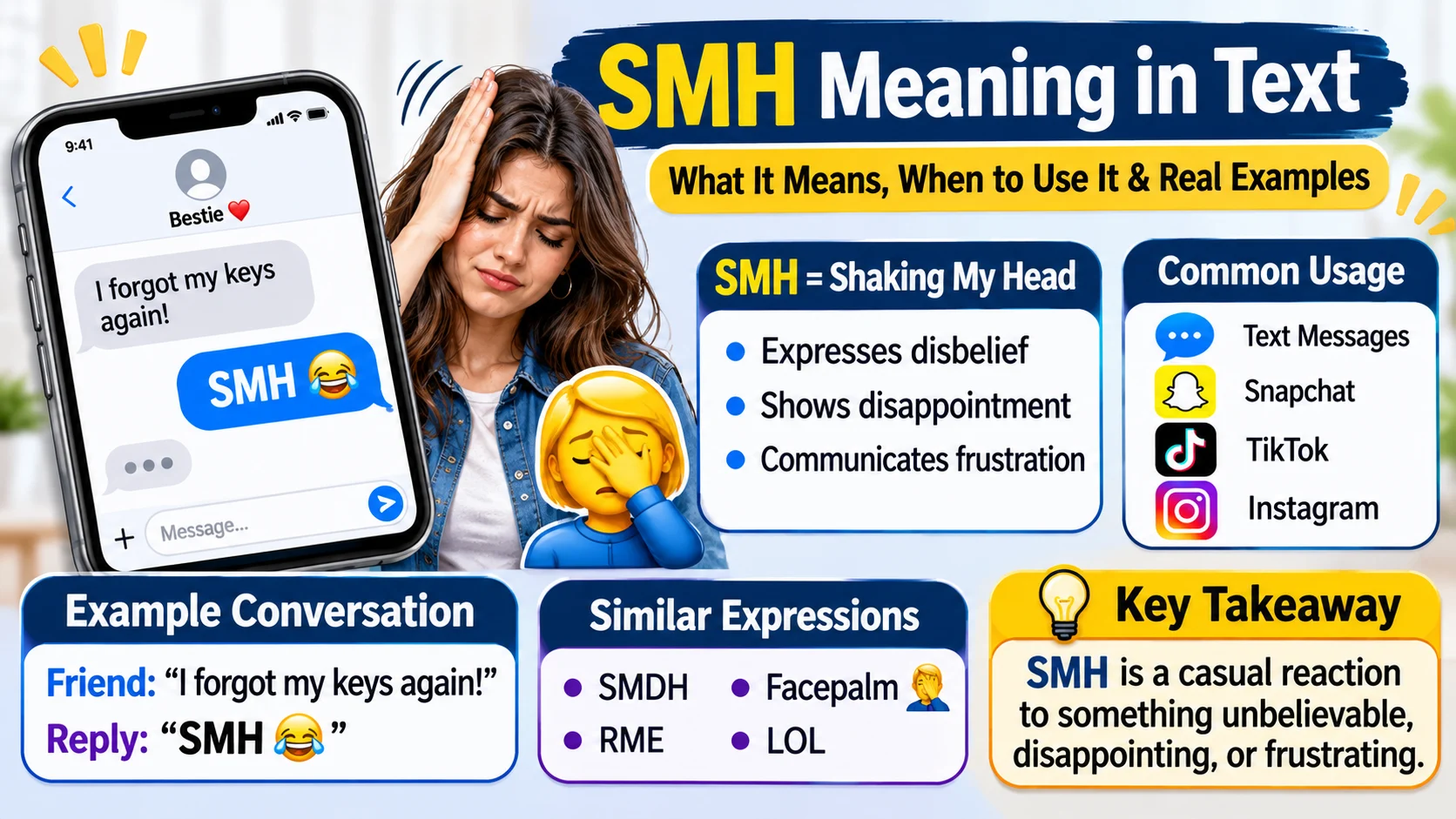
SMH means “shaking my head.” It is a popular internet abbreviation used in texts and social media to express disappointment, disbelief, frustration, or disapproval. People often use it when someone does something surprising, silly, or frustrating.
The SMH meaning in text is something you might encounter while chatting with friends, scrolling through social media, or reading online comments. SMH stands for “shaking my head,” a common expression people use when they cannot believe what someone has said or done. It usually communicates disappointment, frustration, disbelief, or mild annoyance without requiring a long explanation. You may see it on Snapchat, TikTok, Instagram, Facebook, and in everyday text messages. However, its exact meaning can change depending on the conversation and tone. Understanding when someone uses SMH can help you interpret their message correctly and respond naturally.
Quick Answer: SMH Meaning at a Glance
| Category | Explanation |
|---|---|
| Full form | Shaking My Head |
| Meaning | Expresses disbelief, disappointment, frustration, or disapproval |
| Context | Casual conversations and online communication |
| Platforms | Snapchat, TikTok, Instagram, Facebook, X, and texting |
| Example | “You forgot your keys again? SMH.” |
| Tone | Usually informal; can be funny, sarcastic, or critical |
What Does SMH Mean in Text?
SMH is short for “shaking my head.” It represents the physical action of shaking your head when you hear something disappointing, unbelievable, frustrating, or ridiculous.
Imagine your friend tells you they forgot their phone at home for the third time this week. Instead of writing a long response, you could simply reply:
“Seriously? SMH 😂”
The expression communicates something like:
- “I can’t believe you did that.”
- “That’s disappointing.”
- “What were you thinking?”
- “I have no words.”
- “That’s ridiculous!”
The important thing to understand is that SMH does not always express anger. It can be playful, sarcastic, humorous, or genuinely disappointed.
What Is the Origin of SMH?
The exact person who first created SMH is unknown. However, the abbreviation became visible in early internet culture during the 2000s.
One of its earliest documented Urban Dictionary entries appeared on February 14, 2004. It described the expression as a reaction to something so foolish that words were not enough.
As texting, online forums, and social media became more popular, SMH spread into everyday digital communication. Its meaning became widely recognized across different online communities. Dictionary.com+2
Today, people use SMH in private messages, public comments, captions, memes, and group chats.
Is SMH an Acronym or an Abbreviation?
SMH is technically an initialism because people read its individual letters rather than pronounce them as one word.
For example:
- SMH = Shaking My Head
- LOL = Laughing Out Loud
- OMG = Oh My God
- BRB = Be Right Back
In everyday conversation, people commonly call these expressions acronyms or texting abbreviations. Both descriptions are widely understood, although initialism is the more precise linguistic term.
Different Contexts and Meanings of SMH
Although SMH has one widely recognized meaning, the emotion behind it can change depending on the situation.
Understanding the context helps you avoid interpreting every SMH message as an insult.
1. SMH for Disappointment
Someone might use SMH when another person makes a poor decision or fails to do something expected.
Example:
“She canceled our plans five minutes before we arrived. SMH.”
Meaning: The person feels disappointed or frustrated by the cancellation.
2. SMH for Disbelief
SMH can communicate that something sounds too unbelievable to accept.
Example:
“He seriously spent $500 on a phone case? SMH.”
Meaning: The speaker cannot believe someone spent that much money on a phone case.
3. SMH for Frustration
People also use it when something irritating happens repeatedly.
Example:
“My internet stopped working right before my meeting. SMH.”
Meaning: The speaker is frustrated with the situation.
4. SMH for Humor and Sarcasm
Among friends, SMH can be a playful reaction to silly mistakes or funny situations.
Example:
“I walked into the wrong classroom and sat there for 10 minutes. SMH 😂”
Meaning: The person is laughing at their own embarrassing mistake.
5. SMH for Disapproval
Sometimes, SMH communicates that someone disagrees with another person’s actions or behavior.
Example:
“He blamed everyone else instead of admitting his mistake. SMH.”
Meaning: The speaker does not approve of that behavior.
Can SMH have other meanings?
In rare contexts, SMH may have alternative interpretations, including “so much hate” or “scratching my head.” However, these are not the usual meanings in everyday texting. If someone sends SMH without additional context, “shaking my head” is the safest interpretation. Dictionary.com+1
Real-Life Conversation Examples of SMH
The easiest way to understand SMH is to see how people use it in natural conversations.
Here are five realistic examples from everyday communication.
Example 1: Texting a Friend
Alex: I forgot my wallet at home again.
Jordan: You have to be kidding me. SMH 😂
Meaning: Jordan is playfully expressing disbelief about Alex’s repeated mistake.
Example 2: Talking About a Bad Decision
Mia: He spent his entire paycheck on video games.
Emma: SMH. He needs to manage his money better.
Meaning: Emma disapproves of the financial decision.
Example 3: Social Media Conversation
Chris: Did you see that guy trying to cook without turning on the stove?
Taylor: SMH 😭 That was hilarious.
Meaning: Taylor finds the situation ridiculous and funny.
Example 4: Family Group Chat
Mom: Your brother left the refrigerator door open all night.
Dad: SMH. That’s the third time this month.
Meaning: Dad is frustrated by the repeated mistake.
Example 5: Making Fun of Yourself
Lily: I searched for my glasses while wearing them.
Sarah: SMH 😂 How does that even happen?
Meaning: Sarah is teasing Lily in a friendly way.
These examples show that SMH does not have to sound negative. The surrounding words, relationship, and emojis help communicate the intended emotion.
SMH Meaning on Different Social Media Platforms
SMH generally keeps the same definition across social media platforms. However, the way people use it can depend on the type of conversation.
Snapchat Usage
On Snapchat , SMH commonly appears in private chats, replies to Stories, and quick reactions to friends’ messages.
People use it when someone shares an embarrassing moment, makes a silly mistake, or does something unexpected.
Examples:
- “You forgot to save our Snap streak? SMH 😭”
- “SMH, why would you send that picture?”
- “You really did that? 😂”
The expression remains informal and often carries a playful or teasing tone.
TikTok Usage
On TikTok , SMH frequently appears in video comments and discussions.
Users may write it when reacting to:
- Funny mistakes and embarrassing moments.
- Unexpected video endings.
- Unbelievable opinions.
- Poor decisions or questionable behavior.
- Frustrating situations shown in videos.
Examples:
- “SMH, people really believe this?”
- “He dropped his phone in the pool. SMH.”
- “I can’t believe she actually did that 😭”
In public comments, SMH can sound more critical because it is directed at something other people can also see.
Instagram Usage
On Instagram , SMH is used in comments, direct messages, captions, and Story replies.
People often use it to react to funny posts, celebrity news, relationship situations, and friends’ updates.
Examples:
- “Another Monday already? SMH.”
- “SMH, this is exactly why I don’t trust online shopping.”
- “You posted that picture without telling me? SMH 😂”
It can express anything from mild annoyance to humorous disbelief.
Text Messaging Usage
In ordinary SMS and messaging apps, including WhatsApp and iMessage, SMH is a quick way to communicate a reaction.
It can appear at the beginning, middle, or end of a message.
Examples:
- Beginning: “SMH, I forgot my appointment.”
- Middle: “I was waiting for an hour, SMH.”
- End: “You did that again? SMH.”
A standalone “SMH” can also work as a complete reaction when the other person already understands the situation.
Similar Terms and Variations of SMH
If you understand SMH, you may also come across several related expressions in online conversations. Some communicate similar emotions, while others express stronger reactions.
Here are common alternatives worth knowing.
| Slang | Full Form | Meaning |
|---|---|---|
| SMDH | Shaking My Damn Head | Stronger disappointment or frustration |
| SMFH | Shaking My F***ing Head | Intense frustration or disbelief |
| RME | Rolling My Eyes | Annoyance or disbelief |
| Facepalm 🤦 | No full form | Embarrassment or disbelief |
| LOL | Laughing Out Loud | Amusement |
| OMG | Oh My God | Surprise or shock |
| WTF | What the F*** | Strong surprise, confusion, or frustration |
| NGL | Not Gonna Lie | Introducing an honest opinion |
| FR | For Real | Agreement or emphasis |
| ISTG | I Swear to God | Strong emotion or emphasis |
SMH vs. SMDH
SMH means “shaking my head,” while SMDH means “shaking my damn head.”
SMDH adds stronger emphasis and usually communicates greater frustration, disbelief, or disappointment.
Examples:
- SMH: “You forgot your homework again. SMH.”
- SMDH: “You lost your keys for the fourth time? SMDH.”
SMH vs. Facepalm
Both expressions communicate disbelief or disappointment, but they are not exactly the same.
- SMH: Expresses disapproval, frustration, or disbelief.
- Facepalm 🤦: Represents embarrassment, frustration, or an awkward reaction.
For example, you might use SMH when a friend makes a terrible decision and 🤦 when you accidentally send a message to the wrong person.
SMH vs. RME
RME stands for “rolling my eyes.” It expresses annoyance, impatience, or disbelief.
SMH focuses on the idea of shaking your head, while RME suggests an eye-rolling reaction.
They are often interchangeable in casual conversations, but their emotional tone can differ slightly.
Common Mistakes When Using SMH
Although SMH is easy to understand, people sometimes misunderstand its meaning or use it in situations where it does not fit.
Here are some common mistakes to avoid.
1. Thinking SMH Always Means Anger
SMH does not automatically mean someone is angry.
It can communicate disappointment, amusement, disbelief, sarcasm, or mild frustration.
Better understanding: Check the surrounding conversation before assuming someone is upset.
2. Confusing SMH With LOL
These expressions communicate different reactions.
- SMH expresses disbelief or disappointment.
- LOL expresses laughter or amusement.
For example:
“Your dog just stole your sandwich. SMH 😂”
Here, SMH expresses disbelief, while the laughing emoji makes the reaction playful.
3. Assuming SMH Is Always an Insult
SMH can sometimes sound judgmental, but it is not automatically offensive.
Close friends may use it to tease one another without intending to hurt anyone.
However, a stranger using only “SMH” in response to your opinion might be expressing disapproval.
4. Using SMH in Professional Communication
SMH is informal internet slang. It is generally unsuitable for formal emails, business reports, job applications, or professional messages.
Instead of writing:
“SMH, the project deadline was missed again.”
Try:
“I’m concerned that the project deadline was missed again.”
The second version communicates your concern more clearly and professionally.
5. Assuming Everyone Understands It
Not everyone uses internet slang regularly.
Older relatives, new internet users, or people unfamiliar with texting abbreviations may not understand SMH.
If clarity matters, write “shaking my head” or explain your reaction in ordinary language.
How to Respond When Someone Texts SMH
Your response should depend on the conversation and the person’s intended tone. You do not need to take every SMH message seriously.
Here are some natural replies for different situations.
Casual Replies
Use these when chatting with friends:
- “LOL, I know.”
- “Right? 😂”
- “I can’t help it.”
- “That’s wild.”
- “I know, right?”
Funny Replies
If someone is teasing you, a humorous response can keep the conversation light.
- “Don’t judge me 😂”
- “It happens!”
- “I’m doing my best.”
- “Even I don’t understand myself.”
- “My bad, my bad!”
Friendly Replies
If the other person sounds disappointed, acknowledge the situation.
- “Yeah, that wasn’t my best moment.”
- “I understand why you’re frustrated.”
- “You’re right about that.”
- “I know, I’ll fix it.”
- “Sorry about that!”
Professional Alternatives
If someone uses SMH in a work-related conversation, respond with clear language rather than more slang.
- “I understand your concern.”
- “I agree that this situation needs attention.”
- “Let’s work on resolving the issue.”
- “I see what you mean.”
- “I’ll make sure it doesn’t happen again.”
Helpful tip: If someone sends only “SMH,” consider the previous messages before responding. They may be joking, criticizing something, or expressing genuine frustration.
When Should You Use SMH?
SMH works best when you want to communicate a quick reaction without writing a complete explanation.
Use it when:
- A friend makes a silly mistake.
- Something unexpected happens.
- You disagree with someone’s decision.
- You see something unbelievable online.
- You want to express mild frustration.
- You are joking about your own behavior.
Avoid using it when:
- You are writing a formal email.
- You are discussing a sensitive personal issue.
- Someone needs emotional support.
- Your message could sound disrespectful.
- The other person may misunderstand internet slang.
A useful rule is simple: use SMH with people who understand your communication style, and choose clearer words when the situation requires empathy or professionalism.
Does SMH Mean Something Different From a Girl or a Guy?
No. SMH does not have a gender-specific meaning.
Whether a girl or a guy sends it, the usual meaning is still “shaking my head.”
However, the emotion behind the message depends on the conversation, personality, and relationship.
For example:
Girl: “You forgot our movie tickets? SMH 😂”
Guy: “You seriously missed the bus again? SMH.”
Both messages communicate disbelief or disappointment. Neither has a special meaning based on the sender’s gender.
Do not assume someone is angry, flirting, or losing interest simply because they sent SMH. Look at the surrounding conversation for clues.
Frequently Asked Questions
1. What does SMH mean in text messages?
SMH means “shaking my head.” People use it in text messages to express disbelief, disappointment, annoyance, or frustration when something seems ridiculous, surprising, or difficult to understand.
2. What does SMH mean from a girl?
When a girl sends SMH, it generally means “shaking my head.” She might be expressing disappointment, disbelief, playful teasing, or frustration. The exact emotion depends on the conversation.
3. What does SMH mean from a guy?
When a guy texts SMH, it usually expresses disbelief, disapproval, or mild frustration. It can also be a playful response to a friend’s mistake or an unexpected situation.
4. Is SMH rude or disrespectful?
SMH is not automatically rude, but it can sound dismissive or judgmental in serious conversations. Among friends, it is often playful. Consider your relationship and the situation before using it.
5. What does SMH mean on Snapchat?
On Snapchat, SMH stands for “shaking my head.” People use it in private chats and Story replies to react to funny mistakes, surprising situations, or disappointing behavior.
6. What does SMH mean on TikTok?
On TikTok, SMH means “shaking my head.” Users commonly write it in comments when reacting to unbelievable videos, embarrassing moments, questionable decisions, or frustrating online discussions.
7. What is the difference between SMH and SMDH?
SMH means “shaking my head,” while SMDH means “shaking my damn head.” Both express disbelief or disappointment, but SMDH adds stronger emphasis and usually sounds more frustrated.
8. How should I reply when someone texts SMH?
You can respond with “LOL, I know,” “My bad,” or “You’re right.” If the person seems genuinely frustrated, acknowledge their concern instead of replying with another joke.
Conclusion
SMH is a simple but expressive way to say “shaking my head” in digital conversations. Whether you see it in a text message, TikTok comment, or Instagram reply, it usually signals disbelief, disappointment, frustration, or playful annoyance. Its meaning depends on the situation and the relationship between the people communicating. Use it with friends when a quick reaction feels natural, but choose clear, respectful language for serious or professional discussions. Remember that SMH does not always mean anger. Read the surrounding message, consider the tone, and respond thoughtfully. Once you understand the context, you can recognize and use this popular texting expression with confidence.

Dominic Rafe is a humor writer and content creator at Punzite.com specializing in witty puns, clever jokes and entertaining wordplay. With a passion for creating fun and engaging content, he helps bring fresh laughter and creative humor to readers around the world.