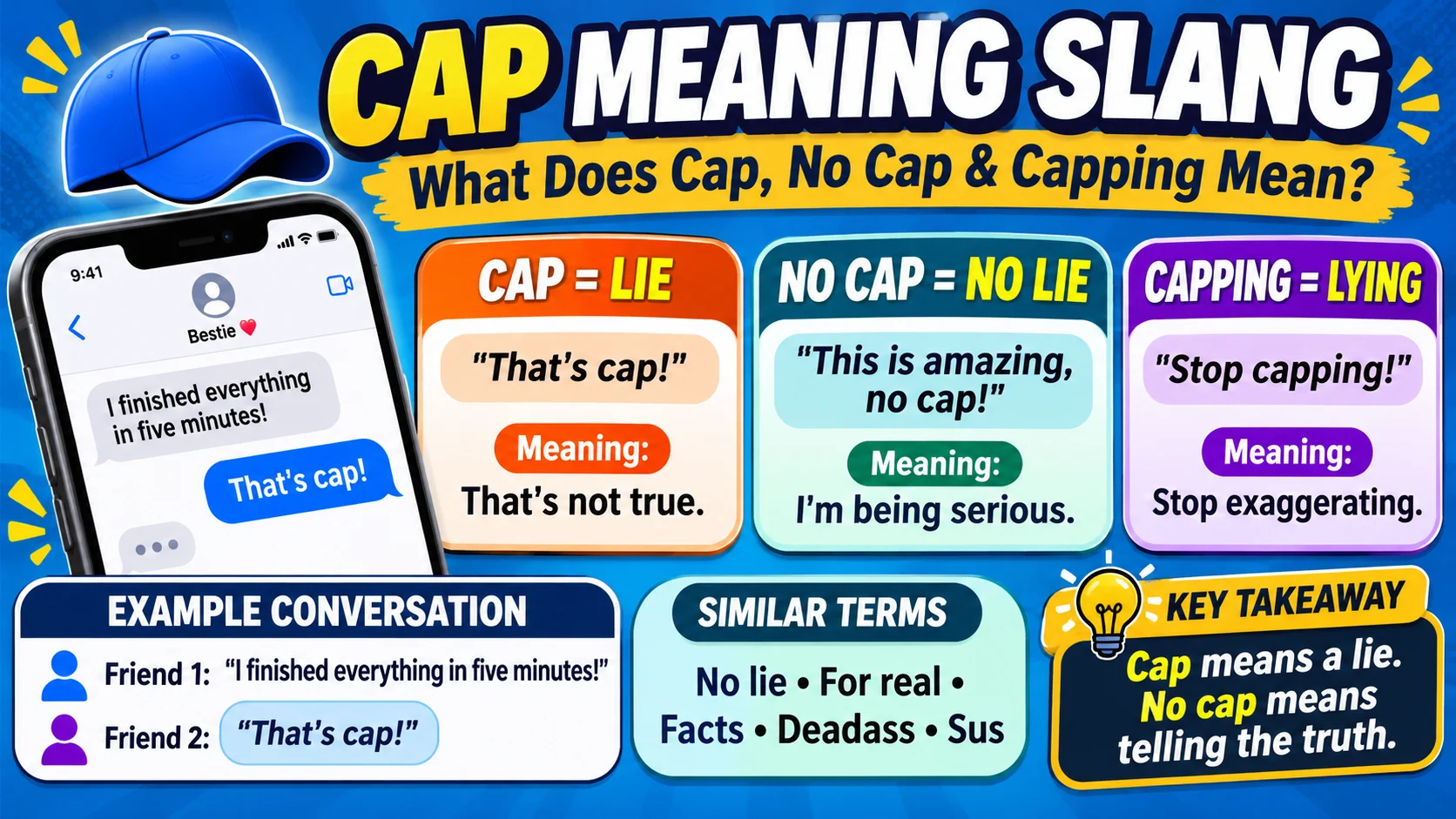
Cap is slang for a lie, false statement, or exaggeration. When someone says “That’s cap,” they mean something is not true. “No cap” means “no lie” or “I’m being serious,” while “capping” means lying or exaggerating.
Cap meaning slang is something you might encounter while scrolling through TikTok, reading Instagram comments, or chatting with friends. If someone replies “That’s cap” to your message, they are suggesting that you’re lying or exaggerating. On the other hand, “No cap” means someone is being completely honest.
This expression has become a familiar part of modern internet slang, especially among younger social media users. It also has roots in African American Vernacular English (AAVE) and hip-hop culture. Understanding the difference between cap, no cap, and capping can help you follow online conversations and use these expressions naturally.
Quick Answer: Cap Meaning at a Glance
| Category | Explanation |
|---|---|
| Meaning | A lie, false statement, or exaggeration |
| Context | Casual conversations, texting, and social media |
| Platforms | TikTok, Snapchat, Instagram, and X |
| Example | “You finished that project in five minutes? That’s cap!” |
| Tone | Informal, playful, skeptical, or confrontational |
1. What Does Cap Mean in Slang?
In modern slang, cap means a lie or an exaggerated statement. People use it when they think someone is not telling the truth or is making something sound better than it really is.
For example:
- “That’s cap!” means “That’s a lie!”
- “Stop capping!” means “Stop lying!”
- “You’re capping!” means “You’re making that up!”
- “Big cap!” means “That’s a really big lie!”
The expression can be playful or serious, depending on the conversation.
Imagine your friend tells you they met a famous celebrity at the grocery store. You find the story hard to believe, so you reply:
“Bro, that’s cap!”
You’re basically saying that you don’t believe their story.
Where Did Cap Slang Come From?
The slang meaning of cap is associated with African American Vernacular English (AAVE). Its history goes back further than its recent popularity on social media.
Historical references connect the expression to bragging, exaggerating, or making false claims. The related expression “high capping” appeared in earlier hip-hop culture, while the term became increasingly familiar through Southern hip-hop.
The phrase received wider mainstream attention during the late 2010s. Atlanta-based rappers Future and Young Thug helped popularize “no cap” through their 2017 song of the same name.
Dictionary.com also traces the expression through earlier Black slang and hip-hop usage. Dictionary.com+1
Today, cap and no cap appear in everyday online conversations, memes, videos, and text messages.
2. What Do Cap, No Cap, and Capping Mean?
Although these expressions share the same root, they have slightly different uses.
| Expression | Meaning | Example |
|---|---|---|
| Cap | A lie or exaggeration | “That’s cap!” |
| No cap | No lie; seriously | “This pizza is amazing, no cap.” |
| Capping | Lying or exaggerating | “Stop capping!” |
| You’re capping | You’re not telling the truth | “You’re capping about that score.” |
| Big cap | A big or obvious lie | “That excuse is big cap.” |
| Cap emoji 🧢 | A way to call something a lie | “You got that for free? 🧢” |
What Does No Cap Mean?
No cap means “I’m telling the truth,” “no lie,” or “I’m being serious.”
People add it to a statement when they want others to know they aren’t exaggerating.
Example:
“That was the best concert I’ve ever attended, no cap.”
This means the speaker genuinely believes the concert was excellent.
What Does Capping Mean?
Capping is the continuous form of cap. It describes someone who is lying, making up stories, or exaggerating.
Example:
“You’re capping if you think you can beat me at basketball!”
In other words, the speaker believes the other person is exaggerating or making an unrealistic claim.
These expressions are closely related, but remember: cap suggests dishonesty, while no cap emphasizes honesty. Later Social Media Glossary+1
3. Real-Life Conversation Examples of Cap
The easiest way to understand slang is to see how people use it in actual conversations. Here are five natural examples inspired by everyday situations.
Example 1: Texting a Friend
Alex: I finished the entire assignment in ten minutes.
Jordan: That’s cap! It took me two hours.
Meaning: Jordan thinks Alex is exaggerating about finishing the assignment so quickly.
Example 2: Talking About Shopping
Mia: I got these sneakers for only $10.
Emma: No way, that’s cap!
Mia: I’m serious. They were on sale.
Meaning: Emma finds the price difficult to believe and questions whether Mia is telling the truth.
Example 3: Social Media Comments
User 1: This is the best burger I’ve ever eaten.
User 2: No cap?
User 1: No cap! You need to try it.
Meaning: The second person asks whether the first person is being serious.
Example 4: Talking About Sports
Chris: I scored five goals in one match yesterday.
Mike: Bro, stop capping!
Chris: I’m not even joking.
Meaning: Mike thinks Chris is exaggerating about his performance.
Example 5: Casual Daily Conversation
Sam: I haven’t watched a single episode of that show.
Ryan: That’s cap. You were talking about it yesterday!
Meaning: Ryan believes Sam is lying because his previous comments suggest otherwise.
4. How Is Cap Used on Different Social Media Platforms?
Cap has the same basic meaning across social media platforms, but the way people use it can vary depending on the conversation.
Snapchat Usage
On Snapchat, people commonly use cap to question a friend’s story, photo, or claim.
For example:
- “You really bought that? Cap!”
- “No cap, this place looks amazing.”
- “Stop capping, I saw what happened.”
The 🧢 emoji can also replace the word itself.
TikTok Usage
TikTok users often use cap in video comments, captions, reactions, and conversations.
For example:
- “This hack actually works, no cap.”
- “Bro is capping.”
- “That’s straight cap.”
People may also use the expression humorously when reacting to unbelievable videos or exaggerated claims.
Instagram Usage
On Instagram, cap frequently appears in comments, reels, stories, and direct messages.
Examples include:
- “That’s cap 😂”
- “No cap, your outfit looks amazing.”
- “Big cap if you think that’s real.”
It can communicate disbelief, playful teasing, or genuine skepticism.
Text Messaging Usage
In text messages, cap is a quick way to challenge something without writing a long response.
For example:
Friend: I just won $500 playing a mobile game.
You: Cap or no cap?
Friend: No cap!
This exchange means you’re asking whether the person is telling the truth.
5. Similar Slang Words and Expressions
If you understand cap, learning a few related slang expressions can make online conversations easier to follow.
Here are some common alternatives:
| Slang | Meaning | Example |
|---|---|---|
| No lie | Telling the truth | “No lie, that was amazing.” |
| For real | Seriously or genuinely | “For real, I loved it.” |
| Fr | For real | “That movie was good, fr.” |
| Sus | Suspicious or questionable | “That story sounds sus.” |
| Fake | Not genuine or truthful | “That sounds fake.” |
| BS | Nonsense or an untrue claim | “That’s a bunch of BS.” |
| Deadass | Seriously or genuinely | “I’m deadass telling you.” |
| Bet | Okay, agreed, or challenge accepted | “Bet, I’ll meet you there.” |
| Facts | Agreement or something true | “Facts, that was hilarious.” |
| No kizzy | No lie or seriously | “That was incredible, no kizzy.” |
Important: These expressions are not exact replacements for cap. Their meanings depend on context. For instance, “sus” means suspicious, while “cap” directly suggests a lie or exaggeration.
6. Common Mistakes When Using Cap
Although cap is easy to understand, people sometimes misunderstand its meaning or use it in the wrong situation.
Here are some common mistakes to avoid.
1. Confusing cap with no cap
These expressions have opposite meanings in their usual slang usage.
- Incorrect interpretation: No cap means someone is lying.
- Correct interpretation: No cap means someone is telling the truth.
2. Thinking cap always means a hat
Cap can refer to an ordinary hat, a limit, or other things depending on context. In internet slang, it usually means a lie or exaggeration.
3. Using cap in formal communication
Cap is informal slang. It may sound unprofessional in business emails, academic writing, or formal discussions.
Instead of saying “That’s cap,” use “That’s inaccurate” or “I don’t think that’s correct.”
4. Assuming every exaggerated statement is a lie
People sometimes exaggerate for humor or storytelling. Calling everything cap can make conversations unnecessarily argumentative.
5. Using no cap without understanding the context
No cap emphasizes sincerity. It doesn’t automatically make a statement true. It simply communicates that the speaker believes what they are saying.
7. How to Respond When Someone Says Cap
Someone might call your statement cap because they don’t believe you. Your response depends on whether you’re joking, explaining yourself, or having a serious conversation.
Here are some natural responses.
| Situation | Possible Response |
|---|---|
| You’re telling the truth | “No cap, I’m serious!” |
| You’re joking | “Okay, you got me 😂” |
| You want to prove it | “I’ve got proof!” |
| Your friend is teasing you | “Believe what you want!” |
| You’re surprised | “Why would I make that up?” |
| You want to agree | “Yeah, that was definitely cap.” |
Professional Alternatives to Cap
If you’re communicating in a workplace, school, or formal setting, consider using clearer expressions instead.
- “That’s not accurate.”
- “I don’t think that’s correct.”
- “That sounds exaggerated.”
- “Can you clarify that?”
- “I’m not sure that’s true.”
These alternatives communicate the same general idea without relying on internet slang.
8. When Should You Use Cap in a Conversation?
Cap works best in casual conversations where everyone understands the expression.
Good situations to use it:
- Chatting with friends.
- Replying to funny social media comments.
- Reacting to unbelievable stories.
- Teasing someone about an exaggerated claim.
- Making casual statements more expressive.
Situations where you should avoid it:
- Professional emails.
- Job interviews.
- Academic assignments.
- Formal presentations.
- Serious conversations involving trust or important facts.
Remember that slang changes with context and audience. A playful “That’s cap!” between friends might sound rude when used during a serious discussion.
Frequently Asked Questions
1. What does cap mean in slang?
Cap means a lie, false statement, or exaggeration. When someone says “That’s cap,” they are suggesting that something is not true or that another person is making an unbelievable claim.
2. What does no cap mean in texting?
No cap means “no lie” or “I’m being serious.” People use it in text messages to emphasize that their statement is genuine and that they aren’t exaggerating.
3. What does capping mean in slang?
Capping means lying, making things up, or exaggerating a story. If someone tells you to stop capping, they believe you’re not being completely honest about something.
4. What does that’s cap mean?
“That’s cap” means “That’s a lie” or “I don’t believe you.” It’s a casual expression people use when they think someone’s statement is false, exaggerated, or difficult to believe.
5. What does the cap emoji 🧢 mean?
The baseball cap emoji can represent the slang word cap, meaning a lie or exaggeration. People often add it to comments or messages to show disbelief or call out an untrue claim.
6. Is cap a Gen Z slang word?
Cap is widely associated with Gen Z internet slang, but its roots are in African American Vernacular English and earlier hip-hop culture. Its use became more mainstream during the late 2010s.
7. What is the difference between cap and no cap?
Cap means a lie or exaggeration, while no cap means honesty or truthfulness. For example, “That’s cap” challenges a statement, whereas “No cap” emphasizes that someone is being serious.
8. Is cap appropriate to use in professional conversations?
Cap is generally too informal for professional communication. In workplace emails, meetings, or formal discussions, expressions such as “That’s inaccurate,” “I disagree,” or “That seems exaggerated” are more appropriate.
Conclusion
Slang makes everyday conversations more expressive, and cap is a perfect example. The cap meaning slang is simple: it refers to a lie, false statement, or exaggeration. When someone says “That’s cap,” they don’t believe what they’ve heard. When they say “No cap,” they’re emphasizing that they’re being honest. Meanwhile, “capping” means making things up or stretching the truth. You’ll often encounter these expressions on TikTok, Snapchat, Instagram, and in text messages. Understanding the difference helps you communicate naturally and avoid confusion. So, next time someone says “No cap,” you’ll know exactly what they mean!

Sara Mitchell is a content writer at Punzite.com who specializes in internet slang, word meanings and language trends. She creates clear, engaging and well-researched content that helps readers understand modern digital communication with ease.
5 thoughts on “Cap Meaning Slang| What It Really Means in 2026”